Derui chamber

 Message
SCOOTER WHEEL & TIRE ASSEMBLIES · ROLLING ENDURANCE
When two scooter tires show different damage in service, a repeatable rolling test can help investigate the difference. Its value comes from controlled specimen preparation, load, speed and contact conditions—not from calling every drum surface a real road.
Turn a tire concern into a defined test programme
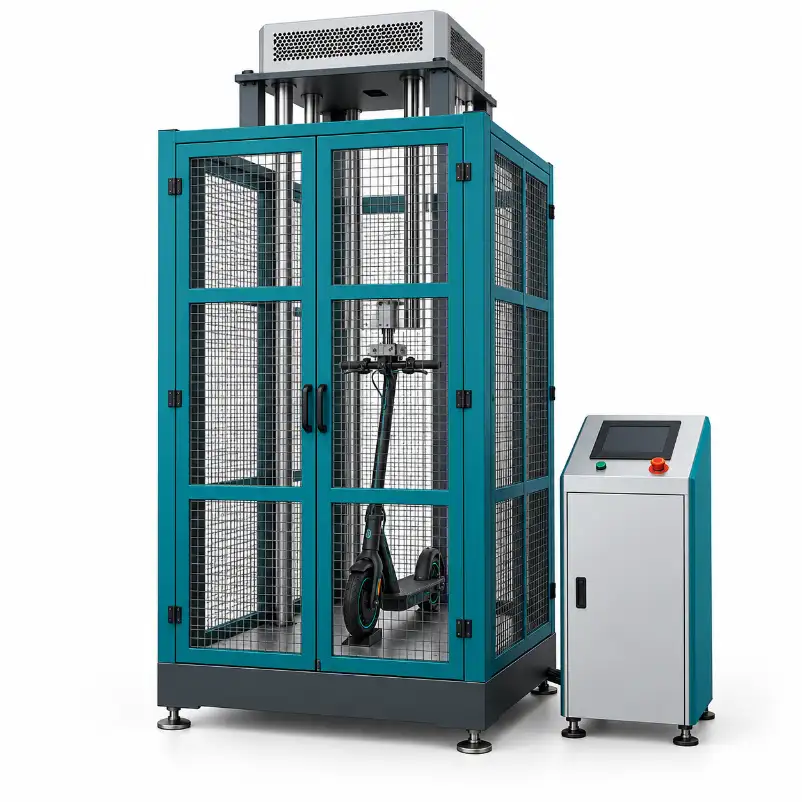
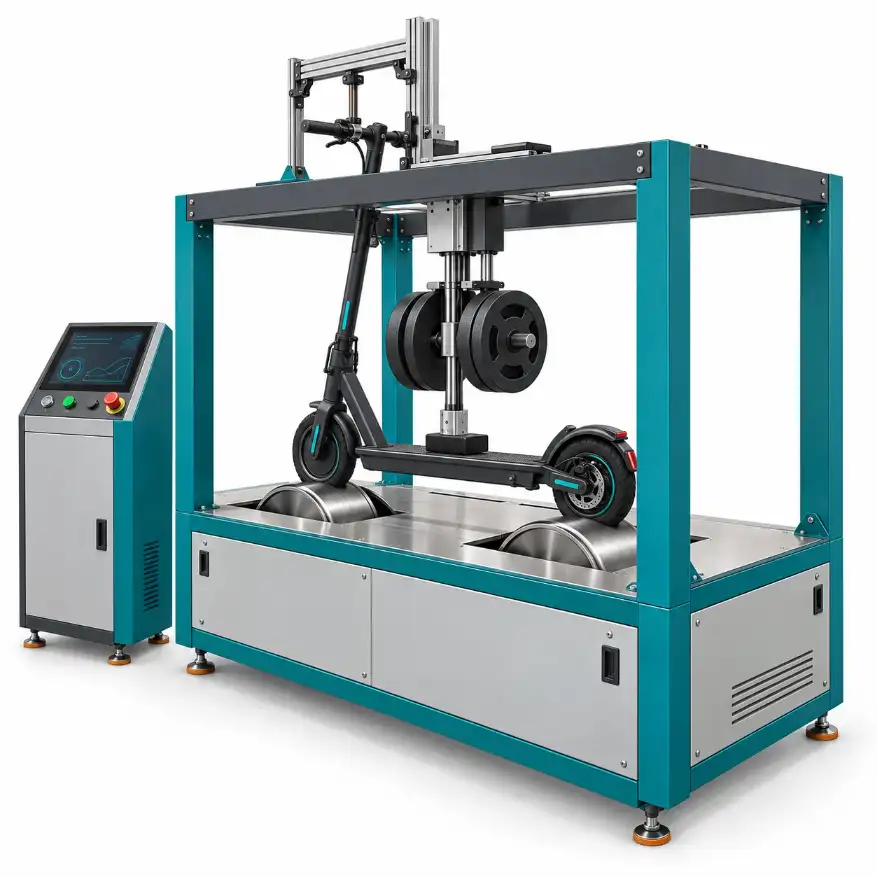
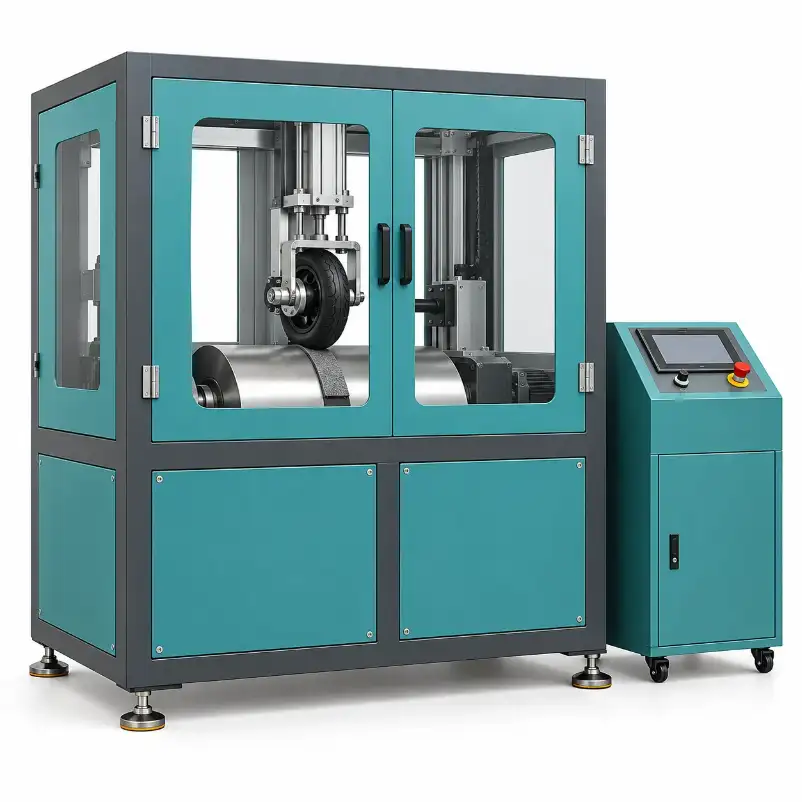
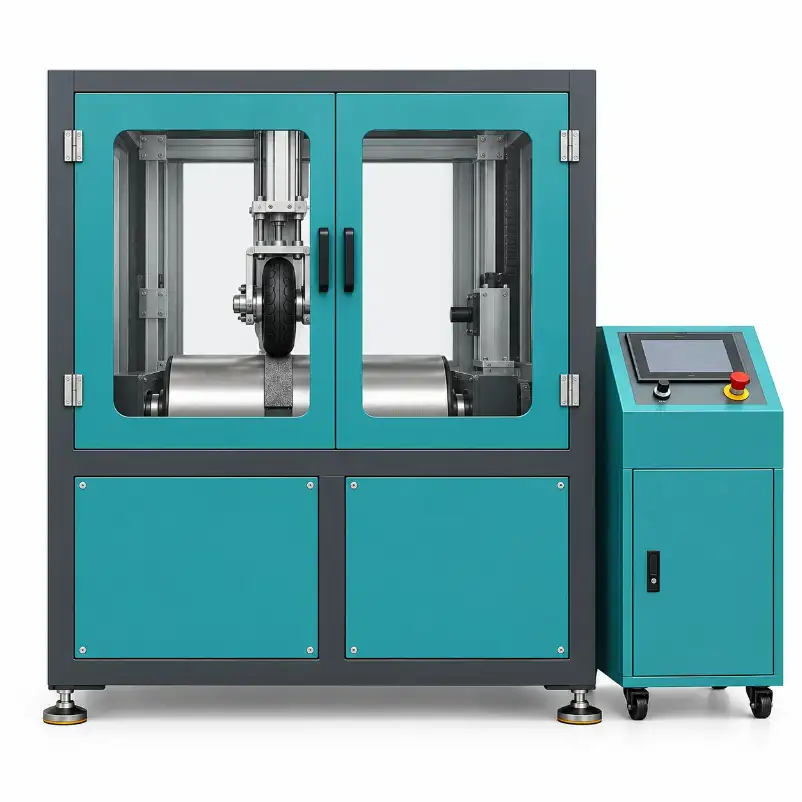
Use Derui’s electric scooter tire road condition testing machine as the starting point for a wheel-and-tire endurance proposal. Define whether the specimen is a wheel assembly, a wheel in its production fork or a complete scooter before selecting the fixture. The illustrated wheel-on-drum configuration is a concept for review.
What Do You Need to Learn About the Wheel or Tire?
| Purchase or development question | Control for a useful comparison | Inspect or measure |
|---|---|---|
| Compare tire constructions | Equivalent wheel geometry, preparation and documented load/speed programme. | Defined damage modes, condition changes and endpoint. |
| Investigate recurring wheel failures | Relevant mounting, tire condition and repeated contact exposure. | Location and timing of loosening, damage or loss of function. |
| Check supplier consistency | Sample identification, baseline inspection and the same approved programme. | Differences between samples using the same acceptance method. |
| Develop a test specification | Specimen boundary, drum geometry, load path and inspection intervals. | Repeatability before drawing conclusions about designs. |
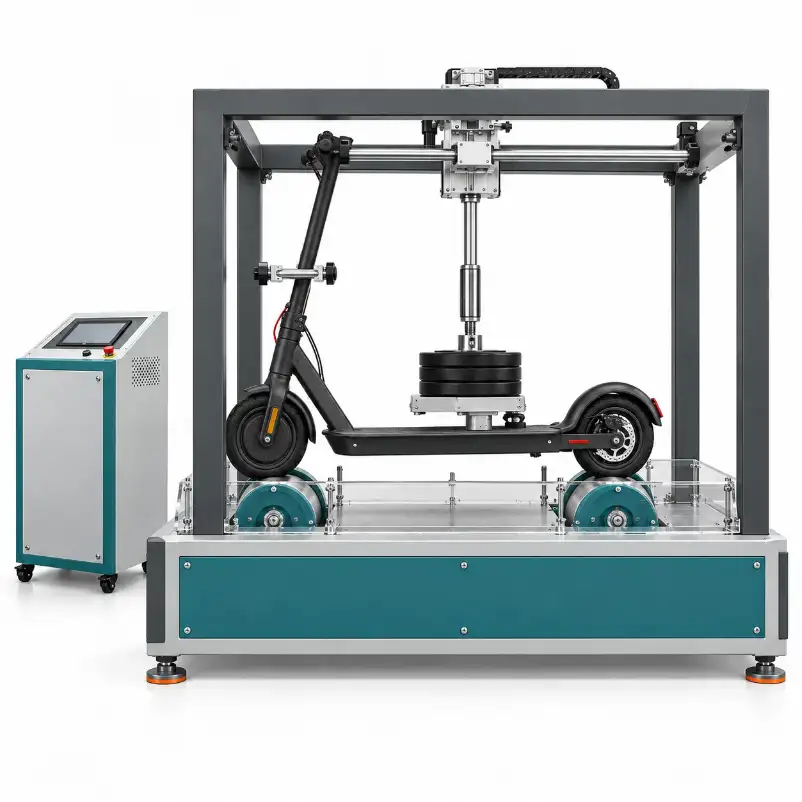
A wheel-and-tire test concentrates on that assembly. For deck, stem and folding-joint endurance with both wheels installed, review a complete-scooter arrangement instead.
Define the Tire, Rim and Axle as One Specimen
Provide outside diameter, width, tire construction, rim specification, axle drawing, bearing arrangement and mass. For pneumatic tires, define inflation pressure, conditioning and pressure inspection timing. A solid or honeycomb tire needs a different preparation description; it does not have an inflation setting.
State whether the assembly includes a hub motor. A motorized wheel may need a defined electrical state, cable support and additional risk controls even when the drum drives the test. Confirm axle retention, anti-rotation features and clearance to valves, discs and motor wiring.
The fixture should load and locate the specimen at approved interfaces. Clamping the tire itself or constraining the axle differently from the agreed method can change the result. Review the working drawing and sample installation before approving a fixture based on external cabinet dimensions.
Make the Contact Exposure Repeatable
Load and speed are conditions, not complete road simulation
Specify the force at the wheel contact, how it is applied, and whether it remains constant or follows a programme. A total machine capacity is not necessarily the allowable load on one tire. Agree on the operating speed under that load and whether the drum or specimen is driven.
Document drum diameter, surface finish, contact width and any replaceable obstacle. Curved drum contact is not identical to a flat road. An obstacle strip imposes repeated events; it does not reproduce every pothole, loose stone or direction change experienced outdoors.
Count events at the right boundary
Running time, drum revolutions, tire revolutions and obstacle contacts are different quantities. State the counting basis, obstacle count per drum revolution and any correction for slip. A displayed distance calculated from drum rotation should be identified as such rather than treated as measured road travel.
Keep additional tests separate
Wet-grip, rolling-resistance, braking-friction and cornering tests require their own hardware, control and measurement methods. They are not automatic outputs of a rolling endurance cabinet. Likewise, an ambient enclosure is not a temperature-controlled chamber.
Record What Happened, Not Only How Long It Ran
- Before: specimen identity, tire/rim variant, initial dimensions, condition and pressure where applicable.
- During: agreed speed, load, elapsed exposure, interruptions and instrumented temperatures or other channels where specified.
- At inspection: approved observations of tread damage, cracking, deformation, looseness, rim/axle condition or loss of function.
- At completion: endpoint, final condition and the reason for pass, fail or an invalid/incomplete run.
Wear needs an agreed dimensional or mass measurement method; a running timer does not measure it. A vibration channel records a defined sensor response, not automatically every source of wheel damage. Select extra channels only when they answer the test objective.
Do not convert a short accelerated programme into years of road life without a validated correlation. A successful sample also does not establish zero puncture risk or full vehicle safety approval.
A Practical Wheel-Endurance Workflow
Identify and condition
Record the tire, rim and axle setup using the agreed preparation method.
Verify contact
Check retention, clearance, loading direction and the selected drum surface.
Run the programme
Apply the agreed rolling conditions and inspection pauses; preserve interruption records.
Assess the findings
Use the same inspection and endpoint rules for every sample in the comparison.
Specify and Accept the Actual Test Configuration
| Configuration item | Confirm before ordering |
|---|---|
| Specimen and fixture | Wheel-only, production-fork or complete-scooter arrangement; axle, tire size and cable clearance. |
| Working envelope | Allowable force, speed and duration together, with drive and thermal limits. |
| Contact system | Drum geometry, surface, obstacle details and replacement procedure. |
| Instrumentation | Which channels are measured, displayed and saved; calibration and sampling scope. |
| Protection and access | Wheel retention, moving-part and fragment guarding, stop functions and access conditions. |
| Records and service | Test recipe, specimen result, consumables, maintenance, utilities and documentation. |
For factory acceptance, run a representative assembly at the proposed conditions. Verify contact alignment, speed/load measurement where specified, counting basis, stop behaviour and record export. Demonstrate fixture changeover with the smallest and largest proposed assemblies rather than assuming one sample proves the entire range.
Send the wheel drawing, tire type, test objective, working conditions, inspection method, required evidence and site utilities. If a standard or customer method is required, provide its exact version and applicable clause for a compatibility review; the equipment name alone is not proof of compliance.
Scooter Tire Road Tester FAQs
Does the machine test the tire alone?
The tire must be mounted in a defined assembly. Confirm whether your proposal uses a wheel fixture, production fork or full scooter before comparing quotations.
Can one setup cover pneumatic and solid tires?
Review size, loading, heat generation and mounting for each construction. Their preparation and inspection criteria will differ.
Does it measure wet grip or braking?
Not unless a suitable dedicated configuration and measurement method are specified. Rolling endurance results alone do not establish either property.
Are temperature and wear measured automatically?
Only the agreed installed measurement channels are available. Wear often requires separate inspections; specify the required method and records.
How long should a test run?
Use the approved endpoint, duration or event count for your test objective. There is no universal programme that predicts every tire’s road life.
How does this differ from a double-roller scooter tester?
This page focuses on wheel-and-tire evaluation. A double-roller arrangement supports both wheels of an assembled scooter and addresses a different specimen boundary and load path.
Compare Tires Under Conditions You Can Explain
Define the assembly, exposure and inspection evidence first. Use them to review a suitable wheel test fixture and operating programme.