Derui chamber
📋 Table of Contents
Motorcycle Frame Vibration Testing: A Complete Technical Guide
Frame fatigue is one of the most critical safety concerns in motorcycle manufacturing. Learn how professional testing laboratories perform frame vibration testing to ensure compliance with international standards and protect riders from catastrophic failure.
⚡ Key Takeaway
Frame vibration testing is not optional — it is a regulatory requirement in all major markets. A frame that passes static load testing can still fail under repeated cyclic loading. This guide covers vibration test standards, methods, equipment, and acceptance criteria.
🔧 Key Parameters for Motorcycle Frame Vibration Testing
- Test frequency range: 5 – 150 Hz (sinusoidal sweep)
- Maximum acceleration: 30g peak (or as specified by standard)
- Test duration: 200,000 – 500,000 cycles (depending on standard)
- Load application: Sine sweep followed by random vibration
- Temperature range: -20°C to +60°C (for environmental chamber testing)
- Acceptance criteria: No visible cracks, stiffness drop ≤ 15%
- Why Frame Vibration Testing Matters
- Key International Standards
- Vibration Testing Methodology
- Types of Vibration Tests
Why Frame Vibration Testing Matters
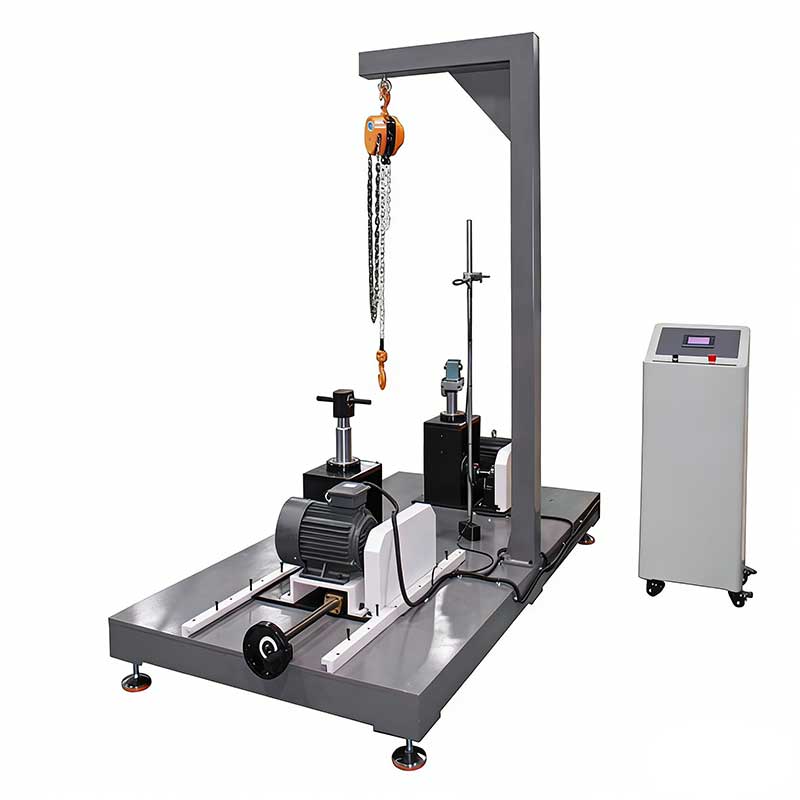
Motorcycle Frame Vibration Test Machine for Durability Testing
Motorcycle frames endure tremendous cyclic stress during normal operation. Every bump, turn, and acceleration event creates stress cycles that can eventually lead to fatigue failure. Unlike sudden overload failures, fatigue failures occur progressively and can be difficult to detect without proper testing.
Real-world riding generates complex multi-axis vibration patterns. A frame that passes static load testing may still fail under repeated cyclic loading. This is why vibration fatigue testing is mandatory for motorcycle type approval in most markets.
Key International Standards
ISO 8644:2021 — Motorcycle Wheels
Covers requirements for motorcycle wheel testing, including dynamic fatigue. While primarily focused on wheels, the test protocols establish baseline methodology applicable to frame testing.
ECE R62 — Unladen Motorcycle Handlebars
Specifies strength requirements for steering assemblies and handlebar mounts. Frame vibration testing must account for these attachment points.
GB/T 4562-2013 (China National Standard)
China’s national standard for motorcycle frame testing specifies test frequencies, acceleration levels, and acceptance criteria for domestic market compliance.
EU Type Approval (Regulation EU 168/2013)
Requires all two and three-wheeled motor vehicles to undergo frame fatigue testing as part of the whole-vehicle approval process.
Vibration Testing Methodology
Test Setup
- Frame mounted on rigid test fixtures at engine mounting points
- Accelerometers placed at key stress concentration locations
- Displacement sensors monitoring frame deflection under load
- Environmental chamber for temperature-controlled testing (-5°C to +45°C)
Test Parameters
Failure Criteria
Testing continues until one of the following occurs:
- Visible cracks appearing on any frame member
- Measured stiffness drops by more than 15% from baseline
- Accelerometer readings indicate resonant frequency shift exceeding 5%
- Reaching the defined cycle count without failure (pass criterion)
Types of Vibration Tests
1. Sinusoidal (Sine Sweep) Vibration
Most common method. The frame is subjected to vibrations at increasing frequencies while monitoring for resonant responses. Key resonance frequencies are identified and then used for durability testing at those specific frequencies.
2. Random Vibration Testing
Simulates real-world conditions more accurately by applying broadband random vibration energy across the frequency spectrum. More representative of actual road conditions but more complex to analyze.
3. Resonance Search Testing
Deliberately sweeps through the frequency range to identify natural resonant frequencies of the frame structure. These resonant frequencies are then targeted for endurance testing.
4. Multi-Axis Vibration (MAVT)
Advanced testing where vibration is applied simultaneously along multiple axes. More accurately simulates real-world loads but requires specialized 6-DOF (six degrees of freedom) test rigs.
Common Frame Failure Modes
Test Equipment Requirements
Documentation and Compliance
✅ Test Report Must Include
⚠️ Important: Type Approval vs. R&D Testing
Type approval testing must be conducted at an accredited laboratory (ISO/IEC 17025) and the test report must be submitted to the certification authority. R&D testing can be done in-house but must use the same test parameters and acceptance criteria as the type approval test.
Need Motorcycle Frame Vibration Testing Equipment?
DeRui Tester provides complete motorcycle frame vibration test systems, including electrodynamic shaker tables, multi-axis fixtures, and data acquisition software. Our CNAS-accredited lab also offers ISO 8644 and ECE R62 compliant testing services.
Conclusion
Motorcycle frame vibration testing is a critical quality gate for every motorcycle manufacturer. The combination of sinusoidal and random vibration testing reliably identifies structural weaknesses that static testing cannot detect.
Investing in proper vibration testing equipment and procedures protects riders from dangerous frame failures, shields manufacturers from warranty and liability exposure, and ensures compliance with international market requirements.
🔗 Related Products
🔗 Related Products
📚 Related Articles
Need Professional Motorcycle Testing Equipment?
Explore our range of testing machines designed for compliance with international standards.
Drop Test Data Analysis and Interpretation
Collecting drop test data is only the first step—interpreting it correctly is what separates a pass from a meaningful safety assessment. Modern drop test systems equipped with high-speed cameras and load cells capture far more data than simple pass/fail outcomes.
Key Metrics to Track
- Peak deceleration (g-force): The maximum deceleration experienced during impact. For e-scooters, values exceeding 80g on the steering column or 50g on the deck frame indicate potential structural compromise. These thresholds come from EN 17128 and ASTM F2264 guidelines.
- Impact duration: The time from initial contact to peak force. Shorter durations (<5ms) indicate brittle failure modes, while longer durations (10-20ms) suggest energy-absorbing deformation. Both are informative for design improvement.
- Permanent deformation: Measure the dimensional change after each drop using calibrated gauges. Acceptable limits are typically 5mm for the steering column and 3mm for the deck, though specific standards should be consulted.
- Crack propagation: Use dye-penetrant testing or ultrasonic inspection after the drop sequence to detect subsurface cracks that are not visible to the naked eye. Micro-cracks often propagate under subsequent fatigue loading.
Drop Height and Mass Parameters by Standard
Different standards specify different drop parameters based on the scooter classification and intended use. The following table summarizes the key parameters across major standards:
Common Failure Modes in Drop Testing
Understanding where and why e-scooters fail during drop testing helps engineers design more robust products from the start. Here are the most common failure modes observed in test laboratories:
- Steering column weld cracking: The joint between the steering column and the folding mechanism is the highest-stress point in a drop event. Cracks typically initiate at the weld toe and propagate under repeated impacts. Fix: increase weld throat size, add gusset reinforcement, or switch from MIG to TIG welding with post-weld heat treatment.
- Deck frame buckling: The deck platform may buckle at mid-span if the aluminum extrusion wall thickness is insufficient (below 2.0mm for 6000-series alloys). Fix: increase wall thickness or add internal ribbing to the extrusion profile.
- Wheel axle bending: Front wheel axles are particularly vulnerable because the drop force is concentrated on a small contact patch. Axle bending exceeding 1° of camber change is considered a failure. Fix: upgrade from 10mm to 12mm axle diameter, or use hardened steel (grade 12.9) instead of standard carbon steel.
- Battery compartment deformation: If the battery is mounted in the deck, drop impacts can deform the compartment and damage cells. Even without visible external damage, internal cell separators can be compromised. Fix: add energy-absorbing foam between the battery pack and deck, and ensure at least 3mm clearance on all sides.
- Folding mechanism disengagement: The folding latch can spring open during impact if the locking mechanism relies solely on spring tension without a positive mechanical lock. Fix: use a cam-over-center latch that cannot be released by impact forces alone.
💡 Design for Impact: The most effective approach is to incorporate energy-absorbing features at the design stage rather than relying on material over-specification. Rubber suspension elements, crumple zones in the steering column, and floating battery mounts can absorb 30–40% of impact energy without adding significant weight or cost.