Derui chamber
📑 Table of Contents
- ▸ Introduction to Scooter Drop Testing
- ▸ Why Impact Durability Testing Matters
- ▸ Key Standards Governing Scooter Drop Tests
- ▸ Essential Testing Equipment
- ▸ Complete Drop Test Procedure
- ▸ Critical Test Parameters
- ▸ Common Failure Modes and Analysis
- ▸ Drop Test vs Vibration Test
- ▸ Best Practices for Reliable Results
- ▸ Frequently Asked Questions
- ▸ Conclusion
Introduction to Scooter Drop Testing
Electric scooters face a harsh reality on urban streets. Potholes, curbs, stairs, and unexpected road obstacles subject these vehicles to sudden impact loads that far exceed normal riding forces. Scooter drop testing is the standardized method engineers use to verify that a scooter frame, deck, and critical components can survive these real-world impacts without catastrophic failure.
Whether you are a manufacturer preparing for market compliance, a quality control engineer setting up test protocols, or a product designer optimizing frame geometry, understanding impact durability standards is essential. This guide covers every aspect of scooter drop testing, from the governing standards and required equipment to step-by-step procedures and failure analysis techniques.
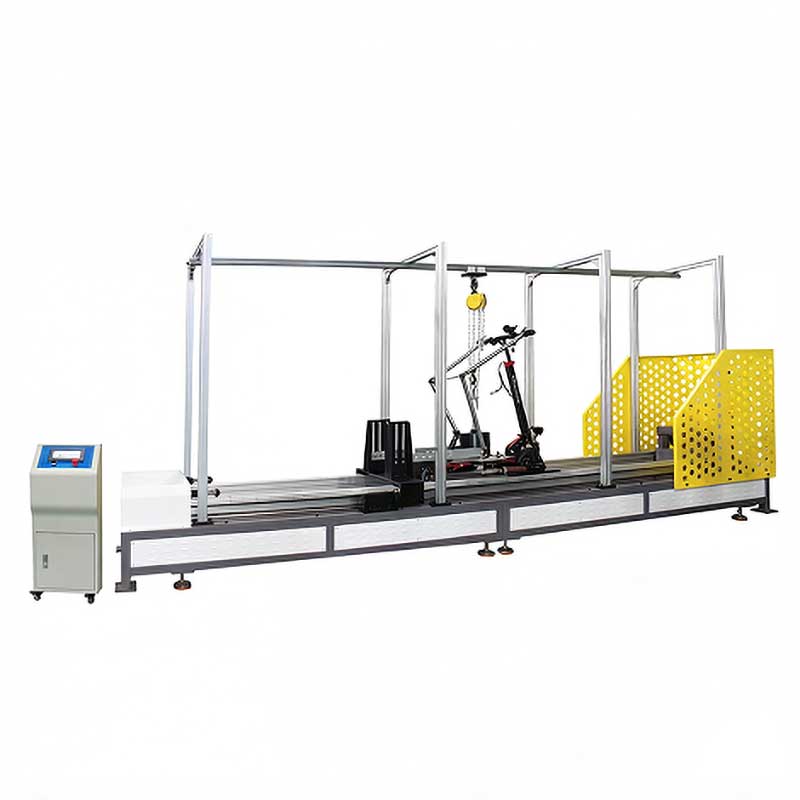
Scooter Horizontal Impact Tester for EN Standard Compliance
Why Impact Durability Testing Matters
Impact events are among the most demanding conditions an electric scooter will encounter during its service life. Unlike the predictable cyclic loads of normal riding, impact loads are sudden, high-magnitude forces that can cause immediate structural failure.
Consider these real-world scenarios:
- Curb drop — a rider accidentally rides off a sidewalk curb at 15 km/h, generating forces of 3–5 times the scooter’s weight
- Pothole strike — hitting a deep pothole at cruising speed creates a sharp vertical impulse on the front wheel and fork
- Folded drop — a folded scooter falls from a table or vehicle rack, impacting the ground on its deck edge or handlebar
- Tip-over impact — the scooter tips over while parked, striking the ground on its side
Each of these events transfers energy through the frame structure in a different pattern. A well-designed scooter must absorb or distribute this energy without fracture, permanent deformation, or loosening of critical joints.
Impact testing does not just verify that a scooter survives a single drop. It validates the entire structural design — frame welds, bolted joints, material selection, and component mounting — against worst-case loading conditions.
Key Standards Governing Scooter Drop Tests
Multiple international standards address impact and drop testing for electric scooters and light electric vehicles. Understanding which standard applies to your product is the first step toward compliance.
EN 17128 — Safety Requirements for Self-Balancing Scooters and Powered Skateboards
EN 17128 is the primary European standard covering the safety of electric scooters (also known as personal light electric vehicles or PLEVs). While the standard focuses primarily on electrical safety and performance requirements, it indirectly requires that the vehicle structure withstands foreseeable impacts during normal and foreseeable misuse conditions.
EN 14619 — Safety Requirements for Scooters (Non-Motorized and E-Scooters)
EN 14619 provides specific mechanical safety requirements including impact resistance. This standard mandates that the scooter frame and deck must withstand specified impact loads without fracture or dangerous deformation. The drop height and impact surface requirements are clearly defined.
ISO 4210 (Referenced for Bicycle-Based Components)
Some scooter manufacturers reference ISO 4210 impact testing methods for components derived from bicycle technology, such as forks, handlebars, and wheels. This provides a recognized baseline for impact test methodology.
UL 2272 — Electrical Systems for E-Scooters
While UL 2272 primarily addresses electrical safety (battery and charging systems), manufacturers pursuing UL certification typically also perform mechanical impact testing on the battery enclosure to ensure it survives drops without internal short circuits or fire hazards.
Essential Testing Equipment
Performing reliable scooter drop tests requires specialized equipment designed for repeatable, high-precision impact loading. Unlike simple manual drop tests, professional equipment ensures consistent drop height, orientation, and impact energy across multiple test samples.
Scooter Horizontal Impact Tester
The Scooter Horizontal Impact Tester (also known as a scooter horizontal impact testing machine) is purpose-built for evaluating the impact resistance of electric scooter frames and assemblies. This equipment simulates horizontal impact events such as wall collisions, vehicle strikes, and lateral crash scenarios.
Free-Fall Drop Test Rig
A free-fall drop test rig elevates the scooter to a specified height and releases it onto a defined impact surface. Key features include:
- Precise height adjustment — typically 200mm to 1500mm with ±2mm accuracy
- Quick-release mechanism — electromagnetic or pneumatic release for repeatable drops
- Impact surface options — steel plate, concrete, or rubber mats per standard requirements
- Orientation fixtures — hold the scooter at specified angles (flat, on edge, on end) during release
Instrumented Impact Measurement System
For advanced testing, accelerometers and strain gauges mounted on the test specimen capture the actual impact forces and structural response. This data is critical for:
- Validating finite element analysis (FEA) models
- Comparing design iterations quantitatively
- Identifying peak stress locations for design improvement
Equipment Comparison
Complete Drop Test Procedure
Follow this standardized procedure to ensure consistent and reliable drop test results.
Step 1: Sample Preparation
- Obtain a minimum of 3 test samples per test condition for statistical significance
- Verify all fasteners are tightened to manufacturer-specified torque values
- Confirm tire pressure is set to the recommended operating range
- Record sample weight, dimensions, and any pre-existing marks or defects
- Install accelerometers or strain gauges if data acquisition is planned
Step 2: Test Environment Setup
- Set ambient temperature to 20 ± 5°C and relative humidity to 65 ± 20%
- Prepare the impact surface: a flat, rigid steel plate (minimum 20mm thick) mounted on a concrete base, or the surface specified by the applicable standard
- Position high-speed cameras (minimum 1000 fps) to capture the impact event from multiple angles
- Verify calibration of all measurement instruments
Step 3: Drop Height Configuration
Set the drop height according to the applicable standard and test scenario:
- Flat drop (deck down) — 300mm typical for EN 14619
- Edge drop (deck on side) — 500mm to simulate tip-over
- End drop (front or rear) — 300mm to 600mm depending on use case
- Curbsim drop — 150mm with forward velocity of 5–10 km/h (requires inclined ramp)
Step 4: Execute the Drop
- Position the test specimen on the drop rig in the required orientation
- Verify the release mechanism is properly armed
- Ensure all personnel are clear of the impact zone
- Activate the data acquisition system
- Release the specimen and record the impact event
- Allow the specimen to come to complete rest before approaching
Step 5: Post-Test Inspection
- Perform a thorough visual inspection of all frame welds, joints, and fasteners
- Check for cracks using dye penetrant inspection (DPI) or magnetic particle inspection (MPI)
- Measure any permanent deformation against acceptance criteria
- Verify that all safety-critical functions (folding mechanism, brakes, throttle) still operate correctly
- Document findings with photographs and measurement data
Always wear appropriate personal protective equipment (PPE) during drop testing. Impact events can produce flying debris, and battery packs on damaged scooters may pose electrical hazard. Keep a fire extinguisher rated for lithium battery fires accessible in the test area.
Critical Test Parameters
Several parameters significantly influence the outcome and relevance of drop testing. Understanding these variables is critical for obtaining meaningful results.
Common Failure Modes and Analysis
Understanding the typical failure modes observed during scooter drop testing helps engineers focus their design efforts on the most vulnerable areas.
1. Frame Tube Fracture at Weld Joints
The most common failure mode is fracture at or near welded joints, particularly where the steering column meets the deck. This occurs because the weld zone is typically harder and more brittle than the base metal, making it susceptible to crack initiation under impact loading.
2. Deck Cracking and Delamination
Scooters with composite or multi-layer deck construction may exhibit delamination — separation of the deck layers — after repeated impact testing. Even if the deck does not fracture completely, delamination can significantly reduce its load-bearing capacity.
3. Steering Column Bending
Front-end impacts can cause permanent bending of the steering column (also called the “T-tube” or “stem”). Even small amounts of bending can misalign the front wheel and create unsafe handling characteristics.
4. Fastener Loosening and Joint Separation
Impact loading can cause bolted joints to loosen or back out, particularly at the folding mechanism and handlebar clamp. In extreme cases, the folding joint may partially open under impact, creating a dangerous structural discontinuity.
5. Battery Compromise
On scooters with integrated battery packs, severe impacts can damage battery cells or internal connections. While not always immediately visible, internal battery damage can lead to thermal runaway during subsequent charging — a critical safety hazard that makes battery enclosure impact resistance a top priority.
For battery safety beyond UL 2272, combine drop testing with nail penetration and crush tests to create a comprehensive battery safety validation program.
Drop Test vs Vibration Test: Key Differences
Impact drop testing and vibration testing are complementary but fundamentally different methods for evaluating scooter durability. Understanding when to use each — and how they work together — is essential for a complete durability validation program.
A comprehensive durability program includes both: impact tests to prove the scooter can survive the worst-case event, and vibration tests to prove it endures the cumulative fatigue of daily use.
Best Practices for Reliable Results
To maximize the value of your drop testing program, follow these industry-proven best practices.
Frequently Asked Questions
What drop height is standard for scooter testing?
The drop height depends on the applicable standard and the specific test scenario. EN 14619 typically specifies a flat drop from 300mm onto a steel plate. For curb simulation, a 150mm drop with forward velocity is common. For folded storage drops, heights up to 1000mm may be specified depending on the product’s intended use.
How many samples should I test?
A minimum of 3 samples per test condition is recommended for preliminary assessment. For formal type approval or certification testing, 5 samples is the typical requirement. For research and development, even a single prototype test provides valuable directional data.
What constitutes a “pass” in drop testing?
Generally, a scooter passes a drop test if it meets these criteria: no fracture of the frame or critical components, no separation of welded or bolted joints, no permanent deformation that impairs safe operation, and all safety-critical functions (brakes, steering, folding mechanism) remain operational after the test.
Can I perform drop testing without specialized equipment?
Basic free-fall drop tests can be performed with relatively simple fixtures — a height platform and a defined impact surface. However, for consistent results, precise height control, and regulatory compliance, purpose-built impact testing equipment is strongly recommended.
How does drop testing relate to rider safety certification?
Drop testing is typically one component of a broader safety certification program. Standards like EN 17128 require a combination of mechanical, electrical, and performance tests. While drop testing alone does not grant certification, failing a drop test almost certainly disqualifies a from passing the complete standard.
Conclusion
Scooter drop testing is a critical element of any electric scooter durability and safety validation program. By simulating real-world impact events in a controlled laboratory environment, manufacturers can identify structural weaknesses before products reach consumers, reducing safety risks and costly recalls.
✅ Key Takeaways
- Multiple standards apply — EN 17128, EN 14619, ISO 4210, and UL 2272 each address different aspects of impact resistance
- Equipment matters — Purpose-built testing machines deliver more consistent and meaningful results than improvised setups
- Process is everything — Following a standardized procedure with proper sample preparation, environmental control, and post-test inspection ensures reliable, repeatable results
- Impact and vibration testing complement each other — A complete durability program requires both types of evaluation
Need Professional Scooter Testing Equipment?
Explore our range of e-scooter testing machines designed for EN 17128 and EN 14619 compliance.