Derui chamber
📋 Table of Contents
EN 14619 vs EN 17128: Which Standard Applies to Your Scooter?
If you manufacture or import scooters into the EU, you must comply with the correct EN standard. Choosing the wrong one can lead to CE marking rejection and costly redesign. This guide explains the scope, requirements, and how to determine which standard applies to your product.
⚡ Key Takeaway
EN 14619 applies to kick scooters (non-motorized). EN 17128 applies to personal light electric vehicles (PLEVs) — including electric scooters up to 25 km/h. Check your product’s max speed and motorization before selecting the standard to certify against.
🔧 Why This Matters for Testing Equipment
- EN 14619 requires drop tests, stem fatigue tests, and brake performance — your test bench must cover drop heights up to 200 mm and fatigue cycling up to 100,000 cycles.
- EN 17128 adds electrical safety (IEC 62133), EMC (EN 55014), and speed limiting system tests — your test bench must integrate electrical load simulation and speed measurement.
- Overview of Both Standards
- EN 14619:2020 Scope
- EN 17128:2019 Scope
- Side-by-Side Comparison
Overview of Both Standards
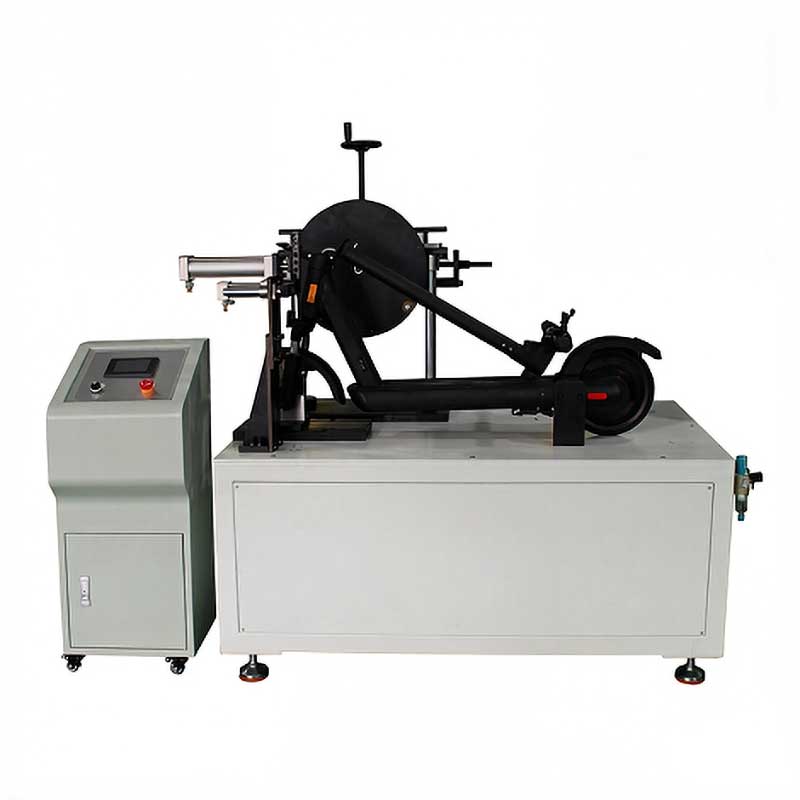
Scooter Folding Fatigue Test Machine for EN 17128 Compliance
Both EN 14619 and EN 17128 are European harmonized standards under the General Product Safety Directive (GPSD) and the Machinery Directive. Compliance with either (depending on product type) allows the manufacturer to affix the CE mark and legally sell in the EU.
EN 14619:2020 Scope
What Products Does It Cover?
- Kick scooters with handlebars (non-motorized)
- Wheel diameter from 100 mm to 200 mm (typical)
- Folding and non-folding designs
- Intended for children over 5 years and adults
Key Test Requirements
1. Drop Test
A drop from 200 mm onto a steel plate. Three drops: rear wheel, front wheel, and frame. Pass criteria: no cracking, steering still functional, folding mechanism locks securely.
2. Stem Fatigue Test
Sinusoidal force applied at stem top: ± 400 N at 5 Hz for 100,000 cycles. After the test: no cracking, permanent deformation ≤ 5 mm.
3. Brake Performance
Braking distance from 15 km/h: ≤ 6 m on dry surface, ≤ 15 m on wet surface. Test repeated 10 times per brake type.
4. Handlebar Load Test
Static downward load of 2,000 N applied to handlebars. No yielding, no permanent deformation > 2 mm.
EN 17128:2019 Scope
What Products Does It Cover?
- Electric scooters (standing or seated) with rated power ≤ 500W
- Maximum speed ≤ 25 km/h (16 mph)
- Personal use (not shared/fleet vehicles)
- Excludes self-balancing vehicles (those fall under EN 17128 as well, but often certified separately)
Additional Tests Beyond EN 14619
1. Electrical Safety (IEC 62133)
Battery pack must pass overcharge, short circuit, and drop tests. IP rating of IPX4 minimum for the battery enclosure.
2. EMC (EN 55014)
Motor and controller must not emit electromagnetic interference exceeding Class B limits. Immunity tested per EN 55024.
3. Speed Limiting System
The speed limiting system (often a controller setting) must engage at 25 km/h ± 1 km/h. Tested with the scooter on a dynamometer under full load.
4. Regenerative Brake Test (if equipped)
If the scooter has regenerative braking, the system must engage safely and not create abrupt deceleration > 0.5g.
Side-by-Side Comparison
✅ Which Tests Overlap?
Which Standard Do You Need?
Dual Compliance Strategy
Many manufacturers certify to both EN 14619 and EN 17128 — even if their product only requires one. Why?
- Market flexibility — Sell both non-motorized and electric versions with minimal redesign
- Insurance requirements — Some EU insurers require EN 17128 even for non-motorized scooters used in mixed fleets
- Retailer demands — Major EU retailers (Decathlon, Halfords) often require dual compliance for scooter product lines
⚠️ Important: Speed Limiter Must Be Tamper-Resistant
EN 17128 requires the 25 km/h speed limiter to be tamper-resistant. If the speed limiter can be easily bypassed (e.g., by cutting a wire or changing a controller setting), the product fails compliance — even if the limiter works correctly in the factory setting. Use potted controllers or encrypted firmware for the speed limiter.
Need EN 14619 & EN 17128 Testing Equipment?
DeRui Tester manufactures integrated test benches covering both EN 14619 and EN 17128 requirements — including drop test machines, stem fatigue testers, brake performance test stands, and electrical safety test modules. CNAS-accredited lab testing services also available with certified reports.
Conclusion
EN 14619 and EN 17128 serve different product categories but share significant test overlap. If your scooter has a motor and battery, EN 17128 is mandatory. If it’s human-powered only, EN 14619 applies. Getting this wrong delays CE marking and can force costly redesigns.
Investing in dual-compliant test equipment from the start gives you maximum market flexibility and future-proofs your testing lab against evolving EU regulations.
🔗 Related Products
🔗 Related Products
📚 Related Articles
Need Professional E-Scooter Testing Equipment?
Explore our range of testing machines designed for compliance with international standards.
Practical Implications for Manufacturers
Choosing between EN 14619 and EN 17128 has significant practical implications beyond just the test procedures. Here is a detailed breakdown of how each standard affects your product development timeline, testing costs, and market access strategy.
Dual Certification Strategy for Dual-Mode Scooters
Some manufacturers produce scooters that can be used in both powered and non-powered modes. For these products, a dual certification strategy may be the most efficient approach:
- Start with EN 17128: Design and test to the more comprehensive standard first. Since EN 17128 includes all the mechanical safety requirements of EN 14619 (and more), compliance with EN 17128 automatically covers the mechanical aspects of EN 14619.
- Document mechanical test results separately: When you conduct the EN 17128 mechanical tests (frame fatigue, brake performance, steering stability), document the results in a format that can also be used for the EN 14619 technical file. This avoids redundant testing.
- Add the “non-powered mode” technical file: Create a separate technical file demonstrating that the scooter, when used without motor assistance, meets EN 14619 requirements. Include specific warnings in the user manual about the dual-mode capability.
- Labeling requirements: The product must carry both the CE mark (under the PLEV framework per EN 17128) and the appropriate marking for the toy/sporting goods framework (per EN 14619). Consult your Notified Body on the exact labeling format.
💡 Cost Optimization: Dual certification typically adds only 15–20% to total testing costs when planned from the start, compared to 40–60% if you attempt to add the second certification after the product is already in production. Plan early and test once.
Understanding the EN 17128 Annex Structure
EN 17128 is structured with several normative annexes that specify detailed test procedures. Understanding which annexes apply to your product is essential for efficient certification planning:
- Annex A — Mechanical safety requirements: Covers frame and steering assembly fatigue, brake performance, and static strength testing. This is the core mechanical annex and applies to all PLEVs regardless of motor power or battery capacity.
- Annex B — Electrical safety requirements: Specifies insulation resistance, leakage current, and overcurrent protection tests. Critical for e-scooters with battery packs above 100 Wh. Test equipment must be calibrated to IEC 61010 standards.
- Annex C — EMC requirements: Defines emissions and immunity limits for the motor controller and BMS. Note that EMC testing must be conducted with the scooter in both stationary and operating modes.
- Annex D — Battery safety: References IEC 62133-2 for lithium-ion battery systems. Additional requirements include a specific overcharge test at 1.5× rated voltage and a crush test with 150 kN force applied over a 150mm × 150mm area.
When preparing your technical file, ensure that test reports cover all applicable annexes. Missing even one annex will result in a non-conformity finding that delays certification by weeks.