Derui chamber

 Message
ASSEMBLY LINE · BOUNDED OPERATING CHECKS BEFORE SHIPMENT
A scooter that powers on briefly may still show an assembly or running problem during a defined operating check. Production-line aging—also called run-in or burn-in—adds a repeatable screening step before the release decision.
Match the run-in sequence to the approved scooter model
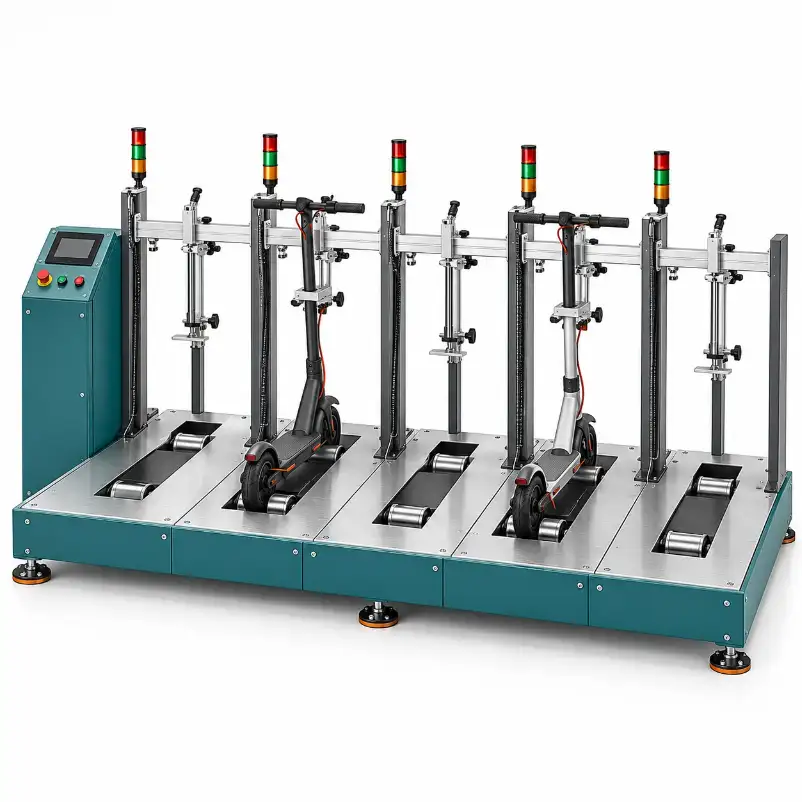
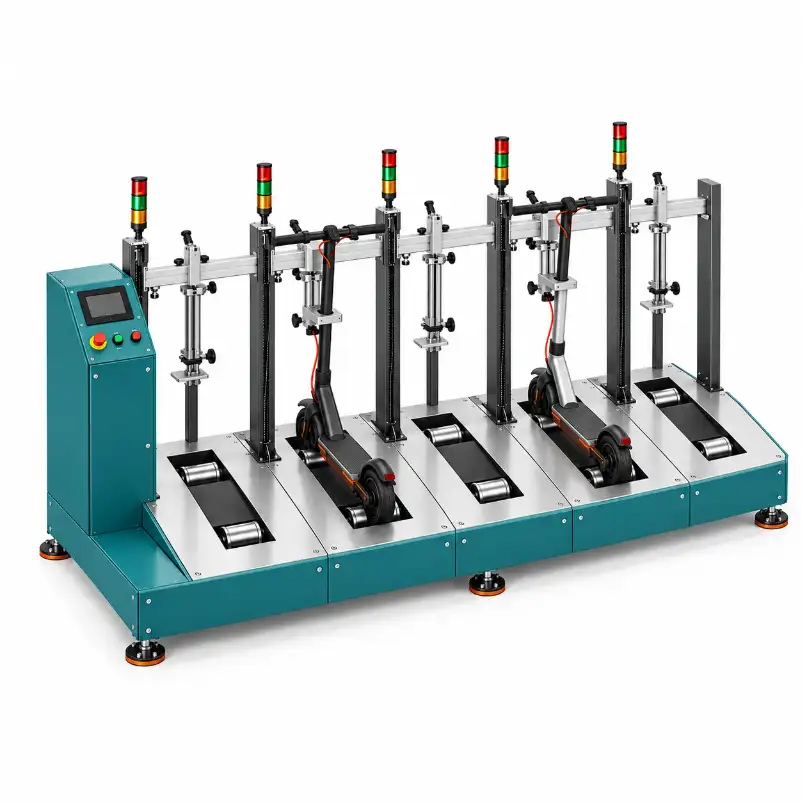
Derui’s scooter production line aging test machine is intended for reviewing multi-position running checks on assembled scooters. The reference layout shows five fixture positions. Confirm the active station count, drive arrangement and result handling for your production plan.
Run-In Is a Production Check, Not a Lifetime Prediction
The production engineer’s task is to define which observable problems this station should screen for. Depending on the approved configuration, a running sequence can support checks for starting/running behaviour, intermittent cut-outs, abnormal operating indications or conditions requiring further inspection. The actual detection channels and criteria must be identified.
| Production requirement | What to define | Do not infer |
|---|---|---|
| Post-assembly operating screen | Model state, run sequence, observation points and reject limits. | Guaranteed field reliability or zero defects. |
| Controlled running exposure | Wheel support, drive mode, time, speed and load if equipped. | Full chassis fatigue or calibrated motor power. |
| Temperature / current checks | Installed sensors, locations, limits and sampling. | Every cell’s condition or complete battery safety validation. |
| Release decision | Recorded criteria and a review path for failed or incomplete runs. | Certification, road range or an entire battery cycle-life result. |
Use separate equipment and methods for structural endurance, braking-distance evaluation, battery capacity/cycling or destructive safety qualification. A short run-in station cannot replace those programmes.
Define How Each Scooter Will Run
Provide the wheelbase, tire size, stem/deck geometry, vehicle mass and driven-wheel layout. Review fixture adjustment, restraint contact areas and access to controls. The fixture must stabilize the scooter without damaging the finish, crushing cables or operating the brakes unintentionally.
State whether the scooter powers its own wheel against a passive support, works against a controlled resistance, or is moved by powered rollers. These arrangements impose different loads on the motor, battery and drivetrain. Free-running support rollers are not equivalent to an electronically controlled road-load system.
Define throttle activation and enable conditions for the actual controller. Some models require a kick-start state, a sequence or an interface before powered operation. Throttle automation, brake actuation and communication with the scooter are separate integration tasks—not implied by a fixture clamp.
Keep preparation consistent
Agree on battery charge state, ambient conditions, tire pressure where applicable, starting temperature and accessory state. Different preparation can change current and temperature behaviour even when the displayed speed and duration are the same.
Plan Stations Around Dwell Time and Handling
A multi-position layout can overlap test dwell, but the number of physical bays does not establish independent testing. Confirm what is shared: controller, load resource, safety zone, measurement channels, data path and operator access.
- Start/stop: batch operation or individual station release?
- Recipes: one model per batch or independently selected model recipes?
- Failures: one affected position or a shared stop for the rack?
- Access: can operators load or unload safely while another bay runs?
- Records: separate scooter identities and actual results for every active position?
- Utilities: simultaneous operating demand, cooling and service access at full occupancy?
Estimate capacity using the complete handling and test cycle, then demonstrate it. Five bays do not guarantee five times one-station output. Loading, setup, dwell, unloading, faults and changeover can become the constraint. No fixed running time fits every scooter and release plan.
Define what happens after a power interruption or operator stop. A partly completed run must remain identifiable; automatic restart or crediting the full dwell time should not be assumed.
Make the Release Record Useful to Quality Control
Associate each scooter with its model, build/recipe revision, station, operator and start/end status. Specify which values are actually measured and saved. A running command is not proof of measured wheel speed, and a signal lamp alone is not a traceable test report.
If current, voltage or temperature is required, define the measurement boundary and sensor. If noise is an operator observation, record it as such; automated noise classification needs its own method and hardware. Brake-lever response checks should not be called stopping-distance or brake-force measurements without the corresponding setup.
Define the output file or factory-system connection, required fields, duplicate-ID handling, offline behaviour and access permissions. Preserve failed runs and a clear retest history rather than overwriting the first result with a later pass.
Running energized scooters requires an approved risk assessment, site incident procedures and verified stop/access controls. Do not infer fire suppression, thermal-runaway containment or unattended operation from the rack design or its indicator lamps.
A Clear Production Run-In Workflow
Load the model
Confirm vehicle identity, preparation and the approved release recipe.
Check readiness
Verify fixture, wheel contact, cables, control access and operating conditions.
Apply the sequence
Complete the defined operating dwell, observations and measured checks.
Record the decision
Preserve the result and direct failed or interrupted units to controlled review.
Accept the Rack as a Working Production Step
| Selection item | Confirm in the project scope |
|---|---|
| Vehicle envelope | Approved models, wheelbase/tire range, driven wheels, fixture contact points and changeover. |
| Operating programme | Drive/resistance arrangement, speed, dwell and permitted temperature/electrical conditions. |
| Station architecture | Active positions, shared resources, individual/batch operation and access boundaries. |
| Release evidence | Measured channels, observations, limits, records and rejected-unit handling. |
| Facility | Full-load electrical demand, floor support, clearances, ventilation and incident planning. |
| Delivery | Acceptance run, training, manuals, maintenance, consumables and agreed support. |
During factory acceptance, run the planned station occupancy with representative scooters. Verify the actual running conditions, identity association, shared-resource limits and recorded results. Demonstrate approved fault simulation, interrupted tests, retest handling and safe loading/unloading. Measure the complete workflow time, not only programmed dwell.
What to send for a production-line proposal
Share scooter drawings and variants, controller start behaviour, desired checks and limits, run duration, target units per hour, staffing/handling plan, result-system requirements and factory utilities. If a customer or market specification is relevant, provide the applicable method; run-in does not establish blanket standards compliance.
Scooter Production Aging Tester FAQs
What does aging mean on this page?
It means a defined production run-in or operating screen of an assembled scooter. It is not automatically battery aging, full vehicle fatigue or a prediction of road service life.
Are all five positions independent?
The reference layout has five positions. Individual operation, sensing and safe access must be confirmed for the selected control architecture.
Does it measure battery capacity or motor torque?
Not unless the appropriate separate instruments, loading hardware and methods are included. A running scooter and timer do not provide these measurements.
Can different scooter models share the rack?
Review each fixture, drive/enable sequence and recipe. Independent model recipes and changeover must be specified rather than assumed.
How long should each scooter run?
Choose a duration based on the release objective and approved model. Confirm the complete line cycle and demonstrate it during acceptance.
Does a passing run replace certification?
No. It records the outcome of the agreed production check. Product qualification and regulatory assessment remain separate activities.
Fit the Run-In Check to Your Assembly Line
Define the scooter model, release checks and line target so the station layout supports the work you actually need.