Derui chamber

 Message
SCOOTER TEST EQUIPMENT · STEERING ASSEMBLY EVALUATION
Choose a scooter steering mechanism test machine by the question the test must answer—not the equipment name alone. The assembly, restraint arrangement and load path determine whether a result concerns steering movement, joint security or structural loading.
Start with the steering assembly and the required test
Derui can review your scooter drawing, specimen and test procedure to define a proposed equipment configuration. The reference arrangement uses a floor-standing gantry and complete-scooter mounting platform. Confirm the actual actuation and measurement functions in the technical proposal.
- Identify the test boundary: handlebar, stem, adjustment joints, fork and included vehicle interfaces.
- Define what moves and what is held: loading direction, specimen supports and permitted freedom.
- Specify the result: movement, slip, deformation, play or damage under defined conditions.
Which Steering Assembly Test Do You Need?
Engineering teams may investigate a loose handlebar, a slipping telescopic joint, increasing steering resistance or damage after repeated loading. These symptoms do not all require the same fixture or drive system.
| Test objective | Setup question | Evidence to define |
|---|---|---|
| Steering movement / operating resistance | Which interfaces rotate, through what range and with what fork or wheel freedom? | Required movement and, if specified, measured operating torque versus position. |
| Rotational security / joint slip | Which lower interface is restrained while torque is applied to the assembly? | Relative rotation, slip or damage against the prescribed criterion. |
| Upward / downward strength or retention | Where is the axial load applied, and what supports react it? | Applied load, displacement, retention or permanent change as required by the method. |
| Repeated structural loading | What direction, lever arm, waveform and restraint represent the required loading? | Completed programme, inspections and any specified structural change. |
Rotating a steering assembly repeatedly is not the same as bending a stem repeatedly. A vertical upper connection also does not establish a rotary drive or a torque-measurement channel.
Choose the assembly boundary deliberately
For design validation, use the specified assembly revision and tightening conditions. For supplier comparisons, keep the specimen preparation, interfaces and procedure consistent. For failure investigation, record where play or slip occurs instead of attributing every change to the steering bearing.
Fixture Fit Determines What the Test Actually Loads
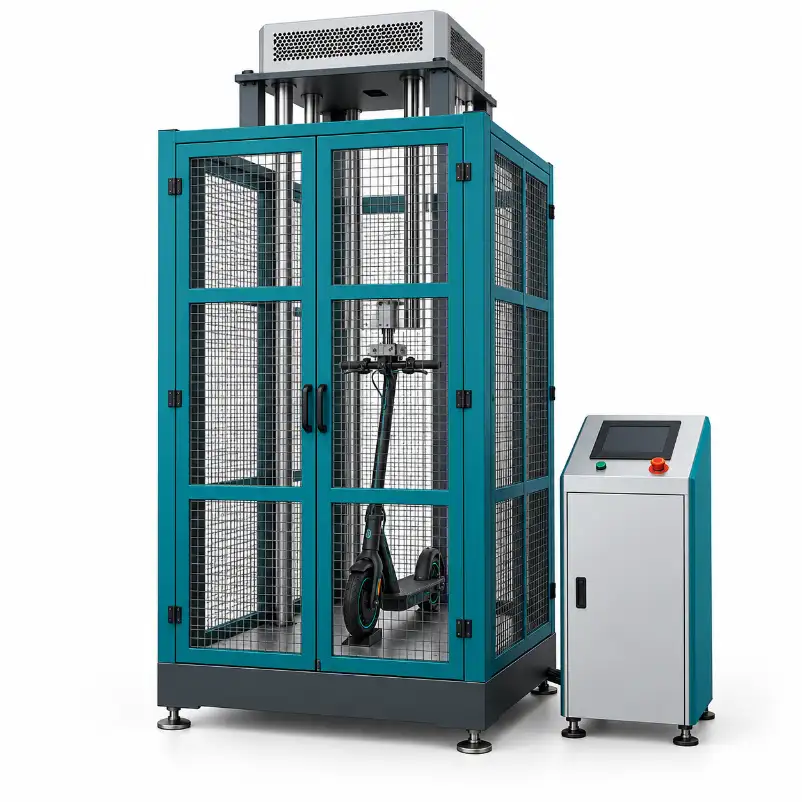
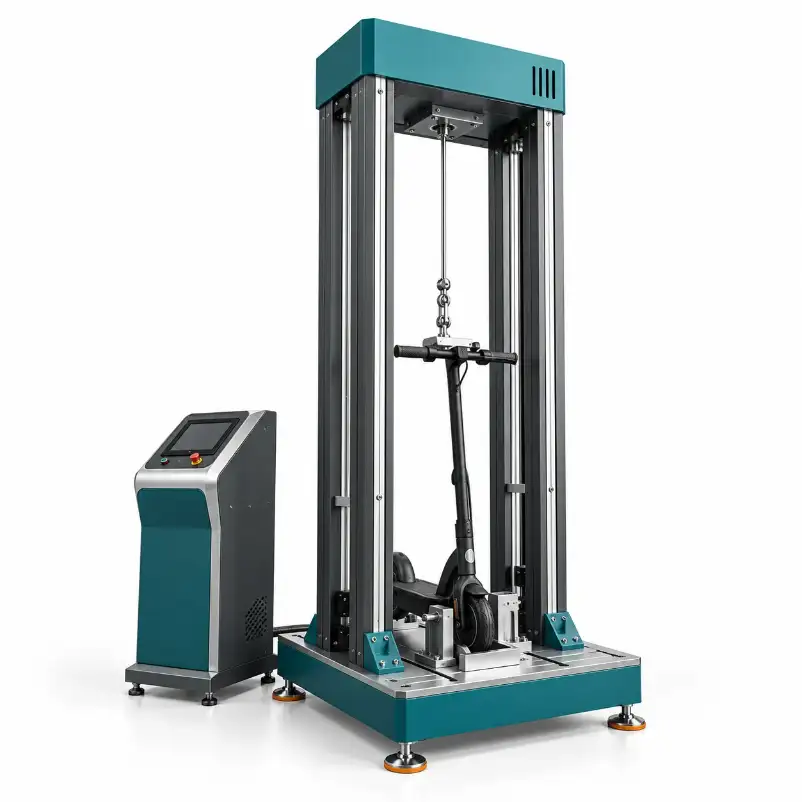
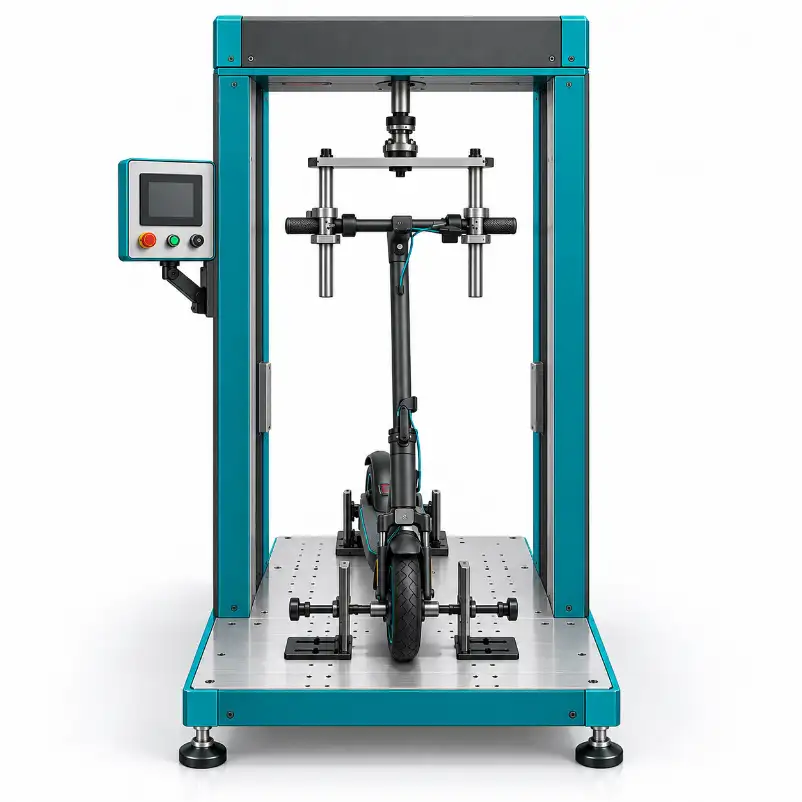
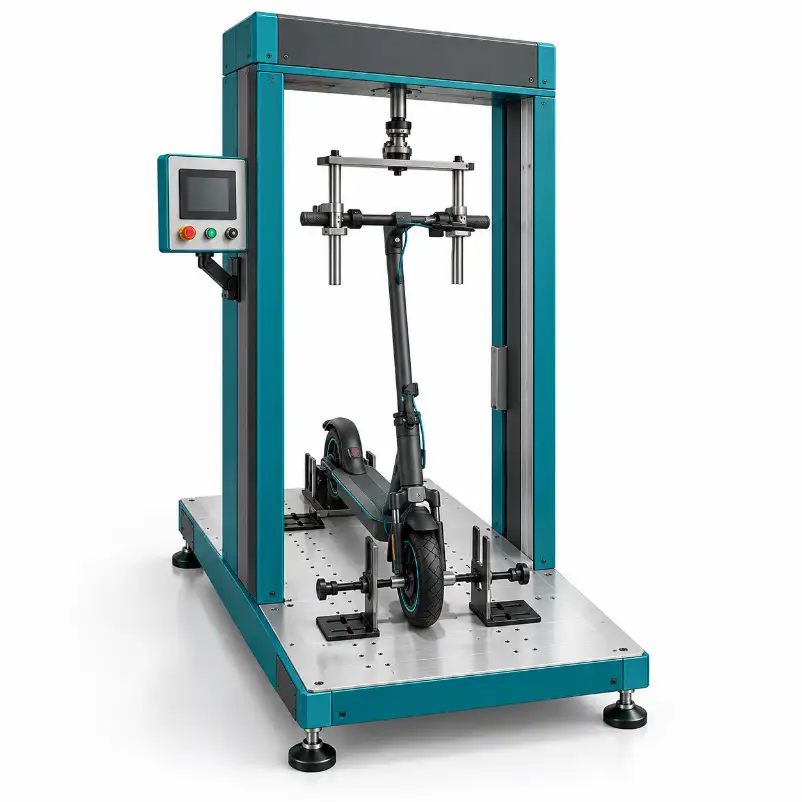
The reference machine shows a two-post frame, an upper connection, side fixture members and restraints around a complete scooter. These features provide an installation concept; the sample geometry and procedure determine the final fixture details.
Handlebar & stem connection
Define contact position, handlebar shape, stem adjustment and the interfaces that must remain in the load path.
Fork, wheel & deck restraint
Specify what is fixed, supported or allowed to move. Avoid bypassing the joint being assessed.
Axis & force direction
Check steering-axis orientation, loading line, lever arm and clearance through the required movement.
A fixed front wheel changes the test boundary
Holding the fork or wheel may be appropriate for a rotational-security task. The same restraint can prevent the intended movement in an operating-resistance test. Agree on the restraint condition before interpreting a result as steering effort.
Record clamp locations, adapters and fastener settings. Cable routing, brake hoses, wheel contact and fixture friction can affect movement or measured resistance. Decide which of these belong in the test and control the others. A fixture adjustment range must be confirmed with actual sample dimensions; “universal” is not a substitute for a fit review.
Match the Measurement to the Result You Need
A controller display or cycle count does not establish force, torque or angle measurement. Request the installed channels, their measurement locations and an example output for the proposed configuration.
- Force: confirm the sensor, loading direction and operating range relevant to the specimen—not only the actuator rating.
- Torque: specify where it is measured. If derived from force, the actual effective lever arm and changing geometry must be addressed; actuator pressure alone is not a torque measurement.
- Displacement or angle: distinguish actuator travel from relative movement at the joint being assessed.
- Play and permanent change: define inspection conditions, reference points and when readings are taken.
- Programme history: distinguish commanded cycles, completed movements, interruptions and specimen-related stops.
For a motion test, define direction changes, dwell and the movement that completes one cycle. If spring return or centring is part of the requirement, state the actual specimen behaviour to assess; do not assume that every scooter has a self-centring mechanism. Automatic stop detection, torque-angle plots and continuous logging require suitable hardware and software and must be quoted explicitly.
Steering Test Machine Configuration Checklist
Use this checklist to compare technical proposals on the same basis. It is a procurement checklist, not an unverified specification table.
| Configuration area | Provide to Derui | Confirm in the proposal |
|---|---|---|
| Specimen family | Scooter drawing, assembly revision, dimensions and adjustment positions. | Installation envelope, included adapters and sample changeover. |
| Test task | Controlled procedure, loading/movement direction and acceptance criteria. | Supported tasks, exclusions and any alternative fixture or drive required. |
| Load or motion | Required range, sequence, rate, dwell and cycle target where applicable. | Achievable conditions with the installed specimen, not just unloaded capability. |
| Measurement | Required force, torque, position, play or inspection results. | Installed channels, verification, recording resolution and example records. |
| Control & records | Completion definition, stop conditions and reporting needs. | Counting logic, interruption handling, data export and supplied software. |
| Installation & protection | Available space, utilities and laboratory safety requirements. | Site requirements, safeguards, instructions, training and acceptance trial. |
Confirm rated capacity, usable measurement range and fixture limits separately. Additional samples, destructive testing, simultaneous stations and laboratory data-system integration need their own scope review.
Review the Applicable Standard Before Selecting the Rig
Vehicle classification matters. EN 14619 concerns kick scooters; EN 17128 addresses personal light electric vehicles within its scope. Toy scooter projects may use the applicable toy-safety requirements, such as EN 71-1 or ISO 8124-1. A product name does not decide which standard or clause applies.
Provide the target market, vehicle category, standard edition and exact test method. Review the specimen preparation, load application, duration, inspections and records required for that task. Check the applicable edition rather than copying an older supplier brochure.
A matched setup can address an agreed test task. It does not by itself demonstrate every requirement of EN 17128, EN 14619 or a toy-safety standard, and this page does not claim that it does.
From Assembly Drawing to a Demonstrated Test Setup
Select the task
Identify the assembly, procedure, load path and result your team needs.
Review the sample
Check restraints, alignment, movement clearance and included adapters.
Demonstrate the sequence
Confirm actual load or movement, installed measurements and stop behaviour.
Review the evidence
Compare the demonstration records with the agreed equipment acceptance criteria.
What to Check During Equipment Acceptance
Use a representative scooter assembly to verify fit and operation. Review an initial setup at a suitable condition before demonstrating the agreed programme under the supplier’s instructions and laboratory safety procedure.
- Setup evidence: specimen ID, fixture photographs, restraint positions, alignment and tightening settings.
- Operating evidence: actual load or movement at the intended interface, sequence definition and any required inspection intervals.
- Measurement evidence: installed channel identification, relevant verification documentation and a sample record.
- Interruption evidence: what triggers a stop, how counts and records are retained and what is required before restart.
- Handover: fixture instructions, operating limits, maintenance, training and agreed protection.
Address pinch points, released specimens, stored energy and moving fixture members. The open concept image is not a validated guarding design. Separate fixture movement or compliance from movement in the specimen when assessing play, slip or deformation.
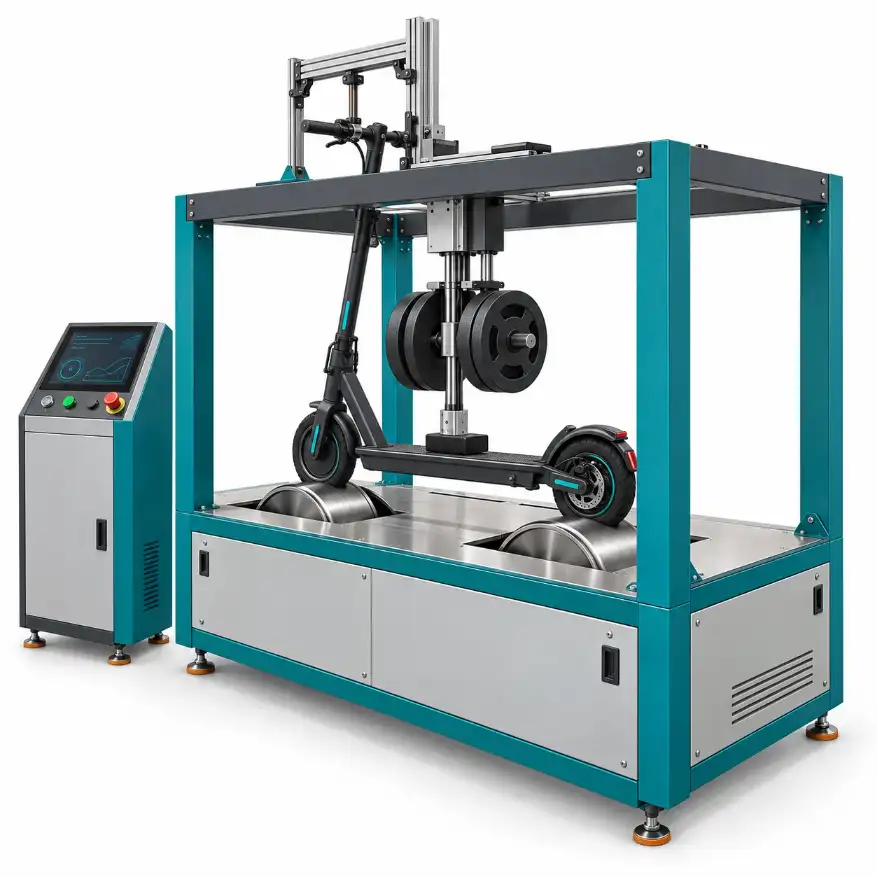
If your task targets a different interface, compare the scooter handlebar fatigue test configuration or the folding mechanism fatigue test configuration. Neither is automatically interchangeable with this steering assembly setup.
What to Send for a Steering Test Machine Quotation
- Product: scooter type, assembly drawing, sample photographs and dimensional limits.
- Method: required test task, controlled procedure, standard edition/clause if applicable and acceptance criteria.
- Installation: what is held, what moves, contact location and any required adjustment positions.
- Conditions: required load or torque, movement, rate, dwell and duration/cycles as applicable.
- Evidence: measurement channels, inspections, output format, safeguards and acceptance demonstration.
Get a proposal with a clear test boundary
Send the drawing and required method. Derui can review the fixture, actuation and measurement scope so your team can compare what is actually included.
Scooter Steering Tester Buying Questions
Is this a steering fatigue tester or a steering tube strength tester?
Similar equipment names are used for different tasks. The original arrangement has a gantry and scooter restraints, but the drive, load direction and fixture must be confirmed. Specify whether you need repeated steering motion, rotational security, axial strength or another defined task.
Can it measure steering torque and angle?
Only with suitable installed measurement channels and a validated setup. Ask for sensor locations, usable ranges and an example record; the image alone does not establish these functions.
Can the same fixture test different scooter sizes?
Provide drawings for each sample family. Confirm the mounting envelope, adjustment, adapters and loading geometry with the actual specimens rather than assuming universal fit.
Does fixing the front wheel still allow a steering movement test?
That depends on the required motion and which interface is restrained. A restraint suitable for a joint-security test may block the movement needed for an operating-resistance test. Review the complete load path.
Does the machine certify a scooter to EN 17128?
No single steering rig establishes whole-vehicle compliance. Identify the applicable clause and verify the proposed setup against that method. Other vehicle requirements need their own assessment.
Can cycle results be converted directly into years of use?
Not without an appropriate correlation and a defined service-duty basis. Report the laboratory conditions and results rather than treating a cycle count as a universal lifespan.
What determines the equipment price?
The selected task, specimen fixtures, actuation range, measurement channels, records, safeguards and acceptance scope determine the configuration. Supply these inputs for a comparable quotation.