Derui chamber
📋 Table of Contents
Bicycle Wheel Hub Testing: Ensuring Air Tightness and Safety
Air tightness is a critical performance parameter for modern bicycle wheel hubs — particularly for tubeless and industrial-grade hubs. Leaky hubs compromise bearing life, allow contamination, and degrade braking performance. This guide covers air tightness testing methods, equipment, and acceptance criteria per international standards.
⚡ Key Takeaway
A wheel hub that fails air tightness testing can allow water, dust, and corrosive agents to enter the bearing cavity, drastically shortening bearing life. ISO 4210 and JIS D 945 require air leakage tests for all hubs used in weather-exposed applications. Testing is mandatory for EU and Japanese market certification.
🔧 Key Parameters for Bicycle Wheel Hub Air Tightness Testing
- Test pressure range: 0.5 bar – 3.0 bar (7 psi – 43 psi), adjustable
- Pressure decay sensitivity: ≤ 0.01 bar (0.15 psi) over 60 seconds
- Test medium: Compressed air (dry, oil-free) or nitrogen (for enhanced sensitivity)
- Acceptable leakage rate: ≤ 0.05 bar/min (typical), ≤ 0.02 bar/min (premium hubs)
- Temperature compensation: Required for tests > 10 minutes or in non-climate-controlled environments
- Test cycle time: 30 seconds – 5 minutes (depending on method and sensitivity)
- Why Air Tightness Matters for Bicycle Wheel Hubs
- Relevant Standards (ISO 4210, JIS D 945)
- Test Principle and Methodology
- Testing Equipment Requirements
Why Air Tightness Matters for Bicycle Wheel Hubs
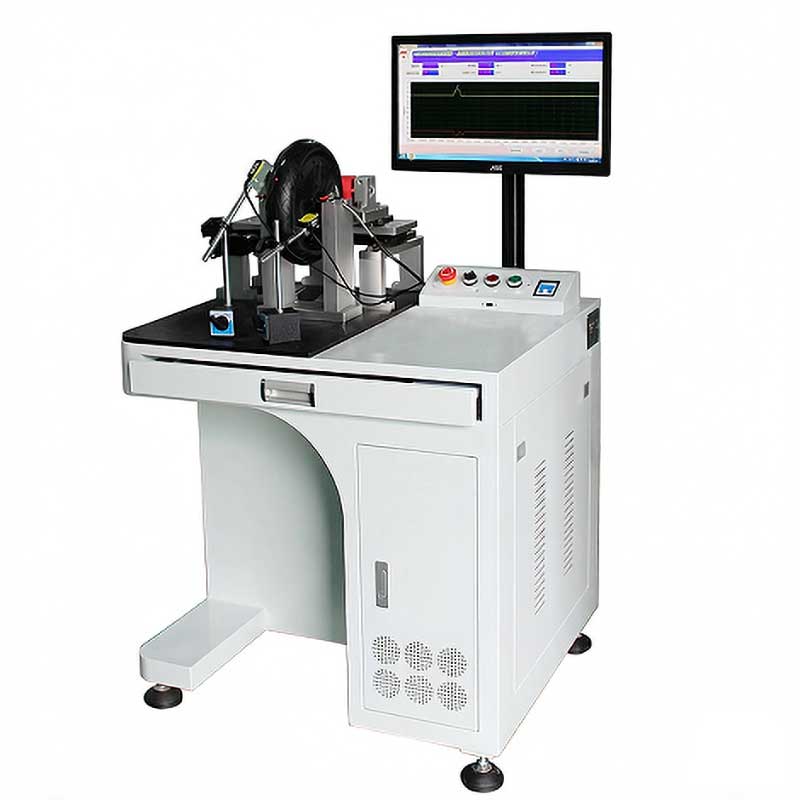
Bicycle Wheel Tire Roundness and Lateral Runout Testing Machine
Bicycle wheel hubs rotate continuously and are exposed to water, mud, salt, and abrasive dust. The hub’s sealing system (labyrinth seals, O-rings, or rubber seals) must maintain an air-tight barrier to protect the bearings inside.
When a hub loses air tightness:
- Bearing contamination — Water and dust enter, washing out grease and causing corrosion
- Increased rolling resistance — Contaminated bearings create drag, reducing efficiency
- Brake rotor compatibility issues — For hubs with integrated brake mounts, air leakage can indicate structural weakness
- Premature hub failure — Bearing replacement before 10,000 km indicates sealing failure
Relevant Standards (ISO 4210, JIS D 945)
ISO 4210:2023 — Bicycle Safety Requirements
Clause 6.7 specifies the air tightness test for hubs. The hub must withstand 2.0 bar internal pressure for 5 minutes without leakage exceeding 0.1 bar/min. This applies to all hubs intended for on-road use in weather-exposed conditions.
JIS D 945:2017 — Bicycle Hubs
The Japanese Industrial Standard specifies more stringent air tightness requirements: 3.0 bar for 10 minutes, leakage ≤ 0.05 bar/min. This is required for all hubs sold in the Japanese market.
EN 14766:2006 — Mountain Bicycles
Requires hub air tightness testing for off-road bicycles. Test parameters are identical to ISO 4210, but additional cyclic water exposure testing is required for hubs used on full-suspension mountain bikes.
Test Principle and Methodology
Pressure Decay Method (Most Common)
The hub is sealed at both ends using custom fixtures that clamp onto the hub shell and prevent air leakage through the bearing bores. Compressed air is introduced to the hub cavity at the test pressure (2.0 bar for ISO 4210). After a stabilization period (30-60 seconds), the pressure decay over time is measured. If the decay exceeds the allowable limit, the hub fails.
Flow Measurement Method (More Sensitive)
A flow meter is connected to the hub cavity. Air is supplied at constant pressure and the flow rate (leakage) is measured directly in ml/min or sccm (standard cubic centimeters per minute). This method is more sensitive than pressure decay and is preferred for high-end hubs.
Helium Leak Detection (R&D Only)
For research and development, helium leak detection can identify micro-leakage paths as small as 10^-7 mbar·L/s. This is not used for production testing but is valuable for seal design optimization.
Testing Equipment Requirements
Step-by-Step Test Procedure
-
Sample Preparation
Clean the hub thoroughly with isopropanol to remove grease and debris from the sealing surfaces. Inspect the hub for visible damage — dented flanges, worn O-ring grooves, or corroded bearing bores must be rejected before testing.
-
Mount Hub to Test Fixture
Install the hub in the test fixture, clamping securely on both flanges. Connect the air supply line to the fixture’s intake port. Ensure all connections are tight — external leaks will cause false failure indications.
-
Pressurize to Test Pressure
Slowly increase air pressure to the test value (2.0 bar for ISO 4210, 3.0 bar for JIS D 945). Use a needle valve to avoid pressure overshoot. Hold at test pressure for 30-60 seconds to allow temperature stabilization.
-
Initiate Test and Record Baseline
Close the input valve and start the pressure decay measurement. Record the baseline pressure (P₀). The test duration is typically 5 minutes for ISO 4210 and 10 minutes for JIS D 945.
-
Measure Pressure Decay
At the end of the test duration, record the final pressure (P₁). Calculate leakage: ΔP = P₀ – P₁. If ΔP > allowable limit, the hub fails. For flow measurement method, read the flow meter directly in sccm or ml/min.
-
Post-Test Inspection
Depressurize the hub slowly to avoid damage. Remove the hub from the fixture and inspect the sealing surfaces for damage caused by the test fixture. Document any observations and update the test report.
Acceptance Criteria
✅ Pass Criteria (ISO 4210 / JIS D 945)
Common Failure Modes
⚠️ Important: Temperature Effects on Pressure Decay
Air temperature changes during the test will cause pressure changes that can be misinterpreted as leakage. For tests longer than 5 minutes, always use temperature compensation: P_corrected = P_measured × (T_ref / T_measured). Alternatively, conduct the test in a temperature-controlled environment (20°C ± 2°C).
Documentation and Traceability
A complete air tightness test report must include:
- Hub model, serial number, and manufacturing date
- Test equipment ID, calibration certificate number, and last calibration date
- Test pressure (bar), test duration (minutes), and temperature (°C)
- Pressure decay (bar) or flow rate (sccm) at each measurement point
- Pass/Fail determination and inspector signature
- Any supplementary observations (bubbles, seal damage, etc.)
Need Bicycle Wheel Hub Air Tightness Testing Equipment?
DeRui Tester manufactures ISO 4210 and JIS D 945 compliant hub air tightness test machines with pressure decay and flow measurement methods, automated test sequences, and data export for quality documentation. CNAS-accredited lab testing also available.
Conclusion
Bicycle wheel hub air tightness testing is a simple but critical quality gate. A hub that leaks allows contaminants to destroy the bearings — leading to premature failure, warranty claims, and safety risks for riders.
Testing per ISO 4210 or JIS D 945 ensures that every hub shipped can withstand real-world weather exposure without compromising bearing life. The test is fast (30 seconds to 5 minutes per hub) and provides definitive pass/fail results.
🔗 Related Products
🔗 Related Products
📚 Related Articles
Need Professional Bicycle Testing Equipment?
Explore our range of testing machines designed for compliance with international standards.