Derui chamber
How to Choose the Right Bicycle Testing Equipment: A Complete Buyer’s Guide
This page provides a detailed overview of the How to Choose the Right Bicycle Testing Equipment: A Complete Buyer’s Guide — including features, specifications, test standards, and applications.
⚡ Key Takeaway
This How to Choose the Right Bicycle Testing Equipment: A Complete Buyer’s Guide is designed for professional laboratory and production line testing. It ensures compliance with international standards and delivers reliable, repeatable test results for quality control and certification.
📋 Table of Contents
📋 Table of Contents
How to Choose the Right Bicycle Testing Equipment: A Complete Buyer’s Guide
Whether you’re a bicycle manufacturer, quality control lab, or testing facility, selecting the right testing equipment is critical to ensuring product safety, meeting international standards, and maintaining competitive advantage. This guide covers everything you need to make the right decision.
⚡ Key Takeaway
Bicycle testing equipment is not just about compliance — it’s about protecting riders, reducing warranty claims, and building a reputation for quality that differentiates your brand in a competitive market.
- Why Bicycle Testing Matters
- Key Types of Bicycle Testing Equipment
- What to Look for When Buying: A Checklist
- Budget Considerations
Why Bicycle Testing Matters
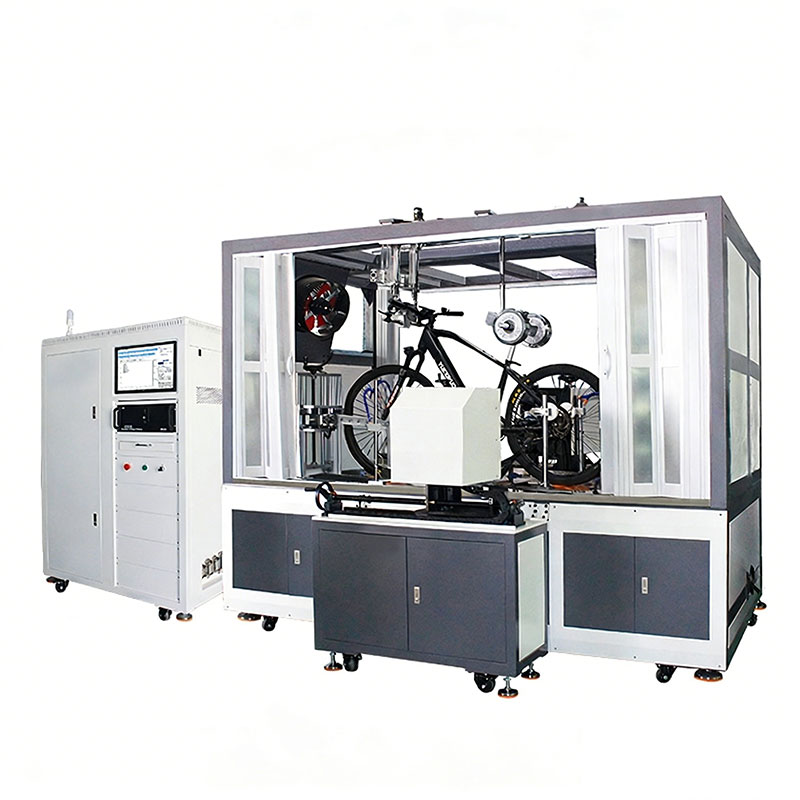
Electric Bicycle Comprehensive Test Machine for Quality Control
Bicycles must meet rigorous safety standards before they can be sold in most markets. Testing equipment helps manufacturers:
- ✅ Verify compliance with ISO 4210 (bicycle safety standards), EN 14764 (city/hybrid bikes), and JIS D9411 (Japanese standard)
- ✅ Ensure durability under real-world riding conditions — often thousands of kilometers compressed into hours of accelerated testing
- ✅ Identify potential failure points before products reach consumers, avoiding costly recalls
- ✅ Reduce warranty claims and product liability exposure
- ✅ Build brand reputation through consistent, documented quality
Key Types of Bicycle Testing Equipment
1. Frame and Fork Testing Machines
The frame is the backbone of any bicycle. Frame fatigue testing machines apply cyclic loads to simulate years of riding in a matter of hours or days. Key tests include:
- Vertical loading test – Simulates rider weight and road impacts (typically 300-600 kgf)
- Horizontal loading test – Tests frame rigidity during cornering and braking maneuvers
- Pedal force test – Evaluates bottom bracket area stress under pedaling loads
When choosing a frame tester, look for machines that can test both road bikes and mountain bikes with adjustable fixtures — this flexibility becomes critical as your product line expands.
2. Brake Testing Systems
Brake performance directly affects rider safety. A bicycle brake testing machine measures:
- Braking force and efficiency across full speed range
- Wet and dry braking performance under controlled conditions
- Pad wear rates and pad-to-rim/rotor compatibility
- Heat dissipation under repeated braking cycles
Modern brake testers should accommodate disc brakes, rim brakes, and e-bike regenerative braking systems. The last thing you want is to upgrade your product line only to find your test equipment can’t handle the new brake type.
3. Wheel and Tire Testing Equipment
Wheel fatigue testers simulate road conditions to check spoke tension, rim strength, and hub durability under radial and lateral loading. Combined with tire rolling resistance machines, these give a complete picture of wheel system performance for every riding condition.
4. Pedal and Crankset Testers
Pedals endure thousands of rotation cycles under varying load conditions. Dedicated pedal durability testers apply dynamic vertical and horizontal forces to ensure pedals won’t fail under real-world pedaling loads — a common failure point for budget component manufacturers.
What to Look for When Buying: A Checklist
✅ Buyer’s Checklist — 6 Must-Have Features
Must support ISO 4210, EN 14764, JIS D9411, CPSC 1512 depending on your target markets
Should cover from children’s bikes (20 kg) to cargo e-bikes (250 kg) with a single machine
Real-time monitoring, automated report generation, and export to PDF/Excel for quality documentation
Quick-change fixtures for different bike types — frame, fork, wheel, and brake testing without re-buying equipment
Annual calibration service, spare parts availability (5+ year commitment), and technical training included
CE marking, ISO 9001 certified manufacturer, and CNAS calibration certificates for international acceptance
Budget Considerations
Bicycle testing equipment investment ranges significantly based on capabilities and capacity. Here’s what to expect at each level:
Entry-Level
⭐ Mid-Range
Full Laboratory
Recommended approach: Start with the most critical tests for your primary product line — typically frame fatigue and brake testing cover 80% of your compliance needs. Expand as your testing requirements grow and new product categories are added to your portfolio.
Common Mistakes to Avoid
❌ Mistake #1 — Buying Without Future Standards in Mind
Choose equipment with upgradeable firmware and modular fixtures. E-bike testing requirements (higher loads, electrical safety) are rapidly evolving — a rigid, non-upgradeable system becomes obsolete within 2-3 years.
❌ Mistake #2 — Ignoring Calibration Costs
Annual calibration is not optional for accredited testing. Budget 5-8% of equipment purchase price per year for calibration and maintenance. A $50,000 machine with $3,000/year calibration is still far cheaper than invalidated test reports.
❌ Mistake #3 — E-Bike Testing Capability as an Afterthought
If you manufacture or plan to manufacture e-bikes, ensure your equipment handles higher loads (minimum 150 kg system weight), and check whether the equipment supports electrical safety testing per IEC 62133.
❌ Mistake #4 — Choosing Based on Price Alone
Reliability and measurement accuracy are more important than upfront cost for testing equipment. A ±2% force measurement error could mean the difference between a passing test and a product that fails in the field — creating liability far exceeding any equipment savings.
Looking for Professional Bicycle Testing Equipment?
DeRui Tester offers ISO 4210-compliant frame, brake, wheel, and pedal testing machines with global technical support and CNAS-traceable calibration.
Conclusion
Investing in the right bicycle testing equipment is one of the most important decisions a manufacturer can make. Focus on equipment that matches your current product line, supports relevant international standards, and comes from a reputable supplier with strong after-sales support. The upfront investment in quality testing equipment pays for itself many times over through reduced recalls, happy customers, and the ability to enter markets that require documented compliance testing.
🔗 Related Products
🔗 Related Products
📚 Related Articles
Need This Equipment?
Derui Tester manufactures this equipment with full compliance to international standards. Contact us for a quote or technical consultation.
Need Professional Bicycle Testing Equipment?
Explore our range of testing machines designed for compliance with international standards.