Derui chamber
Bicycle Test Bench Types: Frame, Brake, Wheel and Complete-Bike Testing
A test bench should be chosen by the specimen and the decision the test must support. This guide maps four common bicycle testing jobs to the rig, fixture and measurement questions that matter before procurement.
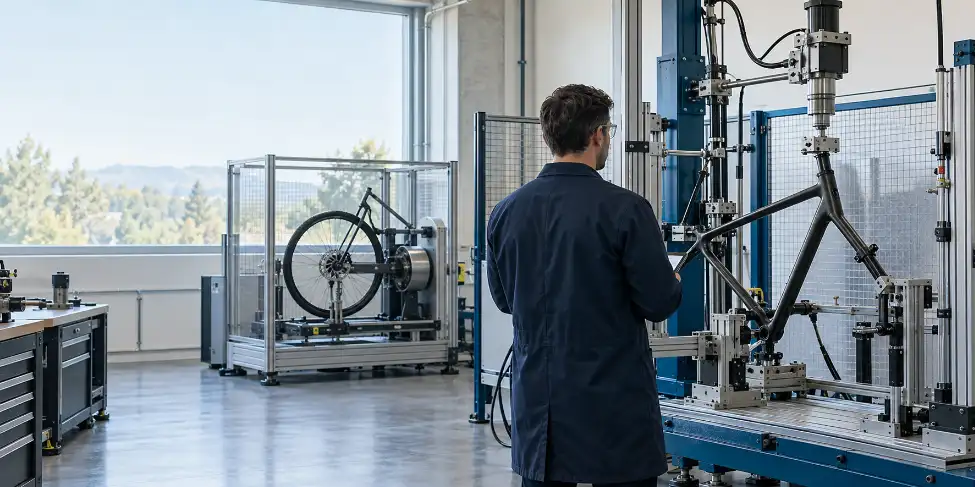
A frame fatigue rig, brake test station, wheel rig and complete-bicycle bench answer different questions. A shared controller or adjustable fixture can sometimes serve several methods, but the required load path, specimen support and evidence must be checked method by method.
The phrase bicycle test bench covers a wide range of machines. That is useful in a first search, but too broad for a quotation. A frame fatigue test acts on a structure; a brake test evaluates braking behaviour; a wheel test locates and measures a rotating assembly; and a complete-bicycle rig may reproduce an operating condition. Each needs a different way to hold, drive and measure the specimen.
This article helps you decide which type of station belongs in your test plan. Once the station is clear, use our bicycle test bench specification guide to define load, speed, stroke, control and data requirements for the RFQ.
Start with the test decision, then select the station
Separate the tests your laboratory must run from the machines you might buy. ISO 4210-2 describes requirements across bicycle systems, while the relevant methods are organised in separate parts for braking, frame and fork, and wheel and rim testing. The applicable edition and any customer or market-specific requirements should be confirmed before a machine is specified.
| Testing job | Typical station architecture | Check before buying | Evidence to request |
|---|---|---|---|
| Frame / fork strength and fatigue | Rigid fixture plus controlled load or impact arrangement | Mounting points, load direction, specimen size range, actuator travel | Load and cycle records; fixture drawing; stop-condition record |
| Brake testing | Brake application and wheel/vehicle motion arrangement matched to the method | Which brake is tested, where force is applied, what speed or motion is required | Brake input and response data; test sequence; calibration path |
| Wheel / rim testing | Wheel support and measurement rig, with loading where the method requires it | Hub interfaces, wheel size, tyre state, radial/lateral measurements | Measurement trace, setup photographs, pass/fail criteria |
| Complete-bicycle evaluation | Roller, riding-simulation or other complete-vehicle arrangement | Wheelbase, tyre, gearing, drive/brake interfaces, operator safety | Speed, load or power record; operating sequence; specimen ID |
Practical rule: A station name is not evidence that it performs a specific standard test. Ask the supplier to map every required method to a fixture, controlled variable, measurement channel and acceptance demonstration.
Frame and fork rigs: reproduce the load path
Frame and fork testing is about structural response under a defined mounting and loading condition. Depending on the method, the programme may call for a fatigue sequence, a static load or an impact arrangement. ISO 4210-6:2023 addresses frame and fork test methods within the ISO 4210 series. A generic actuator frame may be a useful starting platform, but it does not establish method compatibility on its own.
Show the supplier where the frame is restrained and where the force enters it. Include the geometry of the smallest and largest frames you will test. Then review whether the fixture preserves the intended boundary condition as the sample deflects. If the load enters at the wrong location or the support adds unintended stiffness, repeatable data can still describe the wrong test.
- Identify whether the specimen is a bare frame, fork, frame-fork assembly or complete bicycle.
- Provide drawing views of the head tube, bottom bracket, dropouts and other relevant interfaces.
- State whether multiple load directions or fixture changeovers are required.
- Define what constitutes a failure and how the machine should stop and preserve evidence.
For a deeper method-specific discussion, see our ISO 4210-6 frame fatigue selection guide.
Brake stations: distinguish the test output
Brake equipment is often grouped under a single label even when the tasks are different. A project may need to apply a defined force at the lever, evaluate the response of an assembled bicycle, or run an internal durability sequence. These tasks need different motion, mounting and measurement arrangements. ISO 4210-4:2023 specifies braking test methods for ISO 4210-2; it does not make every device marketed as a brake tester interchangeable.
Before choosing a rig, name the brake system and the measurement that determines acceptance. Is the essential result a brake input, a wheel response, a stopping behaviour, or a change after repeated operation? Then specify how the wheel or complete bicycle is supported and moved during the test. Brake actuation alone does not establish the same result as a bicycle-level braking method.
Wheel and rim rigs: control the support and measurement
A wheel station must locate the wheel consistently before its measurement has meaning. ISO 4210-7:2023 covers wheel and rim test methods for ISO 4210-2. The machine architecture depends on the particular method: rotational measurement, retention or strength evaluation should not be collapsed into one vague promise of “wheel testing”.
List the hub or axle interfaces, wheel diameters, tyre conditions and expected load or speed where relevant. For a multi-size laboratory, specify how quickly adapters can be changed without losing alignment. Ask for a sample report showing the actual measured quantity and the calibration path of the measuring channel.
If wheel testing is a major part of your programme, our bicycle wheel testing guide covers the methods in more detail.
Complete-bicycle benches: keep the vehicle boundary condition visible
Complete-bicycle benches are useful when the question concerns the assembled product rather than an isolated component. A roller or riding-simulation arrangement can support development work, production checks or a defined internal operating sequence. It may need to accommodate different wheelbases, tyre sizes, drivetrains and electric-assist configurations.
Record exactly what a bench is expected to simulate and which result will be used for acceptance. A laboratory simulation is not automatically a substitute for a prescribed road test. ISO 4210-2 includes a road test of a fully assembled bicycle; whether an alternative rig can be used for your purpose must be established from the applicable method and approval route.
A combined platform is attractive when it serves several compatible tests without compromising fixture geometry or measurement quality. Review each proposed test individually, including changeover time and calibration. “Multi-function” should be demonstrated through an agreed test matrix, not only a product brochure.
Choose a lab plan that matches your actual test volume
A new laboratory rarely needs every station on day one. Rank the required tests by product risk, applicable method, expected throughput and whether the result is needed for design work, release or routine production control. This makes the first purchase easier to justify and leaves a clear path for later modules.
| Lab situation | Reasonable starting approach | Trade-off to review |
|---|---|---|
| One high-volume, repeatable test | Dedicated station with short changeover | Less flexible when the product family changes |
| Several related frame/fork methods | Modular actuator platform with method-specific fixtures | Fixture validation and setup discipline become critical |
| Mixed bicycle and e-bike development | Separate the structural and whole-vehicle test matrix, then share only compatible functions | A broad platform may cost more and still miss a specialist test |
| Low-volume or exploratory testing | Define the method first; outsource some tests or phase the investment | Scheduling and data ownership must be agreed |
Ask the supplier for a coverage table: required method, proposed station, fixture, sensor, control mode, sample range, changeover and factory acceptance demonstration. Any blank cell is a question to resolve before purchase.
What to send for a bicycle test bench quotation
A useful first enquiry can fit on one page if it includes the details that govern architecture:
- Bicycle or component type, target markets and sample drawings.
- Applicable standard edition, customer method or internal procedure.
- Required tests grouped as frame/fork, brake, wheel/rim and complete-bicycle tasks.
- Specimen size envelope, mass and mounting interfaces.
- Required controlled variable, useful range, motion and cycle or speed profile for each test.
- Measurement channels, output files, failure criteria and traceability needs.
- Expected throughput, fixture changeover, site utilities and available floor space.
- Which test must be demonstrated with a representative sample at factory acceptance.
For the detailed specification of a selected station, continue with the load, speed, fixtures and data guide.
Need to define your bicycle testing stations?
Send Derui your test list, applicable methods and representative drawings. We can review which tasks call for separate stations and where a shared platform may be practical, then discuss a configuration and acceptance plan.