Derui chamber
Standards & Compliance
E-Bike and E-Scooter Frame Fatigue Testing Standards: A Practical Selection Guide
Use product classification to select the standards route first, then translate that route into fixture geometry, load paths, control requirements and an equipment RFQ that the laboratory can actually execute.
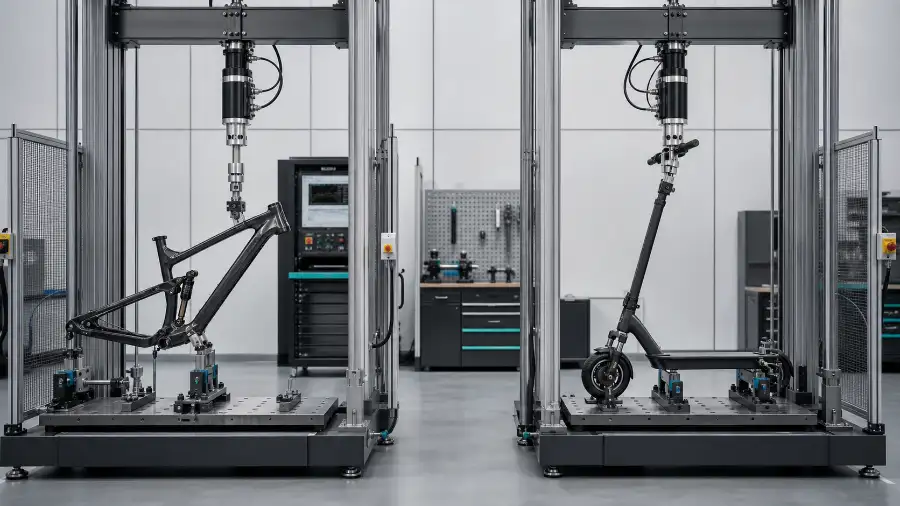
Bicycle projects commonly begin with ISO 4210 or ISO 8098, European EPAC e-bikes commonly include EN 15194, and standing e-scooters within the PLEV scope commonly begin with EN 17128. Classification, intended use, target market and the current adopted edition must be confirmed before fixtures or machine capacity are specified.
Manufacturers often ask for an “e-bike frame fatigue standard” or an “e-scooter frame fatigue standard” as if each product category points to one universal test bench. In practice, the fatigue equipment comes after the standards decision, not before it. A frame fatigue method only makes sense when the product category, exclusions, intended user and target market are already defined.
Why frame fatigue testing starts with product classification
“Frame fatigue” sounds like one engineering task, but it can belong to different product routes. A conventional bicycle frame, an EPAC e-bike frame and a standing e-scooter frame may all require cyclic structural evaluation, yet they do not necessarily sit under the same product standard. The classification decision affects scope, exclusions, rider mass assumptions, electrical-function requirements and the supporting technical file.
That is why a lab should begin with five basic questions: What propels the vehicle? Is it pedal-powered, electrically power assisted or fully light-electric? What is the rider position? Is there a seat? What is the target maximum design speed? Who is the intended user? Which market will receive the product? Until those questions are answered, a supplier quotation for a fatigue machine is only a mechanical proposal, not a standards-based solution.
When bicycle standards such as ISO 4210 or ISO 8098 are the starting point
ISO 4210-2:2023 applies to young adult, city and trekking, mountain and racing bicycles with a maximum saddle height of 635 mm or more, including folding bicycles. ISO 4210-6:2023 specifies the frame and fork test methods for that bicycle safety framework. That makes ISO 4210 one of the most important starting points when the product is still fundamentally a bicycle rather than a separate PLEV category.
ISO 4210-1:2023 also clarifies that the bicycle series does not apply to specialized bicycles such as delivery bicycles, recumbents, tandems, BMX bicycles and bicycles intended for severe competition or stunting. This matters because a supplier should not assume that every two-wheeler with pedals follows the same fatigue route.
For young children’s bicycles, ISO 8098:2023 is relevant instead. ISO states that it applies to bicycles with a maximum saddle height of more than 435 mm and less than 635 mm. It also notes that bicycles with a saddle height of 435 mm or less should be checked against national ride-on toy regulations, while bicycles with saddle height 635 mm or more move into the ISO 4210 series.
For fatigue-equipment planning, the practical implication is straightforward: if the specimen is fundamentally a bicycle, first decide whether it belongs in the ISO 4210 family or ISO 8098. Then identify the current frame or fork test methods, sample envelope, loading points, cycle counts and acceptance logic that the project actually requires.
When EN 15194 is commonly part of the e-bike route
For many European e-bike projects, the common product-level route is EN 15194 for electrically power assisted cycles. BSI describes BS EN 15194:2017+A2:2023 as applying to EPAC bicycles for private and commercial use, except EPAC intended for hire from unattended stations. The older public text of EN 15194 also shows the classic EPAC logic: pedal-equipped cycles with auxiliary electric assistance, maximum continuous rated power of 0.25 kW and assistance cut-off at 25 km/h or sooner if pedalling stops.
That does not mean EN 15194 replaces every bicycle fatigue method with one universal frame test. It means the product is being assessed as an EPAC bicycle, so the frame fatigue plan has to fit that product route and its supporting bicycle test logic. In other words, the standards decision is layered: first confirm the product is an EPAC bicycle, then determine the specific frame and fork structural methods required for the specimen category and project scope.
There are also important variations. BSI lists BS EN 17404:2022 for EPAC mountain bikes, and its scope states that the scope of EN 15194 applies with additional specific requirements. That is a good reminder that “e-bike” is still too broad for direct machine selection. A city e-bike, a folding e-bike and an EPAC mountain bike can drive different testing details even when their overall route sounds similar.
If you are defining an e-bike frame fatigue RFQ, record the bicycle platform, intended use, motor-assistance type, design speed, voltage, wheelbase, frame geometry and any folding or suspension details before discussing actuators or fixtures. The correct fatigue setup is a result of those inputs.
When EN 17128 is the common route for standing e-scooters
For standing e-scooters that fall within the personal light electric vehicle scope, EN 17128 is the main European reference point. BSI’s public overview says BS EN 17128:2020 applies to personal light electric vehicles with or without self-balancing systems, powered from self-contained power sources up to 100 VDC, with or without an integrated charger up to 240 VAC input.
BSI also lists important exclusions. EN 17128 does not apply to toys, vehicles without self-balancing systems that have a seat, vehicles intended for competition, electrically powered assisted cycles, medical vehicles, products above 25 km/h design speed, products above the stated voltage limits and vehicles without an onboard driving operator. Those exclusions matter because they directly affect whether your “e-scooter frame fatigue test” really belongs under EN 17128 at all.
For projects that do fit the PLEV route, frame fatigue testing is part of a wider evaluation package. BSI’s overview points to structural integrity, braking, electrical components, driving-power management, speed limitation, marking and related safety topics. That means the fatigue rig should be specified as one part of a larger project requirements matrix, not as a standalone “EN 17128 machine” purchased without context.
Derui’s relevant product routes include E-Scooter Testing Machines, the Scooter Stem Fatigue Test Machine and the Scooter Dynamic Durability Test Machine. The final configuration should still be checked against the specimen geometry, clause matrix and acceptance requirements.
At-a-glance comparison for frame fatigue planning
| Decision point | Bicycle route | EPAC e-bike route | Standing e-scooter route |
|---|---|---|---|
| Typical starting standards | ISO 4210 series, or ISO 8098 for young children’s bicycles | EN 15194, with the appropriate bicycle platform and related methods | EN 17128 when the product fits the PLEV scope |
| Main classification question | Is it fundamentally a bicycle, and which bicycle category? | Is it an EPAC bicycle within the standard’s scope and limits? | Is it a standing PLEV without triggering listed exclusions? |
| Why fatigue planning differs | Frame and fork methods depend on bicycle type and user range | Frame fatigue sits inside an EPAC product route rather than a purely mechanical route | Frame fatigue is only one part of a broader PLEV safety programme |
| Common mistake | Using one bicycle load plan for every geometry | Assuming every e-bike uses the same frame test path | Calling every powered scooter “EN 17128” without reviewing seat, speed or scope |
| Equipment implication | Need specimen-specific fixtures and load paths | Need fixture and control logic consistent with EPAC project scope | Need a standards-driven fixture and method map, not just a generic fatigue stand |
How to convert the standards decision into a usable equipment RFQ
A test-equipment RFQ should never start with “Please quote one frame fatigue machine.” A better RFQ explains what standard route the product is following and what structural questions the laboratory needs to answer. That helps the supplier size the frame, fixture interfaces, actuator stroke, sensor ranges and control sequence correctly.
What to include in your frame fatigue test-equipment RFQ
- Product type: bicycle, EPAC e-bike or PLEV e-scooter
- Target market and current standard route
- Frame and fork drawings or CAD files
- Wheelbase, wheel size, stem or head tube geometry
- Maximum rider mass or payload assumptions
- Applicable test clauses or method matrix
- Required loads, strokes, frequencies and cycle counts
- Fixture boundary conditions and mounting points
- Required measurements and data export format
- Calibration, FAT and acceptance-report requirements
If your team is still undecided about machine architecture, compare this standards discussion with the existing equipment-selection logic in What Testing Equipment Does My Industry Need? and the standard-selection article EN 14619 vs EN 17128: Which Scooter Standard Applies?.
Four Planning Decisions That Prevent the Wrong Test Setup
The standards comparison becomes useful only when it changes the equipment specification. The following decisions should be recorded before a supplier freezes the load frame, fixture interfaces or control programme.
Confirm whether the product is really inside the stated scope
Do not assign EN 15194 to every product described as an e-bike, or EN 17128 to every powered scooter. Review propulsion, seat configuration, design speed, intended use, user group and market-specific adoption first. A scope error at this stage can invalidate every later fixture and load decision.
Separate the product standard from the mechanical test method
A product-level standard can define the overall compliance route while a related method defines how the frame or fork is loaded. Record both levels in the clause matrix. This prevents a machine from being sold as compliant merely because it can reach a force value.
Decide whether one configurable load frame can serve both product families
An adaptable machine may support e-bike and e-scooter projects, but only when actuator alignment, fixture travel, load-cell range, boundary conditions and control logic can be changed without compromising the method. Shared hardware does not mean shared fixtures or identical programmes.
Freeze the clause matrix before approving the machine architecture
The most expensive purchasing mistake is choosing equipment before the classification and required clauses are agreed. Freeze the specimen list, loading points, cycle profiles, measurements, stop conditions and report requirements first. The resulting RFQ will be easier to compare and far less likely to require costly fixture redesign.
Sources and edition note
- ISO 4210-2:2023, bicycle requirements scope.
- ISO 4210-6:2023, frame and fork test methods.
- ISO 4210-1:2023, bicycle vocabulary and exclusions note.
- ISO 8098:2023, young children’s bicycle scope.
- BSI overview of BS EN 15194:2017+A2:2023, EPAC bicycles scope summary.
- BSI overview of BS EN 17404:2022, EPAC mountain bike note.
- BSI overview of BS EN 17128:2020, PLEV scope and exclusions.
Standards and national adoptions can change. Verify the current edition, amendments and market-specific legal route before freezing any compliance plan or equipment specification. This guide is for technical planning and does not replace a product-specific conformity assessment.