Derui chamber
Testing Equipment Guides
Custom vs Standard Test Machines: A Decision Guide for Testing Laboratories
The best machine is not automatically the most customized one. Choose the lowest-complexity configuration that can reproduce your method, accommodate the real specimen range and deliver the evidence your laboratory must defend.
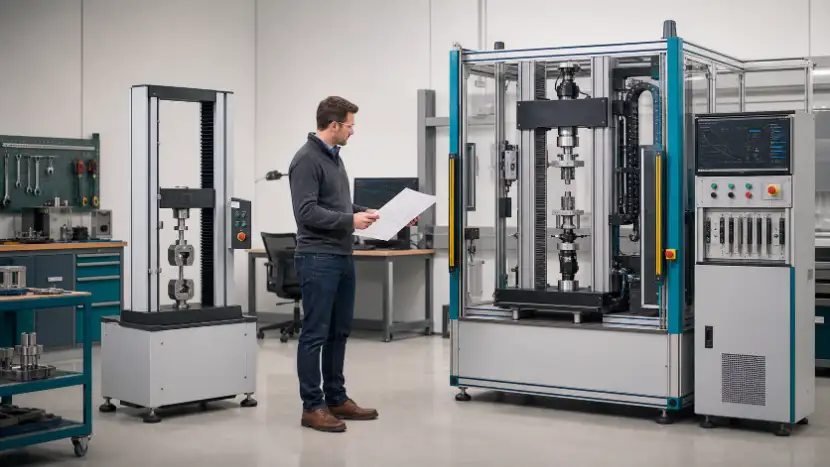
Select a standard machine when the test method, specimen family and reporting workflow are already stable. Select a custom machine when the requirement cannot be met without purpose-designed mechanics, fixtures, controls or integration. For many laboratories, the strongest answer is a proven standard platform with carefully limited customization.
Laboratories often frame the purchase decision as a simple trade-off: a standard tester is cheaper and faster, while a custom tester is more capable. That comparison is incomplete. A poorly selected standard machine can create fixture workarounds, manual data processing and repeated change orders. An over-customized machine can add design risk, training burden and spare-parts complexity without improving the validity of the test.
The decision should begin with the test programme rather than the machine catalogue. What must the laboratory prove? Which specimens will be tested during the next three to five years? Which variables must be controlled and recorded? How much method change is real, and how much is only hypothetical? These questions reveal whether customization solves a verified requirement or merely adds options.
Start with the Test Programme, Not the Machine Type
Write the intended test programme before comparing equipment. List the product families, current methods, expected future methods, specimen dimensions, loads, travel, speed or frequency, environmental conditions, measurement channels, stop logic and reporting needs. Separate requirements that are mandatory on day one from capabilities that may be added later.
A stable programme usually points toward a standard platform. If the same fixture, load path and report are repeated across a narrow specimen range, customization may not create meaningful value. By contrast, a laboratory handling changing prototypes, unusual geometries or multi-axis sequences may need adjustable mechanics and configurable controls from the beginning.
Use the applicable test method as the acceptance baseline, but do not purchase by standard number alone. Two machines may both claim to support the same standard while differing in fixture boundary conditions, useful measurement range, automation and evidence quality. The laboratory still needs to translate the method into a machine specification.
When a Standard Test Machine Is the Stronger Choice
A standard machine is strongest when the manufacturer has already stabilized the mechanical layout, control architecture and software around a repeatable application. Proven assemblies reduce design decisions, simplify training and can shorten manufacturing and commissioning.
Standardization also makes service easier. Common sensors, controllers, actuators and fixtures are more likely to have established documentation and known replacement paths. Operators can learn a consistent workflow, and the buyer can compare quotations against a clearer baseline.
Choose the standard route when the machine can meet the required specimen range and method without unsafe adapters, excessive manual steps or operation near the edge of its useful capacity. A machine should not be called suitable merely because its maximum force is high enough.
| Standard machine advantage | Why it matters | Condition to verify |
|---|---|---|
| Proven architecture | Lower engineering and commissioning uncertainty | The proven configuration actually matches the method |
| Shorter delivery path | Fewer design approvals and custom parts | No major fixture or software redesign is hidden |
| Simpler service | More common components and documentation | Critical spares and support remain available |
| Clearer quotation comparison | Buyers can compare established specifications | Suppliers disclose exclusions and useful ranges |
When a Custom Test Machine Is Justified
Customization is justified when a verified requirement cannot be met safely or repeatably by the standard platform. The driver may be a specimen that cannot be mounted correctly, an unusual load path, synchronized actuators, special environmental conditions, production-line integration or a required data workflow.
The strongest custom projects begin with a stable method and clear interfaces. Provide drawings, mass properties, mounting boundaries, required motion, sensor locations, control modes, cycle profiles, failure criteria and data outputs. If the input remains vague, customization amplifies uncertainty instead of solving it.
Custom does not have to mean a completely new machine. Purpose-designed fixtures, a wider adjustment envelope, an added measurement channel or a validated software sequence may be enough. Preserve proven subsystems wherever they meet the requirement.
Compare the Real Decision Factors
Price and lead time matter, but they should not dominate the first comparison. A useful decision matrix scores both options against test validity, specimen coverage, operator effort, changeover time, measurement quality, safety, integration, support and future method changes.
| Decision factor | Standard machine is favored when | Custom machine is favored when |
|---|---|---|
| Test method | Stable, common and already supported | Unique sequence or combined methods are required |
| Specimen range | Dimensions and mounting points vary little | Geometry, mass or interfaces vary substantially |
| Fixture complexity | Proven standard fixtures reproduce boundaries | Purpose-designed alignment or multi-axis loading is needed |
| Automation | Standalone operation and standard reports are enough | Barcode, MES, robot or multi-station integration is required |
| Future change | Product family and methods are predictable | Known future variants require planned expansion |
Calculate Lifecycle Cost and Project Risk
Compare total cost across acquisition, engineering, fixtures, site preparation, calibration, training, changeover, operator time, software maintenance, spares and future modifications. A low purchase price can disappear quickly if every specimen needs manual alignment or external data processing.
Custom equipment introduces design risk that should be managed explicitly. Require staged approvals for concept, drawings, controls, software and fixtures. Define a factory acceptance test with representative specimens and measurable acceptance criteria. The buyer should know which functions are proven, which are adapted and which are newly engineered.
Standard equipment carries a different risk: hidden mismatch. The quotation may use familiar language while excluding the fixture, useful accuracy range, report logic or safety feature the method needs. Demand an application-level compliance matrix rather than relying on a model brochure.
Consider a Modular Middle Path
Many laboratories do not need a binary choice. A proven load frame or test bench can be combined with interchangeable fixtures, multiple sensor ranges and configurable software. This modular approach keeps core mechanics and controls stable while adapting the parts that truly depend on the specimen.
Derui’s two-in-one e-bike and scooter test bench illustrates the general principle: a shared platform can serve more than one product family when the adjustment range, adapters, measurement channels and control logic are designed for those use cases. That does not make every combined platform appropriate; it shows why planned modularity can reduce duplicated equipment.
Define modular boundaries early. Identify which fixtures are changeable, which sensors can be exchanged, how calibration data follows each channel and which software parameters operators may edit. Uncontrolled flexibility can create more setup errors than value.
Information to Prepare Before Requesting a Quotation
- Current and planned test methods
- Specimen drawings, dimensions and mass
- Mounting points and boundary conditions
- Loads, travel, speed, frequency and cycles
- Control mode and required waveforms
- Measurement channels and useful ranges
- Failure detection and stop conditions
- Changeover-time target
- Software, report and data-export needs
- Safety and site constraints
- Calibration and acceptance requirements
- Known future expansion requirements
Build a Decision-Ready RFQ
Ask suppliers to identify which requirements are met by the standard platform, which require configuration and which require new engineering. Request a separate list of exclusions, assumptions and customer-supplied items. This makes quotations easier to compare and exposes customization hidden behind a standard model name.
For each custom item, define how it will be approved and accepted. Drawings may require dimensional approval; fixtures may require a mounting trial; control modes may require witnessed representative cycles; reports may require a sample output. Connect every acceptance step to the requirement that justified the customization.
The final decision is rarely “standard is better” or “custom is better.” The right decision is the simplest architecture that meets the laboratory’s verified method and evidence needs with acceptable lifecycle risk.
Application note
This guide is based on equipment-selection and engineering-risk principles. Final configuration should be reviewed against the applicable test methods, approved specimen information, site conditions and contractual acceptance criteria.