Derui chamber
Electric Two-Wheeler Production Testing
End-of-Line Testing for E-Bikes and E-Scooters: Building a Practical Test Plan
An effective end-of-line test does not repeat the entire validation programme. It checks the product risks that can still be found and corrected before shipment, within a controlled production cycle.
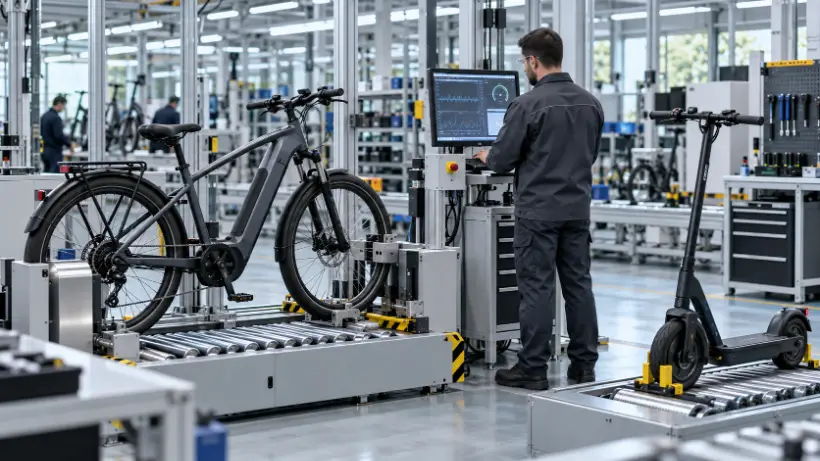
End-of-line testing sits between assembly and shipment. Its purpose is to detect assembly errors, incorrect settings and functional problems that may remain after normal production controls. It is not a substitute for design validation, certification or long-duration durability testing. Those programmes answer different questions and usually operate at different sample rates.
A useful production test must balance detection capability with cycle time. Adding every possible measurement can make the station slow, difficult to maintain and sensitive to normal variation. Removing too much can allow costly defects to pass. The right plan focuses on problems that the production process can create, the test station can identify reliably and the factory can act on immediately.
Define the Production Decision First
Start with a simple question: what must the station decide before this unit can move forward? The answer may include correct assembly, basic electrical function, controlled vehicle response, braking behavior, sensor operation or consistency with the approved product recipe. Write each decision in plain language before selecting instruments.
Define the boundary of the station as well. Some checks may already be completed at subassembly level, during software programming or at an earlier inspection point. Repeating them can create duplicate work without improving detection. Other risks only become visible after the complete vehicle is assembled and powered; these are stronger candidates for end-of-line testing.
Separate mandatory release checks from diagnostic measurements. A release check needs a controlled limit and a clear action. A diagnostic channel may help technicians understand a failure but does not have to control every product decision.
Select Test Items from Production Risk
Use process knowledge, defect history, design characteristics and customer requirements to identify what can go wrong between incoming components and final assembly. Rank issues by their impact, likelihood and ability to escape earlier controls. The list should be reviewed by quality, manufacturing, product engineering and service teams.
E-bikes and e-scooters share some possible checks, but their geometry, controls and operating behavior can differ. Do not assume that one acceptance sequence fits both. Define the product family, drive configuration, wheel range, brake system, sensors, controller software and market-specific settings covered by each recipe.
| Test group | Possible production decision | Planning questions |
|---|---|---|
| Identity and configuration | Correct model, software and recipe are loaded | How is the unit identified and matched to limits? |
| Functional response | Controls and sensors respond in the intended sequence | Which inputs and outputs must be observed? |
| Dynamic operation | Vehicle response is within an approved operating envelope | What speed, load, duration and stabilization are required? |
| Braking check | Brake actuation or response meets the production limit | How are force, speed, timing and safety controlled? |
| Electrical observation | Selected values or protections behave as expected | Which channels are measured, isolated and recorded? |
| Final inspection | No visible assembly or warning condition remains | What requires operator confirmation or image evidence? |
This table is a planning framework, not a universal test list. Final items and limits must come from the approved product and factory control plan. Certification tests should not be reduced to a short production check unless the applicable requirements and responsible engineering team explicitly define that relationship.
Build a Test Sequence That Exposes the Right Conditions
Arrange the sequence so that inexpensive and safe checks occur before powered or dynamic operation. Confirm identity, fixture position, communication and basic safety conditions before the vehicle is driven. If a unit fails an early prerequisite, the station should prevent later actions that could create risk or misleading data.
Define stabilization, ramp, measurement and stop phases for each dynamic step. A single target value is not enough. The control system needs to know how the product reaches the condition, when data becomes valid, how long it is evaluated and what causes an immediate stop.
Where operator actions are required, make them explicit and observable. The interface should identify the product, fixture state, next action and failure reason without forcing the operator to interpret raw engineering data. Diagnostic detail can remain available to authorized technicians.
Control Cycle Time, Flow and Model Changeover
Calculate the available station time from production demand, planned operating time and realistic availability. Include loading, securing, identification, automatic testing, unloading and any manual confirmation. The automatic sequence may be short while handling and changeover dominate the actual cycle.
A cycle-time target should not remove the stabilization or measurement window needed for a reliable decision. If the complete test cannot fit one station, compare alternatives: parallel stations, split test stages, earlier subassembly checks or risk-based sampling for selected engineering measurements. The chosen architecture should maintain clear product flow and failure containment.
For mixed production, document every physical and software change between models. Adjustable wheel supports, adapters and recipes can reduce changeover, but they also introduce setup risk. Use positive location, controlled adjustment and recipe verification so the station cannot apply the wrong limits to the wrong vehicle.
Design Fixtures Around Repeatability and Operator Work
Fixtures must position the vehicle consistently without damaging it or creating an unrealistic operating condition. Define wheelbase, tyre, deck or frame geometry, mass and contact restrictions across the full product range. Review cable routing, sensors, removable batteries and parts that may interfere with clamps or guards.
Repeatable positioning matters because fixture variation can appear as product variation. Establish datums, adjustment scales or verified positions for each recipe. If the station uses rollers, define alignment, contact condition and how the product is restrained safely. If the test applies controls or brakes automatically, define the interface and its adjustment range.
Operator ergonomics is part of cycle time and quality. Loading force, access, reach, confirmation steps and removal after a failed test should be reviewed with representative products. A fixture that is flexible but difficult to set can create more variation than it removes.
Plan Measurement, Limits and Traceability Together
List each measured channel, its purpose, useful range and relationship to the product decision. Separate control channels, acceptance channels and diagnostic channels. Define when the value is sampled, whether the result uses a peak, average, stable window or other approved calculation, and how invalid measurements are handled.
Pass/fail limits need ownership and revision control. Equipment suppliers can implement approved limits and logic, but the responsible product or quality team must define what constitutes an acceptable unit. Include warning zones only when they trigger a defined action.
Traceability may include unit ID, product recipe, software version, operator, timestamp, measured results, limit revision, station status and failure code. Decide what remains at the machine, what is exported and what connects to factory systems. Also define how offline operation, duplicate IDs and retests are controlled.
| Data element | Minimum definition | Common risk if omitted |
|---|---|---|
| Product identity | Unique ID and model or recipe | Results cannot be linked to the correct unit |
| Limit revision | Approved version applied to the test | Old and new acceptance rules become mixed |
| Measurement result | Value, unit, calculation window and status | A pass/fail result cannot be investigated |
| Failure code | Controlled reason and station step | Rework teams receive vague failure information |
| Retest record | Original result, action and authorized retest | Repeated testing can hide process problems |
Choose the Equipment Architecture and Prepare the RFQ
A shared platform can be efficient when e-bikes and e-scooters use compatible roller geometry, restraints, measurements and test logic. Derui’s two-in-one electric bicycle and scooter test bench provides a relevant starting point for discussing a combined performance-testing station. The final configuration still needs to be checked against the real vehicle range, production sequence and approved acceptance requirements.
Separate stations may be stronger when vehicle geometry, throughput, safety controls or test functions differ substantially. A modular solution can sit between these choices: a common control and data platform with product-specific fixtures or stations. Compare the options by detection capability, cycle time, changeover risk, maintenance, future variants and total production impact rather than machine count alone.
Use the E-Scooter Testing resource area for related application content, and review the EN 17128 e-scooter testing guide when that standard route is relevant. Keep compliance validation and end-of-line control clearly separated in the project documentation.
Information to Prepare Before Requesting a Proposal
- Product families and representative drawings
- Production volume and target station cycle time
- Approved release checks and acceptance limits
- Vehicle identity and recipe-selection method
- Wheel, wheelbase, tyre, frame and mass ranges
- Required speed, load and operating sequence
- Control, brake and sensor interfaces
- Measurement channels and calculation rules
- Failure response, stop logic and safety needs
- Changeover method and operator workflow
- Result storage, reports and factory connections
- Calibration, FAT and site acceptance criteria
- Utilities, footprint and line-integration constraints
- Known future product variants
Before release, test the station with representative good units, known defects and boundary variants. Factory acceptance should verify mechanics, recipes, measurements, stop logic, data records and the full operator workflow. Site acceptance should confirm utilities, integration and actual production conditions.
A practical end-of-line plan is selective, measurable and connected to factory action. When the decision, sequence and data are defined first, the equipment specification becomes clearer and quotations become easier to compare.
Planning an e-bike or e-scooter end-of-line test station?
Send Derui your product drawings, production flow, target cycle time, required checks, limits and data needs. Our team can review the application and prepare a technical configuration for discussion.
Application note
This article provides equipment-planning guidance. Product release criteria, test limits and compliance decisions must be approved by the responsible engineering and quality teams against the applicable product, market and controlled documents.