Derui chamber
Bicycle Frame Testing Equipment Buyer’s Guide
How to Choose a Bicycle Frame Fatigue Test Machine: 10 Questions Before You Buy
The right bicycle frame test system is not the machine with the highest force rating or the longest feature list. It is the system that can reproduce your test standard, accommodate your frame geometries, and produce results your engineering team can trust.
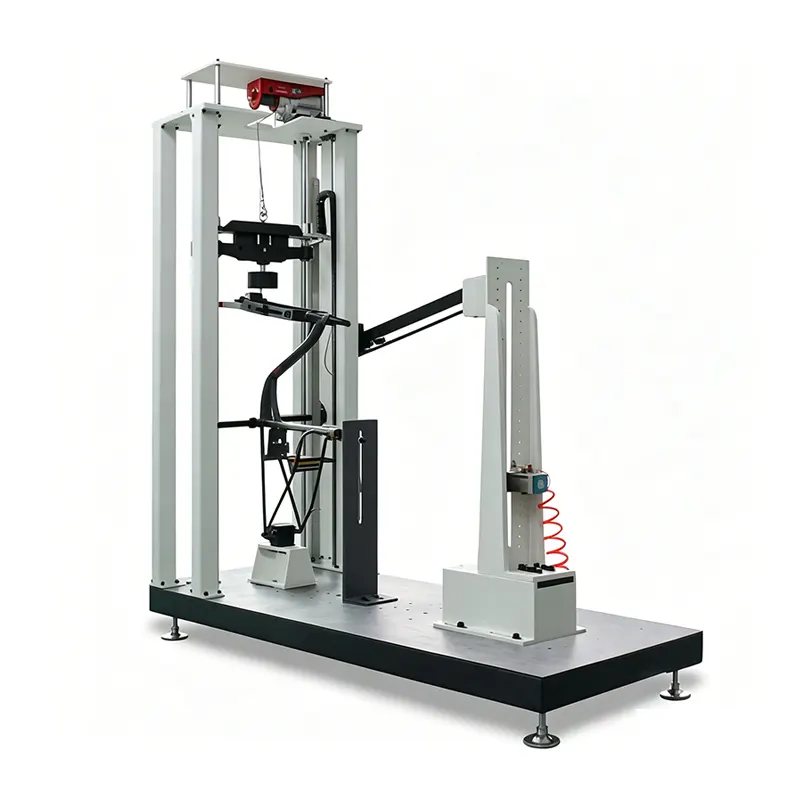
Buying a bicycle frame fatigue test machine can be difficult because quotations often describe very different systems with similar names. One supplier may propose a single-axis pedalling fatigue tester, another a multi-axis frame test bench, and a third a drop-impact platform. All three may be called “bicycle frame testing equipment,” although they solve different engineering problems.
Before requesting quotations, answer the following ten questions. They will help you define the test scope, compare equipment suppliers on the same technical basis, and identify gaps before the machine reaches your quality assurance laboratory.
1. What are you trying to validate?
Start with the engineering decision the test must support. “We need to test a bicycle frame” is too broad for an equipment specification.
A durability programme may verify a carbon fiber or aluminum frame design before tooling approval, evaluate the life of a seat post clamp, reproduce road-induced forces on an e-bike, compare frame suppliers, screen production samples, investigate a field failure, or generate evidence for conformity assessment.
These objectives require different equipment and instrumentation. Production screening may prioritize fast setup and clear pass/fail logic. R&D may require adjustable dynamic load profiles, more sensor channels, and raw-data export. A third-party laboratory may place greater emphasis on traceability and documented method control.
Write one sentence defining the machine’s purpose. For example: “The system shall perform repeatable pedalling, horizontal, and vertical frame fatigue tests on our current and planned mountain bike and e-bike platforms.”
2. Which standard, method, and edition apply?
Do not purchase equipment based only on a standard number in a brochure. Confirm the product scope, target market, edition, and relevant clauses with your compliance team or test laboratory.
ISO describes ISO 4210-6:2023 as the mandatory safety requirements and fatigue test procedures for bicycle frames and forks. It covers pedalling fatigue, horizontal fatigue, vertical fatigue, and drop-impact evaluations. Ensure your equipment covers the specific clauses required for your bike categories (City, Trekking, MTB, Road, EPAC E-Bikes).
Mapping your required test clauses before equipment selection prevents purchasing a machine that lacks required force vectors or stroke range:
| RFQ Field | What to Record |
|---|---|
| Market & Product Scope | Target countries, bicycle category (City, Trekking, MTB, Racing, E-Bike), and maximum rider weight |
| Method Standard | Full standard reference (ISO 4210-6, EN 15194, ANSI Z315.1), edition, and clause numbers |
| Sample & Dynamic Inputs | Complete frame, front fork, or seat post; load vectors, dynamic frequency, displacement, and cycle counts |
| Duration & Failure Criteria | 50,000 or 100,000 cycles; maximum allowable stiffness loss (< 5%) or displacement threshold (< 10 mm) |
3. Do you need a component tester, a complete-frame bench, or a multi-function system?
Component testers apply controlled forces or displacements to the seat post, handlebar, fork, or crank arm. They suit methods requiring a defined load direction, sine waveform, and dynamic cycle count.
Complete-frame test benches mount an assembled frame against bottom-bracket, head-tube, and rear-dropout fixtures. They expose complex strain distributions across top-tube, down-tube, and chain-stay welds that may not appear in an isolated component test. Discover our specialized Bicycle Saddle Fatigue Testing Machine ISO 4210 Compliant.
Multi-function systems can be highly economical when methods share a compatible frame, actuator, and controller. Explore our Bicycle Multi-functional Impact and Drop Test Machine to see how combined impact and drop evaluations are integrated.
4. What product frame envelope must the equipment cover?
Define the smallest and largest bicycle frames expected during the machine’s useful life, but avoid extreme capacity “just in case.” Excess capacity can increase cost and may reduce control resolution at the low load end.
- Overall frame dimensions, rear dropout spacing, and head tube diameter
- Frame materials (Aluminum alloy, Carbon fiber composite, Steel, Titanium)
- Bottom bracket shell width and crank axle thread dimensions
- Seat tube diameter and maximum seat post extension height
- E-bike battery housing geometry, motor bracket location, and center-of-gravity
Provide dimensioned drawings or CAD data where possible. For e-bike frame fatigue testing, explore our Two-in-One Electric Bicycle and Scooter Test Bench.
5. Which control ranges actually matter?
Catalogue maximums do not tell the whole story. Review the usable range, resolution, and closed-loop control performance at normal test points. Key variables include dynamic force (0–5 kN / 0–10 kN), actuator stroke, cycle frequency (1–10 Hz), waveform, and cycle count.
Ask suppliers to map every required test point to the proposed actuator, motor, load cell, and sensor ranges. A load cell sized far above the normal force will not deliver required resolution. Continuous operation near maximum limits reduces long-term equipment robustness.
The quotation should distinguish between adjustable settings, controlled variables, and measured values. A commanded load on an HMI screen is not proof that dynamic force remained within ISO tolerance throughout 100,000 cycles.
6. How will fixtures reproduce intended boundary conditions?
Fixtures are a core part of the measurement system, not an accessory to consider at the end. Review mounting points, actuator alignment, permitted axial movement, prevention of specimen slip, fixture stiffness, geometry adjustment, and safe operator access.
For configurable equipment, request a fixture list that identifies what is included, optional, or required for future frame models. A convenient clamp that alters specimen stiffness can create a repeatable but completely unrepresentative test.
7. What must the system detect, record, and export?
Start with the engineering decisions you will make from the data. A basic quality screening test may need cycle count, elapsed time, and stop reason. Advanced R&D requires dynamic force, displacement, stiffness loss, temperature, and crack interlocks.
- Sensor type, measurement range, and calibration accuracy (±0.5% full scale)
- Data sampling rate (up to 1,000 Hz for dynamic impact peaks)
- Live force-displacement trend curves and automatic alarm thresholds
- Automatic stop upon 5% stiffness drop or crack initiation
- Export formats (CSV raw data, Excel summary, automated PDF test certificates)
- Power-loss data recovery and automatic test sequence resumption
8. How will measurement confidence be demonstrated?
Reliable results depend on more than brochure accuracy. Ask how the measurement chain will be calibrated and verified, including load sensors, signal conditioners, DAQ hardware, and software software routines.
ISO explains that ISO/IEC 17025 accreditation helps testing and calibration laboratories demonstrate technical competence and generate valid, globally traceable results.
Discuss calibration scope, points across the working range, on-site verification checks, recommended calibration intervals, and repeatability evidence. A calibration certificate supports measurement confidence, but it does not validate an uncalibrated fixture setup.
9. What must be proven during Factory Acceptance Testing (FAT)?
A Factory Acceptance Test (FAT) turns purchase specifications into verifiable dynamic evidence before equipment shipment. Agree on FAT criteria before machine design is finalized.
- Confirm the complete machine, fixture, actuator, and accessory list.
- Check physical dimensions with representative customer bicycle frames.
- Verify safety interlocks, physical guards, and emergency stop buttons.
- Verify agreed operating points (e.g. 1,200 N pedalling load at 3 Hz).
- Run a continuous 2-hour dynamic fatigue trial on a test sample.
- Simulate automatic stops for frame crack, pressure drop, and over-deflection.
- Review dynamic data recording, PDF report generation, and CSV export.
- Demonstrate quick fixture changeovers between Road and MTB frame geometries.
- Review operation manuals, electrical schematics, calibration certificates, and critical spare parts.
10. What will it take to operate the machine after delivery?
Review laboratory footprint, floor load-bearing capacity, electrical power supply (220V/380V), compressed air volume, noise levels, safety guarding, and maintenance clearances. Confirm installation responsibility, operator training, preventive maintenance contracts, critical spare parts, and warranty coverage.
For international laboratory projects, confirm English software documentation, remote diagnostic capabilities, time-zone support, and sensor replacement plans.
A Practical Bicycle Frame Test Machine RFQ Checklist
- Test objective, expected sample throughput, and laboratory location
- Target markets, standards (ISO 4210-6, EN 15194, ANSI), and specific clauses
- Bicycle frame CAD files, drawings, materials, and dimension ranges
- Minimum and maximum frame sizes and rear dropout widths
- Required dynamic loads (N), strokes (mm), frequencies (Hz), and cycles
- Measurement sensors, automated PDF reporting, and CSV data exports
- Universal fixture and fast changeover requirements
- Facility utilities (power, compressed air, floor space)
- Calibration certificates and ISO/IEC 17025 traceability expectations
- FAT samples, acceptance criteria, and engineer training expectations
Providing this detailed information in your RFQ allows Derui Tester application engineers to quote the exact required scope, eliminating costly engineering changes later.
Which Bicycle Frame Testing System Should You Choose?
Choose the test system that demonstrates a direct line from the applicable ISO 4210-6 clause to the final test result:
Standard Requirement → Universal Fixture → Closed-Loop Actuator → Real-Time DAQ → Automatic Crack Stop.
Derui Tester develops configurable equipment for bicycle component and complete-frame testing. Relevant starting points include our Bicycle & Frame Testing Equipment catalog, or read more on our Bicycle Testing Technical Resources. The final machine configuration should be reviewed against your exact sample geometry and compliance requirements.
Get a Custom Test Bench Configuration Based on Your Standard
Send your frame drawing, applicable standards, sample dimensions, required dynamic loads, and laboratory requirements to Derui Tester for a customized engineering proposal.
References & Standards
- ISO 4210-6:2023 – Cycles — Safety requirements for bicycles — Part 6: Frame and fork test methods.
- EN 15194:2017 – Cycles — Electrically power assisted cycles — EPAC Bicycles.
- ISO/IEC 17025:2017 – General requirements for the competence of testing and calibration laboratories.