Derui chamber
E-Scooter Safety & Durability Test Guide
EN 17128 & EN 14619 E-Scooter Safety Testing: Key Standards & Test Bench Selection Guide
A practical requirements guide for selecting electric scooter durability testing equipment, covering EN 17128 and EN 14619 stem fatigue, folding mechanism strength, dynamic obstacle tests, and laboratory selection criteria.
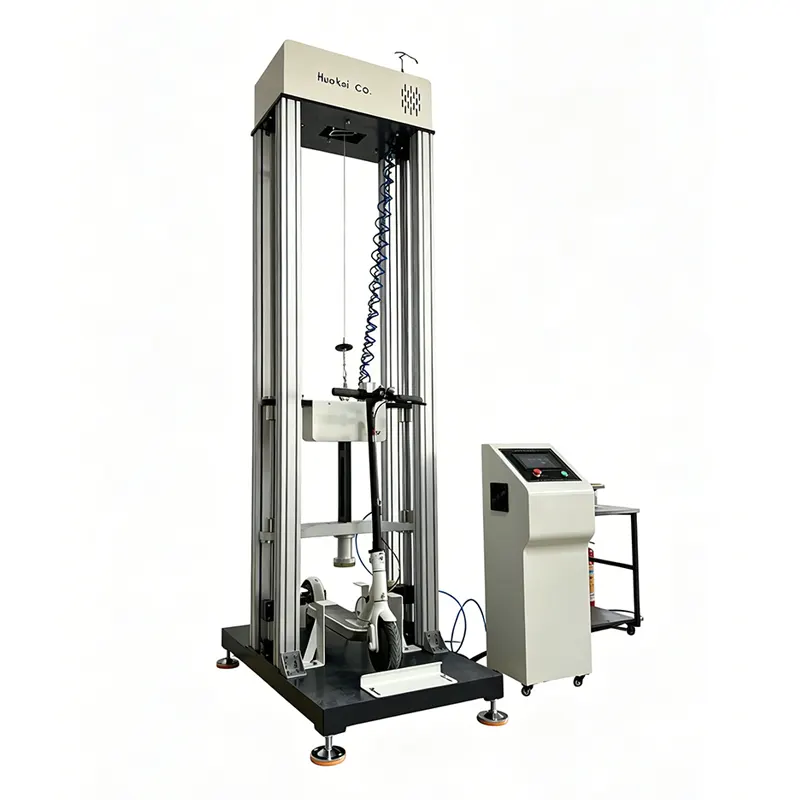
Electric scooters (PLEVs) have rapidly become a primary mode of urban personal mobility worldwide. However, structural failures—such as handlebar stem snapping or folding mechanism latch release during riding—pose severe safety hazards and can lead to costly product recalls.
To ensure structural integrity and market compliance, European standards BS EN 17128:2020 and EN 14619 specify mandatory physical and mechanical fatigue test methods for electric and kick scooters. This guide outlines key EN 17128 test clauses, dynamic load parameters, and equipment selection criteria for R&D and quality control laboratories.
1. What are you trying to validate?
Start with the specific engineering decision the test must support. “We need to test an electric scooter” is too broad for an equipment specification.
A durability programme may verify a new folding mechanism latch before tooling approval, evaluate handlebar stem fatigue under dynamic rider push-pull loads, reproduce road bump impact on a complete chassis, compare frame suppliers, or generate conformity assessment evidence for CE/EN 17128 certification.
Write a clear sentence defining the machine’s purpose. For example: “The system shall perform repeatable EN 17128 handlebar stem fatigue tests and complete-vehicle dynamic obstacle durability runs on our commercial e-scooter models.”
2. Which standards, methods, and clauses apply?
Do not purchase equipment based only on a standard number in a brochure. Confirm product scope, target country, edition, and relevant clauses with your compliance team or laboratory.
EN 17128:2020 applies to Personal Light Electric Vehicles (PLEVs). Key structural clauses require dynamic fatigue evaluation of the steering column, front fork assembly, deck chassis, and folding mechanism locking latches.
EN 14619 & ASTM F2264 cover non-powered and light scooters, specifying front impact drop tests and handlebar push-pull fatigue limits:
| Standard Code | Target Component | Dynamic Input / Load | Cycles / Criteria |
|---|---|---|---|
| EN 17128 Clause 14.2 | Handlebar Stem & Steering Column | Alternating Push-Pull Load (±250 N to ±500 N) | 100,000 cycles without fracture or crack |
| EN 17128 Clause 14.5 | Folding Mechanism Latch | Repeated Latching Force & Dynamic Torque | 10,000 operation cycles without latch failure |
| EN 14619 / ASTM F2264 | Front Fork & Wheel Impact | Drop Weight Impact (135 J) & Front Obstacle Strike | No permanent deformation exceeding limits |
| EN 17128 Clause 14.8 | Complete Vehicle Chassis | Roller Drum with Slats / Obstacles (15–25 km/h) | 100 km to 300 km continuous road-load run |
3. Do you need a component tester, a complete-vehicle bench, or a multi-function system?
Component testers apply controlled dynamic forces to the stem, handlebar, or folding joint. They suit methods requiring precise sine wave load cycles and high force accuracy. Explore our dedicated Scooter Stem Fatigue Test Machine EN 14619 ASTM F2264.
Complete-vehicle roller benches run an assembled e-scooter on roller drums with metallic cleats or obstacles. They expose real-world interactions between the frame, deck, battery housing, folding joint, bearings, and electronic controllers.
Multi-function platforms integrate both structural fatigue and electrical powertrain evaluation into a single bench. Discover our Two-in-One Electric Bicycle and Scooter Test Bench for complete mobility testing.
4. What product frame envelope must the equipment cover?
Define the smallest and largest scooters expected during the machine’s useful life:
- Wheelbase range and wheel diameter (8-inch, 10-inch, 12-inch pneumatic or solid tires)
- Handlebar height and stem adjustment range
- Vehicle mass and maximum payload (e.g. up to 120 kg or 150 kg rider weight)
- Folding latch design and deck clamping interface
Provide dimensioned CAD drawings. For complete-vehicle benches, confirm how rider ballast load is applied to the foot deck and handlebars.
5. Which control ranges actually matter?
Review usable control ranges rather than catalogue maximums. Variables include actuator dynamic force (0–2 kN / 0–5 kN), stroke length (±100 mm), frequency (1–5 Hz), roller speed (0–30 km/h), cleat obstacle height (5 mm to 15 mm), and cycle counts.
Ask suppliers to map required test points to proposed actuators, dynamic load cells, and motors. Operating near equipment limits continuously reduces operational reliability.
6. How will fixtures reproduce intended boundary conditions?
Fixtures are a core part of the measurement system. Review mounting rigidity, steering tube locking, deck clamping, actuator alignment, and changeover time between different scooter models.
A clamp that restricts natural stem flex can create a repeatable test that is completely unrepresentative of real road stresses.
7. What must the system detect, record, and export?
A basic endurance test needs cycle count, elapsed distance, speed, and stop reason. Advanced development requires dynamic force-displacement curves, temperature, and crack interlocks.
- High-precision load cell (±0.5% full scale accuracy)
- Live force and displacement trend monitoring
- Automatic stop upon 5% stiffness loss or lock latch disengagement
- Export formats (CSV raw data, Excel summary, automated PDF reports)
8. How will measurement confidence be demonstrated?
Demonstrating measurement accuracy is essential for CE marking and ISO accreditation. ISO explains that ISO/IEC 17025 accreditation supports laboratory competence and measurement traceability.
Derui Tester provides factory calibration certificates, dynamic load cell traceability, and annual maintenance contracts for all delivered laboratory systems.
9. What must be proven during Factory Acceptance Testing (FAT)?
Agree on measurable FAT criteria before equipment shipment:
- Confirm full equipment, fixture, actuator, and safety guard list.
- Check dimensions with customer scooter samples.
- Verify interlocks, safety enclosures, and emergency stop functions.
- Run a continuous 2-hour dynamic fatigue trial at EN 17128 load parameters.
- Simulate automatic shut-off upon sample failure or force drop.
- Verify software reporting, CSV data export, and calibration documentation.
10. What will it take to operate the machine after delivery?
Review lab footprint, floor loading, 220V/380V power, compressed air requirements, noise isolation, operator training, critical spare parts, and warranty terms.
E-Scooter Test Machine RFQ Checklist
- E-scooter models to test (Commuter, Heavy-duty, Sharing fleet)
- Applicable standards (EN 17128, EN 14619, ASTM F2264, UL 2272)
- Scooter CAD files, stem dimensions, and folding mechanism drawings
- Required loads (N), speeds (km/h), frequencies (Hz), and cycles
- Data acquisition, automated PDF reporting, and CSV raw data exports
- Facility space, power supply, and compressed air availability
- Calibration certificates and FAT sample requirements
Providing this information in your RFQ allows Derui Tester engineers to configure an accurate, cost-effective test rig for your facility.
Which E-Scooter Testing System Should You Choose?
Select the test system that demonstrates a direct line from the applicable requirement to the test result:
Standard Requirement → Representative Fixture → Controlled Dynamic Input → Verified Measurement → Defined Acceptance.
Explore our complete E-Scooter Testing Machines catalog, read our E-Scooter Testing Technical Articles, or return to Derui Tester Homepage for customized solutions.
Get a Custom Quote for Your EN 17128 Test Machine
Send your e-scooter drawing, applicable standard, and laboratory requirements to Derui Tester. Our engineering team will provide a technical proposal within 24 hours.
References & Standards
- BS EN 17128:2020 – Light motorized vehicles for the transportation of persons and goods (PLEV).
- EN 14619:2019 – Roller sports equipment — Kick scooters — Safety requirements.
- ISO/IEC 17025:2017 – General requirements for the competence of testing and calibration laboratories.