Derui chamber
Scooter Standards Decision Guide
EN 14619 vs EN 17128: Which Scooter Standard Applies?
The fastest way to choose between these standards is to identify how the scooter is propelled, who it is designed for and whether its design falls within the stated scope and exclusions.
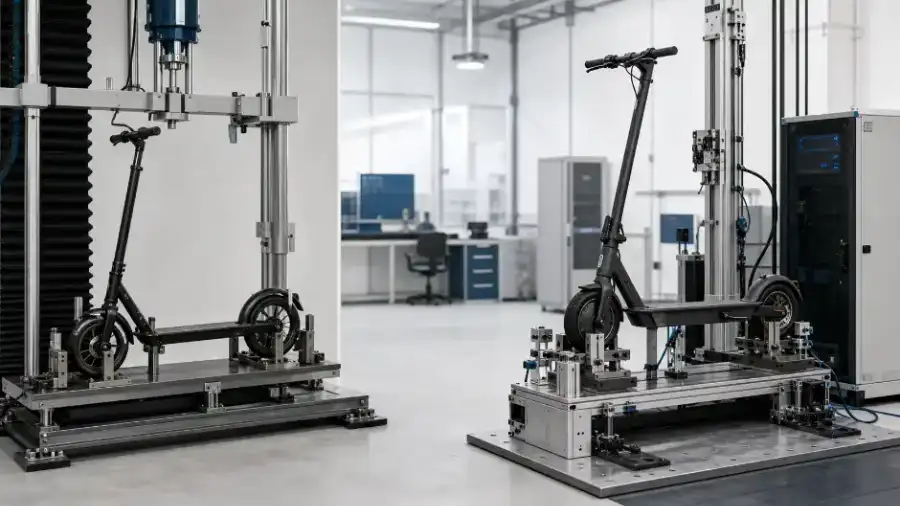
Mechanical kick scooters and personal light electric vehicles begin with different scope decisions. Confirm the product classification before defining tests or buying equipment.
Manufacturers often search for a simple “kick scooter standard” or “e-scooter standard.” The difficult part is not finding a number; it is confirming that the product actually belongs inside that standard’s scope. A wrong decision at this stage can produce the wrong test list, unsuitable fixtures and evidence that does not answer the market-access question.
EN 14619 vs EN 17128 at a glance
| Decision point | EN 14619:2019 | EN 17128 / BS EN 17128:2020 |
|---|---|---|
| Product family | Roller sports equipment — kick scooters | Personal light electric vehicles (PLEVs) |
| Primary propulsion | Muscular activity only | Self-contained electric power source |
| Typical example | Adult or youth non-powered kick scooter | Standing electric kick scooter within the standard’s scope |
| User / energy scope | Intended for users above 20 kg and below 100 kg | Electrical system up to 100 VDC; optional integrated charger input up to 240 VAC |
| Key exclusions to screen | Toy scooters intended for users of 20 kg or less require a different route | Includes exclusions for certain seated vehicles, competition vehicles, EPACs, medical vehicles, vehicles above 25 km/h design speed and other listed categories |
| Test-planning emphasis | Mechanical safety, construction, performance, marking and user information | Mechanical and functional safety plus electric drive, controls, energy and electrical-related requirements within scope |
The table is a screening tool, not a substitute for the licensed standards. Use the exact edition adopted in the destination market and record the clause-level requirements that apply to the actual product.
When does EN 14619 apply?
EN 14619:2019 covers safety requirements and test methods for kick scooters propelled only by muscular activity. Its stated user-mass range is more than 20 kg and less than 100 kg. The propulsion language matters: a conventional kick scooter does not become a PLEV simply because it resembles an electric scooter frame.
For equipment planning, EN 14619 points toward a predominantly mechanical programme. Depending on the applicable clauses and product construction, the laboratory may need to evaluate components such as steering, deck, wheels, folding or locking mechanisms, braking and overall durability, along with markings and instructions. Exact loads, cycles, conditioning and acceptance criteria must come from the licensed standard and the agreed test plan.
If the product is intended for a child weighing 20 kg or less, do not simply apply EN 14619 with reduced loads. That classification can move the product into toy-safety requirements, which changes both the compliance route and test programme.
When does EN 17128 apply?
BSI describes BS EN 17128:2020 as a requirements-and-test-method standard for personal light electric vehicles, with or without self-balancing, that are not subject to type approval for on-road use. The scope includes vehicles with a self-contained power source up to 100 VDC and an optional integrated charger input up to 240 VAC.
A standing commuter e-scooter may therefore be a candidate, but “it has a motor” is not enough. The scope also contains exclusions. Examples listed by BSI include vehicles without self-balancing that have a seat, vehicles designed for competition, electrically powered assisted cycles, medical vehicles, products with a maximum design speed above 25 km/h, higher-voltage products and vehicles without an onboard operator.
Because the product contains an electric drive system, the programme extends beyond mechanical durability. BSI’s overview identifies subjects including structural integrity, braking, electrical components, driving-power management, speed limitation, energy storage, marking and user instructions. The exact set of applicable requirements depends on the product and clause review.
A practical standard-selection path
- Define the product: propulsion, rider position, intended user, maximum design speed, voltage, charger arrangement and intended environment.
- Define the market: destination countries, sales channel and intended public-road or private-area use.
- Check scope and exclusions: use the current national adoption and document why it applies.
- Map requirements by clause: identify tests, inspections, calculations, markings and technical documentation.
- Confirm with a competent laboratory or compliance specialist: resolve edge cases before tooling or test-equipment purchase.
How do the test programmes differ?
Both routes can require mechanical evaluation, but their risk models are not identical. A muscular kick scooter programme is centered on the safety and durability of the physical product during rider-powered use. A PLEV programme must also address risks created by powered propulsion and associated electrical and control systems.
| Workstream | Mechanical kick scooter | Electric PLEV |
|---|---|---|
| Product definition | User mass, geometry, folding arrangement and intended use | Vehicle architecture plus speed, voltage, control system, battery and charger |
| Mechanical validation | Structure, steering, deck, wheel, brake and folding-related evaluations as applicable | Structural integrity, steering, brake, folding and complete-vehicle behaviour as applicable |
| Powered functions | Not applicable to a muscular-only product | Drive control, speed limitation, power management and fault behaviour as applicable |
| Electrical considerations | Normally outside the core product concept | Electrical components, energy storage and charging-related requirements within the applicable scope |
| Evidence package | Test reports, inspection records, marking and instructions | Mechanical and electrical test records, software/control evidence where applicable, marking and instructions |
A laboratory should not copy parameter values from a blog or supplier brochure. The controlled inputs, tolerances, sample conditioning, number of specimens and pass/fail criteria must be traceable to the applicable edition and project test matrix.
Turn the standard decision into an equipment specification
Do not begin an RFQ with “one EN 17128 tester” or “one EN 14619 machine.” Neither standard describes a single universal machine. Start with a clause matrix and group methods by sample, fixture, controlled input and measurement.
| Equipment question | Information to provide | Why it matters |
|---|---|---|
| Sample envelope | Wheelbase, wheel size, stem height, mass, folding geometry and drawings | Determines frame size, adjustment and fixture interfaces |
| Test inputs | Applicable clause, force, displacement, torque, speed, frequency, obstacles and duration | Determines actuator, drive and control ranges |
| Measurements | Force, travel, speed, cycle count, temperature, stop reason and export needs | Determines sensors, channels, sampling and reports |
| Acceptance | Pass/fail criteria, automatic stop logic, calibration and FAT evidence | Makes the quotation and final acceptance verifiable |
Relevant Derui starting points include the Scooter Stem Fatigue Test Machine, Scooter Folding Mechanism Fatigue Test, Scooter Handlebar Fatigue Testing and Scooter Dynamic Durability Test Machine. Final configuration must be reviewed against the applicable clauses, specimen and acceptance requirements.
What to send with your scooter test-equipment RFQ
- Target markets and intended use
- Product type and propulsion method
- Maximum design speed and system voltage
- Intended user mass or payload
- Standard edition and clause matrix
- Dimensioned drawings or CAD files
- Sample sizes and model range
- Required test inputs and measurements
- Data export and report expectations
- Calibration and FAT requirements
Products that need additional scope review
Pause the equipment decision when the product is child-oriented, seated, unusually fast, high voltage, designed for competition, marketed for medical use, intended to carry goods, self-balancing or able to operate in more than one mode. These characteristics may trigger exclusions, other standards or market-specific legislation.
A dual-mode product should not be assigned two standards merely because both names appear relevant. Document its intended function and reasonably foreseeable use, then obtain a product-specific classification. The result may involve more than one standard, but that conclusion should come from a structured requirements assessment rather than keyword matching.
Frequently asked questions
If an e-scooter is switched off, does EN 14619 apply?
Not automatically. Classification is based on the product’s design, intended propulsion and use, not its temporary operating state. An electric drive remains part of the product when switched off.
Is EN 17128 compliance enough to sell an e-scooter in Europe?
Not by itself. A standard can provide test methods and support technical evidence, but applicable product legislation, national requirements and road-use rules must also be assessed for each market.
Can one test machine cover both standards?
Some mechanical methods may share a configurable load frame, controller or measurement system. Fixtures, boundary conditions, ranges and evidence requirements can still differ. Confirm coverage against a clause-by-clause matrix.
Should we buy equipment before the standard review is complete?
No. Complete the product classification and preliminary clause matrix first. It is less expensive to resolve scope questions before machine capacity, fixtures and instrumentation are fixed.
Need a clause-based scooter test configuration?
Send Derui your product drawing, propulsion type, target market, design speed, voltage, intended user and proposed standard or clause list. An application engineer can review the required fixtures, controls, measurements and FAT scope with you.
Sources and edition note
- NSAI — I.S. EN 14619:2019, scope and publication information.
- BSI — BS EN 17128:2020, scope, exclusions and subject overview.
Standards and national adoptions may be revised. Verify the current edition and applicable legal requirements at the start of each project. This guide is for test-planning information and is not legal or certification advice.