Derui chamber
E-Scooter Testing Equipment Buyer’s Guide
How to Choose an E-Scooter Durability Test Machine: 10 Questions Before You Buy
The right test system is not the machine with the highest load or the longest feature list. It is the system that can reproduce your method, accommodate your products and produce results your engineering team can trust.
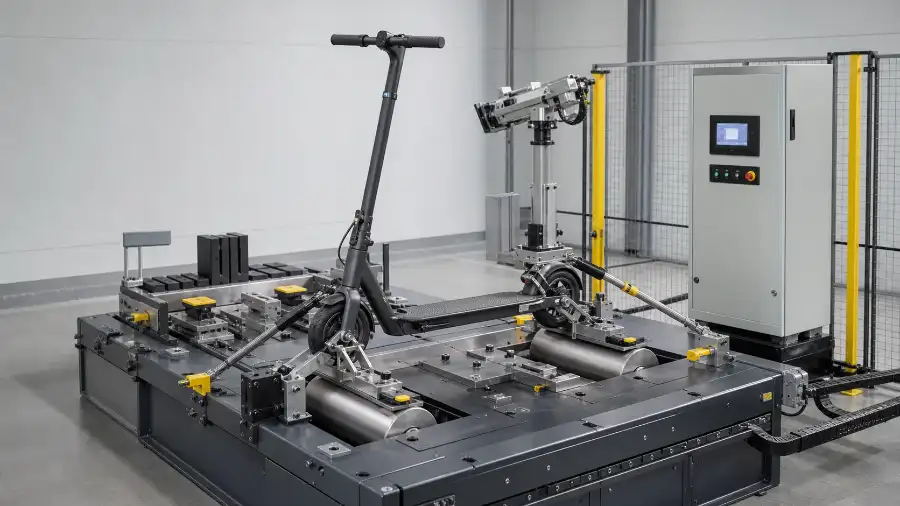
Buying an e-scooter durability test machine can be difficult because quotations often describe very different systems with similar names. One supplier may propose a complete-vehicle roller bench, another a servo-actuated component tester, and a third a multi-function platform. All three may be called “scooter durability testing equipment,” although they solve different problems.
Before requesting quotations, answer the following ten questions. They will help you define the test scope, compare suppliers on the same basis and identify gaps before the machine reaches your laboratory.
1. What are you trying to validate?
Start with the engineering decision the test must support. “We need to test an electric scooter” is too broad for an equipment specification.
A durability programme may verify a frame or steering design before tooling approval, evaluate the life of a folding mechanism, reproduce road-induced loads on a complete vehicle, compare suppliers, screen production samples, investigate a field failure or generate evidence for conformity assessment.
These objectives require different equipment and instrumentation. Production screening may prioritize fast setup and clear pass/fail logic. R&D may require adjustable load profiles, more sensor channels and raw-data export. A third-party laboratory may place greater emphasis on traceability and documented method control.
Write one sentence defining the machine’s purpose. For example: “The system shall perform repeatable complete-vehicle road-load durability tests on our current and planned commuter scooter platforms.”
2. Which standard, method and edition apply?
Do not purchase equipment based only on a standard number in a brochure. Confirm the product scope, target market, edition and relevant clauses with your compliance team or test laboratory.
BSI describes BS EN 17128:2020 as a requirements and test-method standard for personal light electric vehicles within a defined scope. It covers areas including structural integrity, braking, electrical components, driving power management and marking. BSI also lists exclusions, so not every powered scooter automatically falls within its scope.
The UK Department for Transport’s construction-standards research illustrates why the test list must be mapped before equipment selection: structural integrity is not one test. Static loading, impact and other evaluations can act on different parts of the vehicle.
| RFQ field | What to record |
|---|---|
| Market and product | Target countries, vehicle type, intended use and maximum design speed |
| Method | Full standard reference, edition, clause or internal test identifier |
| Sample and inputs | Complete vehicle or component; load, displacement, speed, frequency, impact or obstacle profile |
| Duration and result | Time, distance or cycles; measurements and acceptance criteria |
3. Do you need a component tester, a complete-vehicle bench or both?
Component testers apply controlled forces or displacements to the stem, handlebar, frame, fork or folding mechanism. They suit methods requiring a defined direction, waveform and cycle count. Fixtures and actuator alignment are central to the result.
Complete-vehicle benches run an assembled scooter against rollers, obstacles or a simulated road profile. They can expose interactions between the frame, wheels, bearings, suspension, fasteners and steering assembly that may not appear in an isolated component test.
Multi-function systems can be economical when methods share a compatible frame, actuator and controller. Ask how long changeover takes, which sensors are used for each setup and how alignment is verified. A practical laboratory may combine controlled component fatigue tests with a complete-vehicle bench.
4. What product envelope must the equipment cover?
Define the smallest and largest products expected during the machine’s useful life, but avoid extreme capacity “just in case.” Excess capacity can increase cost and may reduce control quality at the low end.
- Overall dimensions, wheelbase and wheel diameter
- Vehicle mass and maximum permissible payload
- Handlebar and stem adjustment range
- Folding and locking arrangement
- Suspension travel and ground clearance
- Battery, motor and sensitive-component locations
Provide dimensioned drawings or CAD data where possible. For complete-vehicle tests, confirm how rider load is represented and applied. For component tests, identify real interfaces and boundary conditions.
5. Which control ranges actually matter?
Catalogue maximums do not tell the whole story. Review the usable range, resolution and control performance at normal test points. Variables may include force, torque, actuator stroke, speed, frequency, waveform, roller diameter, obstacle geometry, cycle count and temperature.
Ask suppliers to map every required test point to the proposed actuator, motor, load cell and sensor ranges. A load cell sized far above the normal load may not deliver the needed resolution. Operating continuously near a limit can reduce robustness.
The quotation should distinguish between adjustable settings, controlled variables and measured values. A speed shown on the HMI is not necessarily independently measured, and a commanded load is not evidence that the load remained within tolerance.
6. How will fixtures reproduce the intended boundary conditions?
Fixtures are part of the measurement system, not an accessory to consider at the end. Review mounting points, actuator alignment, permitted movement, prevention of slip, fixture stiffness, geometry adjustment, setup references, changeover time and safe access.
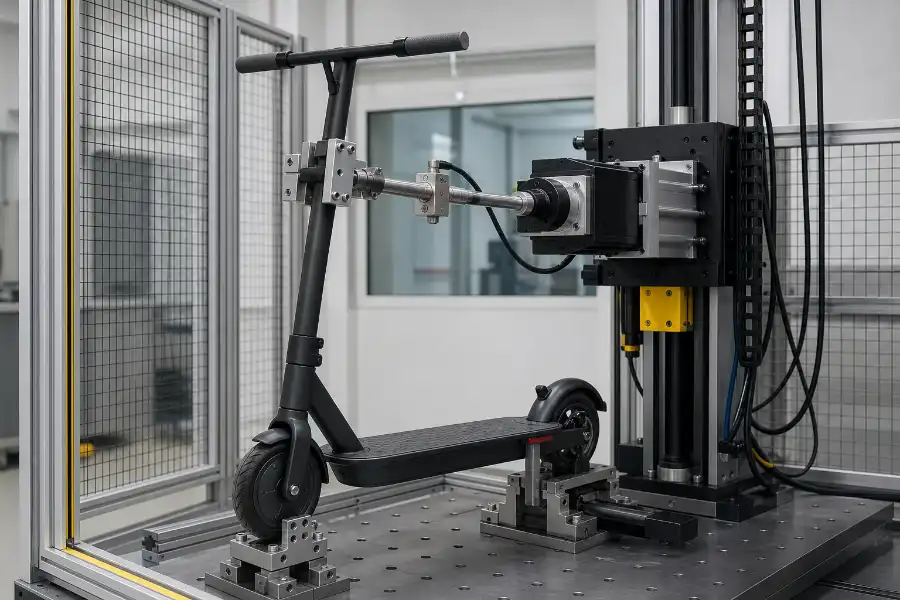
For configurable equipment, request a fixture list that identifies what is included, optional or required for future models. If fixtures will be made locally, agree on interface drawings, allowable loads and interlocks. A convenient clamp that changes specimen stiffness can create a repeatable but unrepresentative test.
7. What must the system detect, record and export?
Start with the decisions you will make from the data. A basic endurance test may need cycle count, elapsed time, operating speed and stop reason. Development work may also require force, displacement, torque, temperature or vibration.
- Sensor type, range and accuracy
- Sampling and recording intervals
- Live trends and alarm thresholds
- Raw and processed export formats
- Sample, operator and programme identification
- Automatic stop and power-loss recovery behaviour
- Programme change history, reports and access levels
If MES or LIMS integration is required, specify the interface and fields in the RFQ. “Supports data export” may mean only manual spreadsheet download, not automated result transfer.
8. How will measurement confidence be demonstrated?
Reliable results depend on more than catalogue accuracy. Ask how the measurement chain will be verified, including sensors, signal conditioning, software and fixtures where relevant.
ISO explains that ISO/IEC 17025 helps testing and calibration laboratories demonstrate competence and generate valid results. Even if an internal laboratory is not accredited, the same purchasing mindset is useful: define traceability, verification intervals, reference equipment and records.
Discuss calibration scope, points across the working range, on-site checks, recommended intervals, correction data, sensor replacement and repeatability evidence. A calibration certificate supports measurement confidence, but it does not by itself validate the complete test method.
9. What must be proven during factory acceptance?
A factory acceptance test (FAT) turns the purchase specification into observable evidence before shipment. Agree it before machine design is finalized.
- Confirm the machine, fixture and accessory list.
- Check dimensions with representative samples.
- Verify guards, interlocks and emergency stops.
- Verify agreed operating points.
- Run a representative programme.
- Simulate alarms, sample failure and automatic stopping.
- Review data recording, exports and reports.
- Demonstrate fixture changeover.
- Review manuals, drawings, certificates and spares.
Define FAT samples, responsibilities, evidence and deviation closure. Video acceptance is useful, but should not replace measurable criteria.
10. What will it take to operate the machine after delivery?
Review footprint, floor loading, electrical supply, compressed air, ventilation, cooling, noise, guarding and maintenance clearances. Confirm installation responsibility, operator training, preventive maintenance, critical spares, remote diagnostics, software terms and warranty scope.
For international projects, confirm language, time-zone support, travel responsibilities and the replacement plan for sensors and control components.
A practical e-scooter test-machine RFQ checklist
- Test objective, expected throughput and laboratory location
- Target markets, standards, editions and clauses
- Scooter drawings, photographs and CAD files
- Minimum and maximum sample dimensions and masses
- Required loads, speeds, frequencies, strokes and cycles
- Measurements, reports and export formats
- Fixture and changeover expectations
- Utilities and available space
- Calibration and documentation requirements
- FAT samples and acceptance criteria
- Installation, training and delivery expectations
Providing this information allows suppliers to quote the same scope and exposes unanswered questions while they are inexpensive to resolve.
Which e-scooter testing system should you choose?
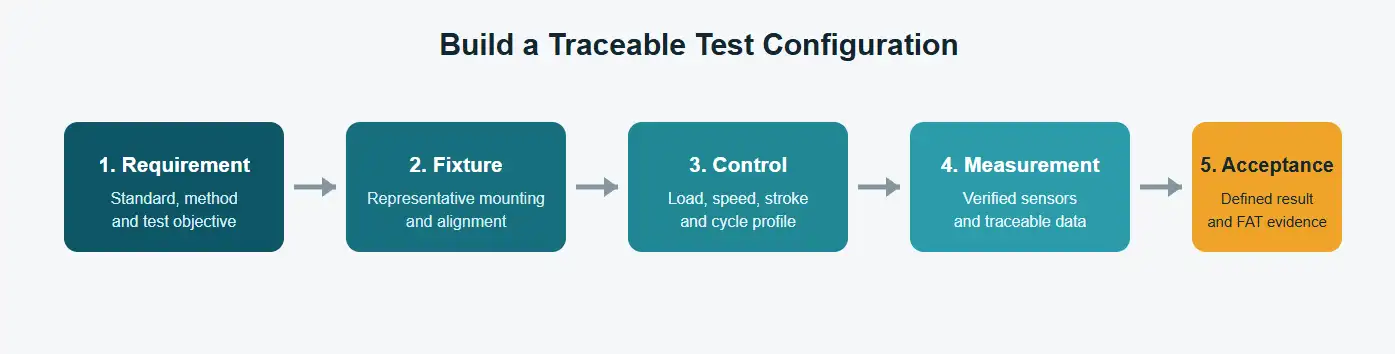
Choose the system that demonstrates a direct line from the applicable requirement to the result:
Requirement → representative fixture → controlled input → verified measurement → defined acceptance.
Derui develops configurable equipment for scooter component and complete-vehicle testing. Relevant starting points include the Scooter Dynamic Durability Test Machine, the Scooter Stem Fatigue Test Machine, folding mechanism fatigue testing and Derui’s E-Scooter Testing resources. The final configuration should be reviewed against the customer’s sample, method and acceptance requirements.
Get a configuration based on your test method
Send your scooter drawing, applicable standard, test list, sample dimensions, required loads and cycles, plus data, calibration and FAT requirements.
References
- BSI, BS EN 17128:2020 overview and scope.
- UK Department for Transport, Technical research into construction standards for e-scooters.
- ISO, ISO/IEC 17025 — Testing and calibration laboratories.