Derui chamber
The folding mechanism is one of the most critical safety components on any kick scooter or electric scooter. It allows the rider to collapse the scooter for storage or transport, but it also introduces a potential point of structural failure. Under EN 17128, the European standard for powered micro-mobility devices, the folding mechanism must undergo rigorous fatigue testing to ensure it can withstand repeated use over the product’s expected lifespan. This article provides a comprehensive guide to scooter folding mechanism fatigue testing under EN 17128, covering the standard’s requirements, test procedures, equipment specifications, and best practices for manufacturers seeking compliance.
📑 Table of Contents
Why Folding Mechanism Fatigue Testing Matters
A scooter’s folding mechanism is subjected to cyclic loading every time the rider folds or unfolds the scooter, but more importantly, it experiences dynamic stresses during riding. Every bump, turn, and acceleration transmits forces through the folding joint. If the mechanism fails while the scooter is in motion, the results can be catastrophic — the deck may separate from the steering column, causing the rider to lose control entirely.
Fatigue failure is particularly insidious because it occurs gradually. A folding mechanism may pass static load tests with comfortable margins, yet develop microscopic cracks after thousands of folding cycles or riding hours. These cracks propagate under continued cyclic loading until sudden, catastrophic fracture occurs. This is precisely why EN 17128 mandates fatigue testing — it simulates the accumulated stress of years of real-world use in a controlled laboratory setting.
From a product liability perspective, folding mechanism failures are among the most commonly reported safety incidents in the micro-mobility industry. Regulatory bodies in the EU, US, and Asia-Pacific regions have all identified the folding joint as a high-risk component, making compliance with fatigue testing standards not just a legal obligation but a moral imperative for responsible manufacturers.
EN 17128 Folding Mechanism Requirements Overview
EN 17128 “Powered micro-mobility devices — Safety requirements and test methods” was published to address the growing e-scooter market. Unlike the older EN 14619 which covered non-powered kick scooters, EN 17128 explicitly accounts for the higher speeds, greater masses, and more complex folding mechanisms found on electric scooters.
Scope of Folding Mechanism Testing
EN 17128 requires that any folding mechanism on a powered micro-mobility device must demonstrate structural integrity under both static and dynamic loading conditions. The standard specifies the minimum number of fatigue cycles, the applied force levels, and the acceptance criteria that must be met. Specifically, the folding mechanism must withstand a minimum of 10,000 folding/unfolding cycles without developing any cracks, permanent deformation exceeding specified limits, or functional impairment that prevents secure locking.
The standard also requires that any secondary locking devices (safety catches, pin locks, or quick-release mechanisms) must remain fully functional after the fatigue test sequence. This dual-locking philosophy ensures redundancy — if the primary latch fails in service, the secondary catch prevents immediate structural separation.
Test Procedure: Step by Step
Step 1: Sample Preparation
Select a representative production sample of the folding mechanism assembly. The sample must include all components that participate in the folding function — the hinge, latch, springs, pins, and any secondary safety locks. Do not use pre-conditioned or aged samples; the test specimen should represent the as-manufactured state. Record the serial number, production batch, and date of manufacture for traceability.
Step 2: Pre-Test Measurement
Before initiating the fatigue test, measure and document the following baseline parameters: the engagement depth of the locking mechanism, the play or free movement in the folded and locked positions, the force required to actuate the folding lever, and the geometric alignment of the hinge components. These measurements serve as the reference against which post-test deformation will be evaluated. Use calibrated instruments with traceability to national standards — typical measurement resolution should be 0.01 mm for dimensional checks and 0.5 N for force measurements.
Step 3: Mounting on the Fatigue Test Machine
Mount the scooter frame assembly onto the scooter folding fatigue test machine using fixtures that simulate the real-world loading conditions. The steering column should be clamped at the handlebar end, and the deck should be supported at the rear axle position. The actuator applies force at the folding mechanism’s pivot point in a direction that simulates the worst-case riding load. Ensure the mounting does not introduce stress concentrations that would invalidate the test results.
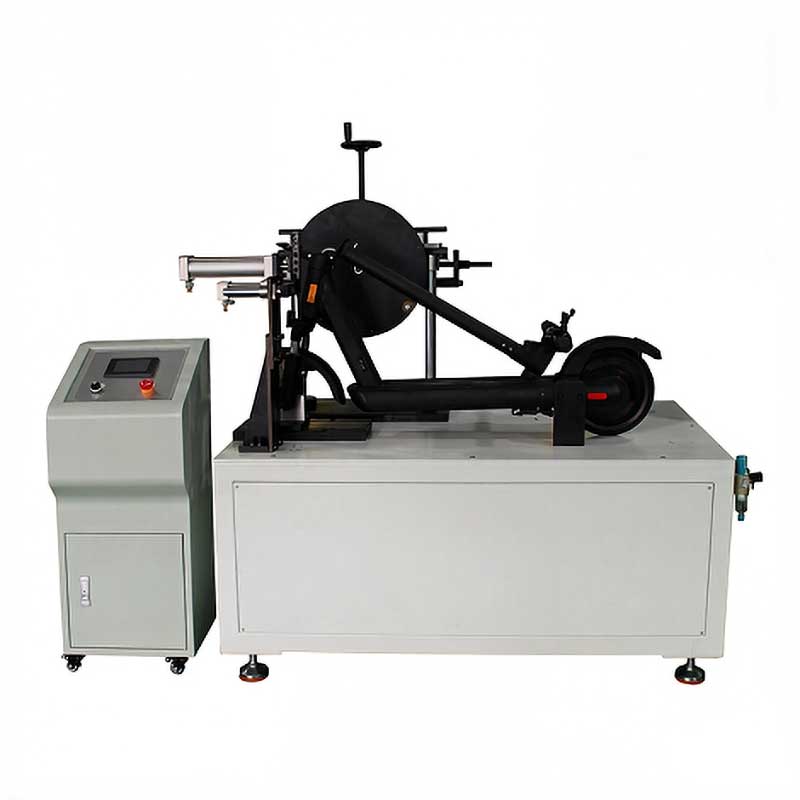
Step 4: Cyclic Loading Execution
Begin the cyclic loading sequence. The test machine applies the specified force at a controlled frequency — typically between 1 and 3 Hz for folding mechanism tests. Higher frequencies risk generating excess heat at the hinge, which could alter the material behavior and produce non-representative results. The force waveform is usually sinusoidal, representing the oscillating nature of road-induced vibrations. Monitor the peak force on each cycle using a load cell integrated into the actuator; if the force deviates by more than ±5% from the target value, pause the test and recalibrate.
Step 5: Folding/Unfolding Cycle Test
Separately from the dynamic fatigue test, conduct the folding/unfolding cycle test. This test simulates the repeated folding action performed by the user. The mechanism is fully folded and then fully unfolded and locked, repeating this sequence for a minimum of 10,000 cycles. After every 2,000 cycles, inspect the mechanism for visible wear, measure the locking engagement depth, and record the actuation force. Any trend of increasing play or decreasing engagement depth signals progressive wear that may lead to failure.
Step 6: Post-Test Evaluation
After completing the prescribed number of cycles, repeat all pre-test measurements. Compare the post-test values against the baseline and the acceptance criteria defined in EN 17128. Examine the mechanism visually and using non-destructive testing methods (dye penetrant or magnetic particle inspection for ferrous components) to detect any cracks that may not be visible to the naked eye. The mechanism passes if: no cracks are detected, permanent deformation does not exceed 2 mm, and the locking function operates securely with no perceptible play.
Equipment Specifications for Fatigue Testing
Selecting the right fatigue testing equipment is crucial for obtaining reliable and reproducible results. The test machine must be capable of applying controlled cyclic loads with precision, and it must accommodate the geometric diversity of scooter folding mechanisms across different models and brands.
The Derui scooter folding fatigue test machine meets these specifications with a 10 kN servo-driven actuator, integrated load cell with ±0.5% accuracy, and a computer-controlled data acquisition system that captures full force-displacement hysteresis loops. This level of instrumentation allows engineers to detect subtle changes in mechanism behavior — such as increasing hysteresis width indicating wear — well before visible damage appears.
Common Failure Modes and How to Address Them
Understanding the typical failure modes observed during folding mechanism fatigue testing helps manufacturers design more robust products. Here are the most common failure types and their root causes:
- Latch Wear and Reduced Engagement: The most frequent failure mode is progressive wear of the latch contact surfaces. After thousands of cycles, the mating surfaces of the latch and catch wear down, reducing engagement depth. This can be mitigated by using hardened steel inserts at contact points, applying wear-resistant coatings (TiN or DLC), or designing the latch with self-adjusting geometry that compensates for wear.
- Hinge Pin Fatigue Fracture: The hinge pin that connects the steering column to the deck is subjected to bending and shear stresses during each cycle. If the pin material has insufficient fatigue strength or if the pin diameter is too small for the applied loads, fatigue cracks can initiate at stress concentration points (such as the transition from the pin head to the shaft). Using higher-grade steel (such as 42CrMo4) and increasing the pin fillet radius can address this failure mode.
- Spring Fatigue and Loss of Preload: The springs that bias the locking mechanism into the engaged position can lose preload over time due to fatigue. This results in reduced holding force and potential unintentional unlocking. Designing springs with a safety factor of at least 2.0 on fatigue life and using shot-peened spring wire significantly improves reliability.
- Frame Tube Cracking at Weld Joints: The area where the folding mechanism bracket is welded to the steering column tube is a high-stress zone. Incomplete weld penetration, porosity, or excessive heat-affected zone hardness can all lead to premature cracking. Radiographic inspection of welds before assembly and post-weld heat treatment to reduce residual stresses are effective countermeasures.
Comparison with Other Standards: ASTM F2264 and EN 14619
Manufacturers selling scooters in multiple markets must understand how EN 17128 compares with other relevant standards. While all three standards address folding mechanism safety, they differ in scope, test parameters, and acceptance criteria.
The key takeaway is that EN 17128 is the most demanding of the three standards for folding mechanism testing, reflecting the higher risk profile of powered scooters. Manufacturers targeting the European market with e-scooters should design to EN 17128 as the baseline, which will generally ensure compliance with EN 14619 and ASTM F2264 as well.
Best Practices for Manufacturers
Achieving reliable folding mechanism performance requires attention throughout the product development cycle. The following best practices will help manufacturers produce folding mechanisms that pass EN 17128 fatigue testing with confidence:
- Design with Fatigue in Mind from Day One: Use FEA (Finite Element Analysis) to simulate the cyclic loading of the folding mechanism during the design phase. Focus on stress concentration points and aim for a fatigue safety factor of at least 1.5 on the critical components. This proactive approach catches design weaknesses before any physical prototypes are made, saving both time and cost.
- Implement Incoming Material Inspection: Verify the mechanical properties of all raw materials and components before they enter production. Hardness testing, tensile testing, and chemical composition analysis should be performed on each batch of hinge pins, latch components, and springs. A single batch of out-of-spec material can cause test failures across an entire production run.
- Conduct Pre-Compliance Testing Early: Don’t wait until the final production sample to perform fatigue testing. Run preliminary tests on prototype assemblies to identify potential issues early. This allows design iterations while tooling changes are still inexpensive. Pre-compliance testing on 2-3 samples at the 50% cycle mark can reveal trends that predict full-test outcomes.
- Invest in Quality Test Equipment: The precision and reliability of your fatigue test machine directly impacts the validity of your test results. Equipment with poor force control or inadequate data logging may produce results that don’t correlate with real-world performance. Choose test machines that offer full waveform capture, automatic cycle counting, and real-time anomaly detection.
- Document Everything: Maintain detailed records of all test parameters, environmental conditions, sample identification, and test results. This documentation is essential for regulatory submissions, quality audits, and failure investigations. A well-documented test program also provides the data needed to optimize future designs.
Pro Tip: When testing folding mechanisms for e-scooters with suspension systems, consider testing the mechanism both with and without the suspension engaged. Suspension forces can alter the load path through the folding joint, and a mechanism that passes the standard test may behave differently when the suspension dynamics are coupled into the folding mechanism.
FAQ
Q1: How many samples should I test for EN 17128 compliance?
EN 17128 does not specify an exact sample size, but best practice in the industry is to test a minimum of 3 samples from different production batches. This accounts for batch-to-batch variability in materials and manufacturing processes. For new product launches, some manufacturers test 5 samples to build a statistical basis for their compliance declaration.
Q2: Can I use accelerated testing to reduce test duration?
Accelerated testing by increasing the force level above the standard requirement is generally not recommended for fatigue testing of folding mechanisms. Fatigue life has a non-linear relationship with applied stress — a small increase in force can dramatically reduce the number of cycles to failure, and the failure mode may shift from high-cycle fatigue to low-cycle fatigue, producing non-representative results. Increasing the test frequency within the allowed range (up to 3 Hz) is a safer way to reduce test duration.
Q3: What happens if my mechanism fails at 9,500 cycles?
A failure at 9,500 cycles means the mechanism does not meet EN 17128 requirements and cannot be certified as compliant. You must identify the root cause of the failure, implement corrective actions (design change, material upgrade, or manufacturing process improvement), produce new samples, and re-test. Document the failure analysis and corrective actions as part of your quality records.
Q4: Does EN 17128 require testing the folding mechanism with the scooter fully assembled?
Yes, the standard requires testing the folding mechanism as part of the complete scooter assembly or a representative sub-assembly that accurately reproduces the loading conditions. Testing the mechanism in isolation (e.g., just the hinge and latch) may not capture the interaction between the folding mechanism and the surrounding frame structure, which can significantly affect the stress distribution.
Q5: How do I handle folding mechanisms with multiple locking positions?
If the folding mechanism has multiple locking positions (e.g., fully folded, partially folded for transport, and fully extended for riding), each functional position must be tested separately. The fatigue test applies to the primary riding position, while the folding/unfolding cycle test should exercise the mechanism through all functional positions. This ensures that wear and fatigue are assessed for every operational configuration.
Q6: Are quick-release folding mechanisms tested differently?
Quick-release mechanisms must undergo the same fatigue and cycle tests as conventional folding mechanisms. However, additional tests may be warranted to verify that the quick-release function does not inadvertently activate under vibration loads. Some manufacturers perform a supplementary vibration test on the locked mechanism to ensure that road vibrations cannot cause unintended release.
Q7: What is the typical cost of a scooter folding fatigue test machine?
Scooter folding fatigue test machines typically range from $8,000 to $25,000 depending on the force capacity, number of test stations, and data acquisition capabilities. A single-station machine with 5 kN capacity and basic data logging sits at the lower end, while a dual-station machine with 10 kN capacity, full waveform capture, and integrated report generation commands a higher price. The investment typically pays for itself within 6-12 months through reduced outsourcing costs and faster time-to-market.
Q8: Can I test multiple folding mechanism designs on the same machine?
Yes, most fatigue test machines use interchangeable fixtures that can be adapted to different folding mechanism geometries. When specifying a machine, ensure the fixture system is versatile enough to accommodate your current product range and anticipated future designs. Some manufacturers also use modular actuator systems that can be reconfigured for different test setups, providing maximum flexibility for evolving product lines.
Q9: Does temperature affect fatigue test results?
Yes, temperature has a significant effect on fatigue performance. Higher temperatures reduce the fatigue strength of most metals and can accelerate wear in polymer components. EN 17128 specifies that tests should be conducted at standard laboratory conditions (23°C ± 5°C). If your product will be used in extreme climates, consider conducting supplementary tests at elevated temperatures (e.g., 45°C) to assess worst-case performance.
Q10: How do I correlate laboratory fatigue test results with real-world lifespan?
The 10,000-cycle folding/unfolding requirement is designed to represent a service life of approximately 3-5 years of typical use. However, the correlation depends on usage patterns — a commuter who folds their scooter daily will accumulate cycles much faster than a recreational user. For the dynamic fatigue test, the force levels are set to represent a worst-case percentile of riding loads. Manufacturers should supplement standard tests with field reliability data to validate the laboratory-to-field correlation for their specific products.
Related Products
Need Professional E-scooter testing Equipment?
Explore our range of testing machines designed for compliance with international standards.