Derui chamber
Tire quality is one of the most critical factors determining the safety, performance, and longevity of electric scooters. Whether navigating smooth city sidewalks or uneven urban terrain, the tires on an e-scooter absorb shocks, maintain traction, and directly influence rider comfort. For manufacturers, tire road condition testing has become an indispensable part of the quality control process, ensuring every unit shipped meets strict performance and safety benchmarks before reaching consumers. This comprehensive guide explores the standards, equipment, methodologies, and best practices that define modern e-scooter tire testing programs.
Key Takeaways
- UL 2272 and EN 17128 are the primary safety standards governing e-scooter electrical and mechanical performance testing requirements.
- Frame fatigue testing for e-scooters requires higher impact energy levels compared to conventional bicycles due to additional battery and motor mass.
- Tire, wheel, and axle endurance tests simulate real-world urban riding conditions across varied road surfaces and loading scenarios.
- Brake system testing evaluates both mechanical and regenerative braking efficiency under dry and wet conditions per applicable standards.
- Environmental testing (IP rating, temperature cycling) ensures e-scooter safety across diverse operating climates and weather conditions.
📍 Table of Contents
Why Tire Testing Matters for E-Scooters
Electric scooters operate under unique conditions that set them apart from bicycles and motorcycles. Most e-scooters use small-diameter solid or pneumatic tires, typically ranging from 6 to 10.5 inches, which means even minor defects in roundness, balance, or material composition are amplified during operation. At speeds of 25 to 40 km/h, a tire with a deviation of just 0.5 mm in roundness can cause noticeable vibration, reduced traction, and accelerated wear on the motor bearings and suspension components. For shared mobility operators who manage fleets of thousands of scooters, tire-related failures represent one of the top maintenance costs, often accounting for 15 to 25 percent of total vehicle downtime. Proper testing at the manufacturing stage dramatically reduces these field failures, protects brand reputation, and ensures compliance with safety regulations in target markets.
Beyond safety, tire performance directly impacts the rider experience. Excessive vibration leads to rider fatigue, uncomfortable commuting, and in severe cases, loss of vehicle control. Regulatory bodies in the European Union, the United States, and Asia-Pacific regions have increasingly tightened requirements for micro-mobility tire durability and performance. EN 17128, the European standard specifically designed for personal light electric vehicles, includes provisions for tire integrity under various road conditions, making road condition testing not just a quality measure but a legal obligation for manufacturers selling into regulated markets.
Key Tire Performance Parameters
When evaluating e-scooter tires under road conditions, quality engineers measure several critical parameters that together paint a complete picture of tire performance. Each parameter requires specific testing equipment and acceptance criteria calibrated to the intended use case of the scooter.
Radial runout, often referred to as roundness deviation, is the most commonly measured parameter because it directly correlates with the vibration experienced during riding. A perfectly round tire produces minimal oscillation, while deviations create periodic impact forces transmitted through the frame to the rider. For solid rubber tires used on many rental scooters, the manufacturing molding process can introduce slight eccentricity, making post-mold measurement essential. Lateral runout, or wobble, measures the side-to-side deviation as the tire rotates and is particularly important for scooters using narrow rim profiles where lateral stability directly affects cornering performance.
Hardness testing using Shore A durometers provides insight into the rubber compound quality and curing consistency. Tires that are too soft wear rapidly and may deform under load, while overly hard compounds transmit excessive vibration and reduce grip on wet surfaces. The optimal range for most e-scooter solid tires falls between 60 and 75 Shore A, balancing durability with rider comfort.
Standards and Regulations Governing Tire Testing
Multiple international standards address tire performance for light electric vehicles, though compliance requirements vary by market. Understanding which standards apply to a specific product is the first step in establishing an effective testing program.
EN 17128 is the most relevant standard for e-scooter tire testing in the European market. Section 4.2 of this standard specifies that wheels and tires must withstand a series of durability tests, including rolling on a drum with a simulated road surface profile. The standard requires tires to maintain structural integrity after a minimum number of drum rotations at specified load conditions, typically equivalent to several hundred kilometers of real-world riding. Manufacturers targeting the EU market must conduct these tests at accredited laboratories or invest in compliant in-house testing equipment.
In the United States, while there is no single federal standard exclusively for e-scooter tires, the CPSC requirements under 16 CFR 1512 cover general bicycle and scooter wheel safety, including tire retention and wheel assembly strength. Many U.S. scooter operators additionally follow internal standards that exceed regulatory minimums, particularly for fleet vehicles subject to extreme usage patterns in shared mobility programs.
Testing Equipment for Tire Road Condition Assessment
Modern e-scooter tire testing relies on a combination of specialized machines, each designed to evaluate specific performance aspects. The most commonly used equipment includes tire true roundness testers, road condition simulation test machines, dynamic durability testers, and precision measurement instruments.
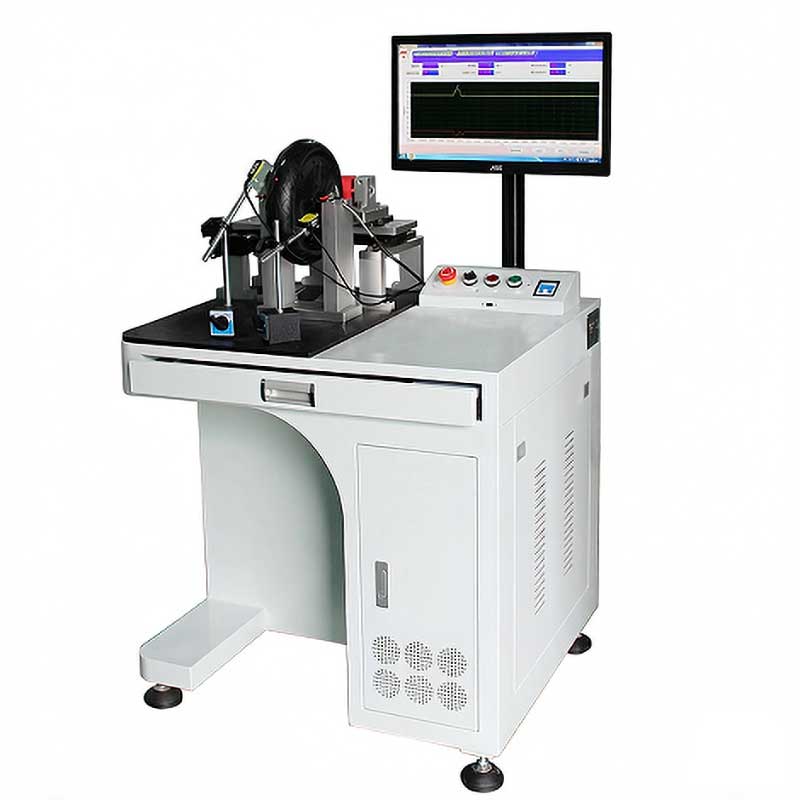
Tire True Roundness and Wobble Testing Machine
The tire true roundness tester uses high-precision displacement sensors, typically laser or LVDT-based, to measure radial and lateral deviations as the tire rotates on a spindle. The tire is mounted on a precision mandrel and rotated at low speed, typically 5 to 30 RPM, while the sensor records positional data at high sampling rates. Modern digital machines can capture data points at intervals of 0.1 degrees of rotation, providing extremely detailed roundness profiles. The measurement accuracy of industrial-grade machines reaches ±0.005 mm, far exceeding the requirements for quality control but providing the margin needed to detect subtle molding defects early in production runs. Many systems include automated pass/fail classification, integrating directly with factory MES systems for statistical process control.
Road Condition Simulation Test Machine
Road condition testing machines simulate the real-world road surfaces that e-scooters encounter during operation. These machines feature a rotating drum or belt with configurable surface textures that replicate asphalt, concrete, cobblestone, and other common road profiles. The scooter wheel under test is pressed against the drum surface under a controlled load that simulates the rider weight plus safety factor, typically 1.2 to 1.5 times the gross vehicle weight. The drum rotates at speeds equivalent to 15 to 40 km/h, and the test runs continuously for durations equivalent to 500 to 2,000 kilometers of real-world use. During the test, sensors monitor tire temperature, wear depth, vibration amplitude, and any signs of cracking, delamination, or separation. The test concludes with a detailed dimensional re-measurement to quantify total wear and detect any permanent deformation.
Advanced road condition testers offer programmable load profiles that simulate real-world riding scenarios, including acceleration, braking, and cornering forces. This cyclical loading more accurately represents field conditions compared to static drum tests, providing a higher confidence level in the test results. The programmable approach is particularly valuable for scooters designed for off-road or mixed-terrain use, where tire loads fluctuate significantly during operation.
Road Condition Test Methods in Detail
A complete tire quality control program for electric scooters typically involves three phases of testing: incoming inspection, process verification, and finished product validation. Each phase serves a distinct purpose in the quality assurance chain.
Phase 1: Incoming Raw Material Inspection
Before tires enter the assembly line, raw rubber compounds and pre-molded tire blanks undergo hardness, density, and tensile strength testing. Samples from each batch are tested using Shore A durometers, with results compared against specification sheets provided by the compound supplier. Batch-level testing at this stage catches upstream quality issues before they propagate into finished products, avoiding costly recalls. For manufacturers sourcing tires from multiple suppliers, incoming inspection also provides data for supplier comparison and qualification, enabling data-driven procurement decisions.
Phase 2: Post-Mold Dimensional Verification
After the tire molding and curing process, each batch undergoes roundness and wobble measurement using the tire true roundness testing machine. Statistical sampling plans, typically AQL 0.65 or tighter for critical parameters, determine how many units from each production lot are measured. For high-volume manufacturers producing more than 10,000 tires per month, automated inline measurement systems can inspect every unit without slowing production throughput. The measured data feeds into SPC charts that track process capability indices like Cp and Cpk, alerting quality engineers when the molding process begins to drift out of specification before defective units reach the customer.
Phase 3: Finished Vehicle Road Condition Validation
The most comprehensive phase involves testing complete wheel assemblies mounted on a road condition simulation machine or a double-roller scooter test bench. This phase evaluates the tire not in isolation but as part of the complete assembly, including the rim, inner tube if applicable, bearings, and hub motor. Testing complete assemblies captures interaction effects that individual component tests cannot detect, such as rim-tire interface stress concentrations or hub motor vibration amplification caused by tire imbalance. Finished vehicle tests typically run for 50 to 200 hours continuously, with periodic inspections at defined intervals to track degradation progression.
Implementing an Effective Quality Control Workflow
Establishing a robust tire testing workflow requires careful planning around test frequency, sample sizes, data management, and corrective action protocols. The following framework provides a practical starting point for manufacturers setting up or upgrading their quality control programs.
- Define test parameters and acceptance criteria: Map each standard requirement to specific test methods, equipment, and pass/fail thresholds. Document these in a control plan accessible to all quality personnel.
- Establish sampling plans: Use AQL-based sampling for dimensional checks and 100-percent inspection for critical safety parameters like runout. Adjust sampling frequency based on supplier quality history and production volume.
- Invest in automated data capture: Modern testing machines with digital outputs eliminate manual recording errors and enable real-time SPC monitoring. Integrating test data into a centralized quality management system provides traceability from raw material lot to finished vehicle serial number.
- Implement gauge R&R studies: Before relying on measurement data for acceptance decisions, conduct repeatability and reproducibility studies to confirm that measurement system variation is small relative to the specification tolerance, typically targeting less than 10 percent of the tolerance band.
- Define escalation procedures: When test results approach specification limits or show adverse trends, clear escalation paths ensure rapid corrective action. Common responses include increasing sampling frequency, quarantining suspect inventory, and initiating root cause analysis with the affected supplier.
Common Tire Defects and How Testing Detects Them
Understanding the most common tire defects helps quality engineers design targeted inspection protocols that catch problems early and cost-effectively.
Road condition durability testing is particularly effective at detecting tread separation, curing voids, and compound inconsistencies that only manifest under sustained load and temperature cycling. A tire that passes static dimensional inspection may still fail during dynamic testing because the combination of heat generation, flexing, and road surface abrasion reveals weaknesses invisible to static measurement alone. This is why the three-phase testing approach is essential: no single test method catches all defect types.
For manufacturers pursuing ISO 9001 or IATF 16949 certification, tire testing data forms part of the product realization process documentation. Traceability from raw material certificate of analysis through incoming inspection, in-process testing, to finished vehicle validation records demonstrates compliance with process control requirements and supports continuous improvement initiatives.
Frequently Asked Questions
What is the difference between a roundness test and a road condition test?
A roundness test measures the geometric precision of the tire profile under static or low-speed rotation conditions, detecting deviations in the tire shape such as eccentricity, ovality, and local irregularities. A road condition test, by contrast, evaluates tire performance under dynamic loading on a textured drum surface that simulates real road conditions. The road condition test generates data on wear rate, heat buildup, structural integrity under load, and vibration characteristics, providing a much more comprehensive assessment of how the tire performs during actual riding. Both tests are complementary: roundness testing catches manufacturing defects quickly and cost-effectively, while road condition testing validates long-term durability and fitness for purpose.
How long does a typical road condition durability test take?
A standard road condition durability test equivalent to 500 kilometers of real-world riding typically runs between 20 and 40 hours on a drum-type testing machine, depending on the drum diameter, surface texture, and applied load. Tests targeting 2,000-kilometer equivalence for premium applications may run 80 to 160 hours. Many manufacturers conduct these tests in parallel on multi-station machines to maintain production throughput while achieving the required validation coverage.
What drum surface textures are used for testing?
Testing machines typically offer interchangeable drum surfaces or belt sections to simulate different road conditions. Common textures include smooth steel for baseline wear testing, coarse grit-coated surfaces for accelerated abrasion testing, patterned surfaces replicating asphalt aggregate, and rubber-cleated drums for simulating uneven urban pavement. The choice of surface depends on the target market and intended use case: fleet scooters operating primarily on smooth bike paths require different surface simulation than off-road recreational models designed for varied terrain.
Do solid tires and pneumatic tires require different test procedures?
Yes, solid and pneumatic tires follow different test protocols despite sharing many measurement parameters. Pneumatic tires require additional pressure retention testing, valve integrity checks, and pinch-flat resistance evaluation under impact conditions. Solid tires, which dominate the shared mobility market due to maintenance advantages, focus more on hardness consistency, thermal degradation under sustained drum contact, and crack initiation testing under cyclic loading. The dimensional acceptance criteria also differ, with pneumatic tires generally tolerating larger roundness deviations because the air volume provides natural damping.
How often should test equipment be calibrated?
Calibration frequency depends on the measurement type and equipment criticality. Displacement sensors used in roundness testers should be calibrated at least every six months using certified gauge blocks or laser interferometers, with intermediate verification checks performed daily or before each test batch. Load cells in road condition machines require annual calibration traceable to national metrology standards. Hardness durometers need verification against certified test blocks before each use session. For manufacturers with ISO 17025 accredited laboratories, calibration intervals are formally managed in the equipment calibration register and adjusted based on historical stability data.
What sample size is appropriate for production line tire testing?
Sample sizes are determined using AQL-based sampling plans defined in ISO 2859-1. For critical safety parameters like radial runout, a typical AQL level of 0.65 with General Inspection Level II results in sample sizes ranging from 8 to 50 units depending on the lot size. For less critical cosmetic parameters, AQL 2.5 or 4.0 with reduced inspection may be appropriate. Manufacturers with mature processes demonstrating long-term Cpk values above 1.67 may justify reduced sampling frequency, while new suppliers or processes under development warrant tightened inspection with increased sample sizes.
Can tire testing data predict field failure rates?
Yes, with sufficient historical data, tire testing results can be correlated with field failure rates using reliability engineering methods such as Weibull analysis. By tracking the relationship between measured roundness deviation, hardness variation, and drum-test wear rates against actual field warranty returns, manufacturers can establish predictive models that identify at-risk production lots before they ship. This predictive approach is particularly valuable for fleet operators who need to estimate tire replacement intervals and budget for maintenance costs across large vehicle populations.
What is the cost of setting up a basic tire testing station?
A basic tire testing station for e-scooter manufacturing typically requires investment in two primary pieces of equipment: a tire true roundness and wobble testing machine (approximately 15,000 to 40,000 USD depending on automation level and accuracy class) and a road condition durability test machine (approximately 25,000 to 80,000 USD depending on drum size, number of stations, and data acquisition capabilities). Additional investments include Shore A durometers, gauge blocks for calibration verification, and quality management software for data analysis. The total investment for a functional two-machine setup typically falls between 50,000 and 150,000 USD, with ongoing calibration and maintenance costs of 5 to 10 percent of capital equipment value annually.
How does tire testing integrate with overall scooter quality control?
Tire testing is one component of a broader scooter quality control system that includes frame fatigue testing, brake endurance testing, electrical system validation, and environmental stress screening. Tire test data should be integrated with the overall vehicle quality database, allowing quality engineers to correlate tire performance with vehicle-level test results. For example, excessive tire vibration detected during road condition testing may correlate with frame fatigue test failures, indicating a system-level issue requiring coordinated corrective action across both tire and frame specifications.
What are the emerging trends in e-scooter tire testing?
The e-scooter tire testing field is evolving rapidly in several directions. Digital twin technology allows virtual simulation of tire performance under varying road conditions before physical prototypes are manufactured, reducing development cycle times. Machine learning algorithms applied to test data are enabling earlier detection of subtle process drift that traditional SPC methods miss. Airless tire technologies, such as honeycomb-structured polymer tires, require entirely new test methodologies that evaluate cell deformation patterns and energy absorption characteristics. Additionally, the push toward sustainability is driving interest in bio-based rubber compounds, which introduce new variables in hardness stability and wear characteristics that testing programs must accommodate.
Related Products
Need Professional E-scooter testing Equipment?
Explore our range of testing machines designed for compliance with international standards.