Derui chamber
Electric scooter manufacturers face a growing maze of testing standards, equipment choices, and certification requirements that can overwhelm even experienced quality teams. From understanding the technical differences between EN 17128 and EN 14619 to selecting the right fatigue testing machine for your production line, the questions pile up fast. This FAQ article answers the most frequently asked technical questions about e-scooter testing, drawing on real-world experience from testing equipment engineers who work with manufacturers across three continents. Unlike introductory overviews, these answers dive into the specific parameters, acceptance criteria, and practical details that matter when you are setting up a test program or troubleshooting a failed compliance test.
Key Takeaways
- EN 17128 and EN 14619 apply to different scooter categories—electric and kick-powered—each with distinct fatigue cycle requirements and test configurations.
- UL 2272 focuses on electrical system safety, while EN 17128 addresses the complete mechanical structure including frame, steering, and folding mechanisms.
- Fatigue testing requires a minimum of 100,000 cycles per EN 17128, but premium manufacturers often test to 200,000+ cycles for shared fleet applications.
- Drop test heights vary by standard: EN 17128 specifies 300 mm for complete scooters, while ASTM F2264 uses different impact energy calculations.
- Proper fixture design and sensor calibration are the two most common sources of invalid test results in e-scooter fatigue laboratories.
📍 Table of Contents
Standards & Compliance FAQ
Q1: What is the difference between EN 17128 and EN 14619 for e-scooter testing?
EN 17128:2020 applies specifically to personal light electric vehicles (PLEVs), including e-scooters with a maximum design speed of 25 km/h. It covers the complete vehicle—frame, steering assembly, electrical system, braking, and stability. EN 14619:2019, by contrast, covers non-motorized kick scooters and roller sports equipment. While both standards include fatigue testing requirements, the test parameters differ significantly. EN 17128 mandates vibration testing at 5–30 Hz for a minimum of 100,000 cycles with a 100 kg simulated rider mass, whereas EN 14619 specifies static cyclic loading at 1–3 Hz for 50,000 cycles. For a detailed comparison, see our EN 14619 vs EN 17128 guide. If your e-scooter can also be kick-propelled, you may need to comply with both standards.
Q2: Does UL 2272 cover mechanical testing or only electrical safety?
UL 2272 is primarily an electrical system safety standard that evaluates the battery, charger, and electrical drive system for fire and shock hazards. It includes mechanical stress tests—vibration, shock, and crush—but these are designed to verify that the electrical system remains safe under mechanical stress, not to validate the structural integrity of the frame or steering assembly. For complete mechanical validation, UL 2272 must be supplemented with EN 17128 or ASTM F2264 testing. Many manufacturers pursue both UL 2272 and EN 17128 certification simultaneously to access US and EU markets. For a walkthrough of the UL 2272 testing workflow, see our UL 2272 certification guide.
Q3: What testing standard applies to e-scooters sold in the United States?
The US does not have a single federal standard dedicated to e-scooters. The most commonly applied standards are ASTM F2264 (consumer scooters), which addresses frame fatigue and component durability, and UL 2272, which covers electrical system safety. The CPSC also enforces general product safety requirements under 16 CFR 1512 for bicycle and scooter wheel assemblies. In practice, manufacturers targeting the US market typically test to both ASTM F2264 and UL 2272, plus any state or city-specific requirements. Shared mobility operators like Bird and Lime often impose their own internal standards that exceed these regulatory minimums.
Frame & Structural Testing FAQ
Q4: How many fatigue cycles are required for e-scooter frame testing under EN 17128?
EN 17128 requires a minimum of 100,000 vibration cycles for the frame and steering assembly, tested with a simulated rider mass of 100 kg applied to the deck platform. The vibration profile sweeps between 5 Hz and 30 Hz at acceleration levels calibrated to simulate real-world road conditions. The frame must show no visible cracks, fracture, or loss of structural integrity after completing all cycles. For premium or shared-fleet scooters that may accumulate significantly more mileage than consumer models, many manufacturers voluntarily test to 200,000–500,000 cycles. Our scooter frame vibration testing guide provides detailed parameter configuration and equipment specifications.
Q5: What is the correct drop test height for e-scooter impact testing?
EN 17128 specifies a drop height of 300 mm for complete scooter impact testing, with the scooter loaded with a 100 kg simulated rider mass. The scooter is dropped vertically onto a flat steel impact surface, and the frame must not exhibit any cracks, permanent deformation exceeding 5 mm, or functional impairment after three successive drops. ASTM F2264 uses a different approach based on impact energy rather than a fixed drop height, calculated from the scooter mass and a specified impact velocity. For detailed test procedures and equipment setup, see our scooter drop testing guide. The scooter drop test machine is designed to perform both EN and ASTM standard drop tests with adjustable heights from 100 mm to 600 mm.
Q6: Can FEA replace physical fatigue testing for e-scooter frames?
No current standard accepts FEA as a complete replacement for physical vibration or fatigue testing. Finite element analysis is a valuable tool for predicting stress distribution, identifying failure-prone locations, and optimizing designs before cutting metal—but it cannot account for all real-world variables such as weld defects, material batch variation, and assembly tolerances. Some certification bodies may accept a reduced physical test program when supported by validated FEA models, but this must be negotiated on a case-by-case basis. Best practice is to use FEA during design iteration and then validate the final design with full physical testing per the applicable standard.
Q7: Why do aluminum e-scooter frames fail fatigue testing even when they pass static load tests?
This is one of the most common and misunderstood issues in e-scooter testing. Aluminum alloys (especially 6061-T6 and 6063-T5 commonly used in scooter frames) have a fatigue endurance limit that is only 30–40% of their ultimate tensile strength. A frame might support 150 kg in a static test without any deformation, yet develop cracks at 50,000 vibration cycles under a fraction of that load. The mechanism is high-cycle fatigue: microscopic slip bands form at stress concentrations (especially weld toes and heat-affected zones), gradually developing into cracks that propagate with each cycle. Unlike steel, most aluminum alloys do not have a true fatigue limit—meaning fatigue damage accumulates at any stress level, though the rate decreases at lower stresses. This is why vibration fatigue testing is absolutely essential and cannot be replaced by static proof testing alone.
Component Testing FAQ
Q8: What fatigue test parameters apply to scooter handlebars under EN 17128?
EN 17128 specifies two mandatory handlebar load cases: vertical bending and torsion. For vertical bending, a force of 600 N is applied at each grip end cyclically at 1–3 Hz for 100,000 cycles. The handlebar must not crack or show permanent deformation exceeding 5 mm. Torsional testing applies 20–40 N·m cyclic torque for 100,000 cycles. Many manufacturers also test horizontal bending as a third load case for complete characterization. For detailed test methods and equipment specifications, refer to our handlebar fatigue testing guide.
Q9: How does scooter stem fatigue testing differ from handlebar testing?
Stem fatigue testing focuses specifically on the vertical tube (stem) that connects the handlebar to the steering headset and folding mechanism, while handlebar testing evaluates the horizontal crossbar and its grip ends. The stem experiences different stress patterns—primarily compressive buckling and bending at the folding hinge—compared to the handlebar’s transverse bending loads. EN 14619 and ASTM F2264 both include specific stem fatigue test configurations where a cyclic force is applied at the handlebar mount point while the stem is clamped at the headset end. For compliance details, see our stem fatigue testing guide and the scooter stem fatigue test machine.
Q10: What testing is required for scooter folding mechanisms?
EN 17128 Section 5.5 requires that folding mechanisms withstand a minimum of 10,000 folding/unfolding cycles without excessive play, loosening of locking features, or failure to fully engage. Additionally, the folding mechanism must pass a dynamic fatigue test where the scooter frame (including the folding joint) is subjected to the standard 100,000-cycle vibration profile with the mechanism locked in the riding position. The folding latch must remain fully engaged throughout the vibration test. For test setup and acceptance criteria, see our folding mechanism fatigue test guide.
Q11: How many throttle actuation cycles should a life test include?
EN 17128 mandates a minimum of 100,000 actuation cycles, with signal deviation remaining within ±5% of the initial calibrated value and return time under 0.5 seconds. For shared-fleet scooters that may be operated by dozens of different riders daily, testing to 200,000–300,000 cycles provides better confidence in long-term reliability. The cycling rate should be maintained at 1–2 Hz to avoid introducing thermal effects that do not occur in real-world use. Our throttle life testing guide covers the complete test protocol and data analysis methodology.
Q12: What tire quality parameters should e-scooter manufacturers test?
The critical tire quality parameters for e-scooters include radial runout (roundness, typically ≤0.5 mm for commuter models), lateral runout (wobble, ≤0.3 mm), Shore A hardness (60–75 for solid tires), dynamic balance (≤5 g imbalance), tread wear rate, and load capacity at 1.5× gross vehicle weight. Unlike automotive tires, e-scooter tire quality standards are still evolving—most manufacturers adapt tolerances from ISO 5775 bicycle standards or internal OEM specifications. For comprehensive tire testing methodology, see our guides on tire roundness testing and tire road condition testing.
Equipment & Lab Setup FAQ
Q13: What specifications should I look for in a scooter frame vibration test machine?
The minimum requirements for EN 17128 compliance are: shaker force rating ≥5 kN (recommended 10–20 kN), frequency range 5–500 Hz (recommended 5–2,000 Hz), maximum displacement ≥25 mm peak-to-peak, table size ≥600×600 mm, and a digital controller supporting sine and random vibration modes. The controller should support at least 2 input channels for accelerometer monitoring and 1 output channel for shaker drive. For research applications beyond compliance testing, look for systems with 8+ input channels, acoustic emission monitoring capability, and full modal analysis software. The scooter frame vibration test machine meets these specifications with a 10 kN electromagnetic shaker and digital sine/random controller.
Q14: How much does a complete e-scooter testing laboratory cost to set up?
A basic e-scooter testing lab covering the core EN 17128 requirements typically requires the following equipment investments: frame vibration test system ($30,000–$80,000), drop/impact test machine ($10,000–$25,000), handlebar and stem fatigue test machine ($15,000–$40,000), dynamic durability test bench ($20,000–$50,000), and tire testing equipment ($25,000–$60,000). Including accessories, calibration equipment, and environmental control, a fully equipped lab costs between $150,000 and $400,000 depending on automation level and throughput requirements. Annual calibration and maintenance costs run 5–10% of the initial equipment investment. For a tailored quotation based on your specific testing needs, contact our engineering team.
Q15: How often should e-scooter test equipment be calibrated?
Calibration frequency depends on the measurement type and equipment criticality. Load cells and force transducers require annual calibration traceable to national metrology standards, with intermediate verification using reference weights before each test series. Accelerometers should be calibrated every 6 months or after any mechanical shock. Displacement sensors in tire roundness testers need verification against certified gauge blocks at least every 6 months, with daily checks using a master ring. Temperature and humidity sensors in environmental chambers require quarterly calibration. For ISO 17025 accredited labs, all calibration intervals are formally managed in an equipment register and adjusted based on historical stability data. A practical rule: any sensor that shows deviation exceeding 10% of the tolerance threshold during intermediate verification should be recalibrated immediately.
Certification & Market Access FAQ
Q16: Do I need third-party testing for EN 17128 compliance?
For CE marking under the EU machinery directive, testing can be performed in-house or by a third-party laboratory, but the testing facility must hold ISO 17025 accreditation for the specific test methods. Many EU importers and retailers require third-party test reports from accredited labs as a condition of purchase, making third-party testing the practical default. Having an accredited third-party certificate also provides stronger legal protection in product liability cases. If you operate an in-house lab, you can still perform the tests yourself provided your lab is ISO 17025 accredited for EN 17128 test methods—this requires documented procedures, validated equipment, trained personnel, and regular proficiency testing.
Q17: How do I test a scooter that targets both EU and US markets?
When targeting multiple markets, apply the most stringent requirements across all applicable standards. For example, if EN 17128 requires 100,000 fatigue cycles and ASTM F2264 requires 100,000 cycles, test to the higher standard. If one standard specifies ±5% signal deviation and another specifies ±3%, use ±3% as the acceptance threshold. For market-specific requirements that cannot be merged—such as UL 2272’s electrical safety tests, which have no EN equivalent—you must complete both sets of tests. A practical approach is to design a single test matrix that covers all applicable standards in the most efficient sequence, avoiding duplicate testing where requirements overlap. The e-scooter testing machines in our product line are designed to support multiple standard configurations on a single platform.
Q18: What happens if my scooter fails a compliance test?
If a specimen fails, the failure must be thoroughly analyzed to determine the root cause before any corrective action. Begin with visual inspection and non-destructive testing (dye penetrant or magnetic particle inspection) of the failed area. Disassemble the specimen and examine fracture surfaces under magnification to identify the failure mode (fatigue crack from weld toe, material defect, design deficiency, etc.). Compare failed units with units that passed at intermediate inspection points. Common corrective actions include improving weld quality, increasing material thickness at high-stress locations, adding reinforcing gussets, and optimizing joint geometry to reduce stress concentration factors. After implementing corrections, the modified design must be re-tested with a full batch of new specimens—typically 2–3 design iterations are required before achieving compliance. Document every iteration in the engineering change notice system for audit traceability.
Testing Cost & Timeline FAQ
Q19: How long does a complete e-scooter compliance test program take?
A complete EN 17128 compliance test program for a single scooter model typically takes 4–6 weeks when testing at a third-party accredited laboratory. This includes frame vibration testing (2–3 days per specimen batch of 3 units), handlebar fatigue testing (2–3 days per load case), drop testing (1 day), brake testing (1–2 days), electrical system testing per UL 2272 if applicable (1–2 weeks), and report preparation (3–5 business days). If design iterations are required, add 2–3 weeks per iteration for modification and re-testing. Starting the testing process early in the product development cycle—preferably during the prototype phase—avoids costly delays when certification deadlines approach.
Q20: Is it more cost-effective to test in-house or at a third-party lab?
The answer depends on your testing volume and product development cycle. For manufacturers producing more than 5 scooter models per year, or those that require frequent design iteration testing, in-house testing is significantly more cost-effective over a 2–3 year period. A typical third-party EN 17128 test program costs $15,000–$30,000 per model, while a fully equipped in-house lab costs $150,000–$400,000 upfront but can test unlimited models with no per-test fees beyond consumables and calibration. In-house testing also provides faster turnaround (days instead of weeks) and the ability to test during development rather than only for final certification. Many manufacturers adopt a hybrid approach: in-house testing during development, followed by third-party confirmation testing for the final certification submission.
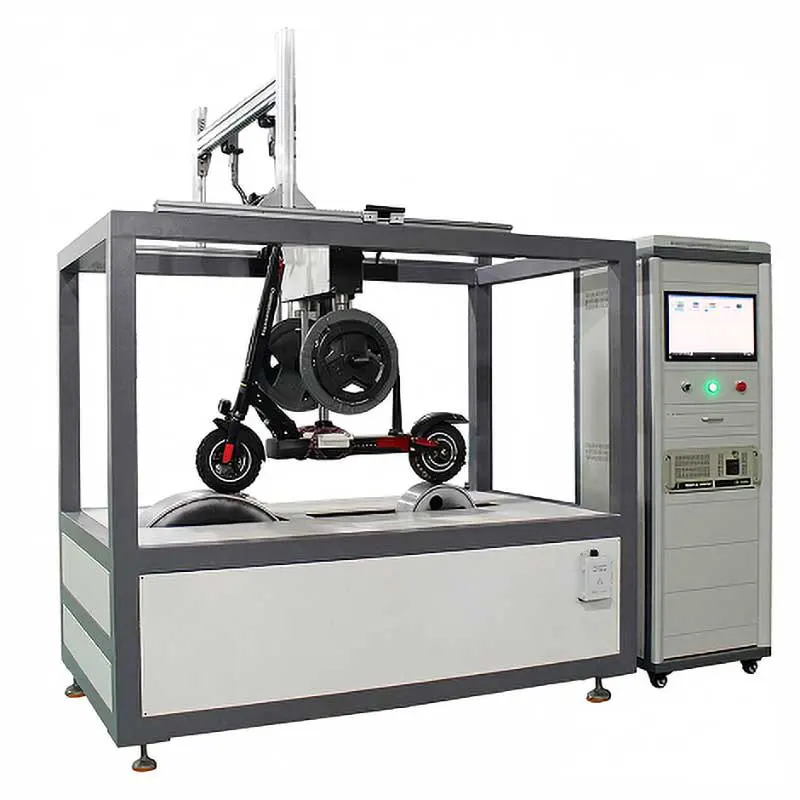
Pro Tip: When setting up your e-scooter test lab, invest in multi-station machines that can test 2–4 specimens simultaneously. This doubles or quadruples your throughput without proportional increases in floor space or operator requirements. The scooter dynamic durability test machine and scooter horizontal impact tester both offer multi-station configurations for high-volume manufacturers.
Related Products
Ready to Build Your E-Scooter Testing Program?
Contact our engineering team to discuss your specific testing requirements and find the right solution for your lab.