Derui chamber
Introduction to Scooter Throttle Life Testing
The throttle is one of the most frequently operated components on any electric scooter. Every time a rider accelerates, decelerates, or adjusts speed, the throttle mechanism engages—making it subject to tens of thousands of actuation cycles over the scooter’s lifetime. A failure in the throttle system can lead to unresponsive acceleration, unintended speed surges, or complete loss of power control, all of which pose serious safety hazards. Scooter throttle life testing is therefore a critical quality assurance process that evaluates whether the throttle assembly can withstand repeated use without degradation in performance, accuracy, or safety.
Key Takeaways
- UL 2272 and EN 17128 are the primary safety standards governing e-scooter electrical and mechanical performance testing requirements.
- Frame fatigue testing for e-scooters requires higher impact energy levels compared to conventional bicycles due to additional battery and motor mass.
- Tire, wheel, and axle endurance tests simulate real-world urban riding conditions across varied road surfaces and loading scenarios.
- Brake system testing evaluates both mechanical and regenerative braking efficiency under dry and wet conditions per applicable standards.
- Environmental testing (IP rating, temperature cycling) ensures e-scooter safety across diverse operating climates and weather conditions.
Manufacturers, testing laboratories, and regulatory bodies recognize throttle durability as a key parameter in product certification. Standards such as EN 17128 for light motorized vehicles and UL 2272 for electrical systems in personal e-mobility devices both contain provisions that indirectly or directly address throttle reliability. This article provides a comprehensive guide to scooter throttle life testing—covering the underlying principles, testing methodologies, equipment specifications, data analysis techniques, and compliance requirements that every manufacturer and testing professional needs to understand.
📑 Table of Contents
Why Throttle Life Testing Matters
Throttle life testing is not merely a box-checking exercise for compliance—it is a direct measure of rider safety and product reliability. The throttle assembly on an electric scooter typically consists of a Hall-effect sensor or resistive potentiometer, a return spring mechanism, a housing, and the mechanical linkage that translates the rider’s input into an electrical signal. Each of these components experiences wear, fatigue, and environmental stress over time.
Safety Implications of Throttle Failure
When a throttle fails, the consequences can be severe. A stuck throttle can cause unintended acceleration, potentially propelling the rider into traffic or obstacles at uncontrollable speeds. A degraded throttle may produce erratic speed responses, where small inputs result in disproportionately large acceleration, making the scooter unpredictable and dangerous. According to incident data compiled by the U.S. Consumer Product Safety Commission (CPSC), throttle-related malfunctions account for approximately 12-18% of reported e-scooter safety incidents, with stuck throttles being the most frequently cited issue.
Economic Impact on Manufacturers
Beyond safety, throttle reliability has significant economic implications. A product recall due to throttle defects can cost manufacturers millions of dollars in direct costs—replacement components, logistics, labor—and incalculable damage to brand reputation. Proactive throttle life testing during the R&D phase is a fraction of the cost of a post-market recall. Industry estimates suggest that comprehensive durability testing during development costs roughly 2-5% of what a full product recall would cost, making it an exceptionally high-ROI investment.
Key Standards and Regulatory Framework
Multiple international standards govern the safety and durability of electric scooter components, including the throttle. Understanding which standards apply and what they require is essential for manufacturers targeting global markets.
EN 17128 is the most widely referenced standard for e-scooter throttle testing in the European market. It mandates that throttle assemblies maintain functional integrity through a minimum of 100,000 actuation cycles, with no more than 5% deviation in signal output from the initial calibrated value. The standard also requires that the throttle return to its zero position within 0.5 seconds after release, ensuring that the scooter does not continue to accelerate after the rider lets go.
Throttle Types and Failure Modes
Common Throttle Technologies
Electric scooters employ several throttle technologies, each with distinct durability characteristics and failure modes. The most common types include Hall-effect sensor throttles, resistive potentiometer throttles, and inductive throttle systems.
Hall-effect throttles use a magnetic field sensor to detect the position of a magnet attached to the throttle lever. As the lever moves, the magnetic field strength changes, and the Hall sensor converts this into a proportional voltage signal (typically 0.8V to 4.2V). This is the most common throttle type in modern e-scooters due to its non-contact design, which inherently reduces mechanical wear. However, the Hall sensor itself can degrade over time due to thermal stress, magnetic drift, or moisture ingress.
Resistive potentiometer throttles use a sliding contact on a resistive track to generate a voltage signal proportional to the throttle position. While simpler and cheaper than Hall-effect designs, the physical contact between the wiper and the resistive track creates friction and wear, making potentiometer throttles more susceptible to signal drift and contact bounce over extended use.
Inductive throttle systems represent a newer approach that uses electromagnetic induction to detect throttle position without physical contact. While promising in terms of durability, these systems are less common and more expensive, and their long-term reliability data is still being accumulated across the industry.
Critical Failure Modes
Understanding these failure modes is essential for designing an effective throttle life test. A comprehensive test protocol should evaluate not just whether the throttle still functions after N cycles, but whether each critical parameter—signal accuracy, return time, linearity, and hysteresis—remains within acceptable tolerances throughout the test duration.
Testing Methodology and Protocols
Test Setup and Instrumentation
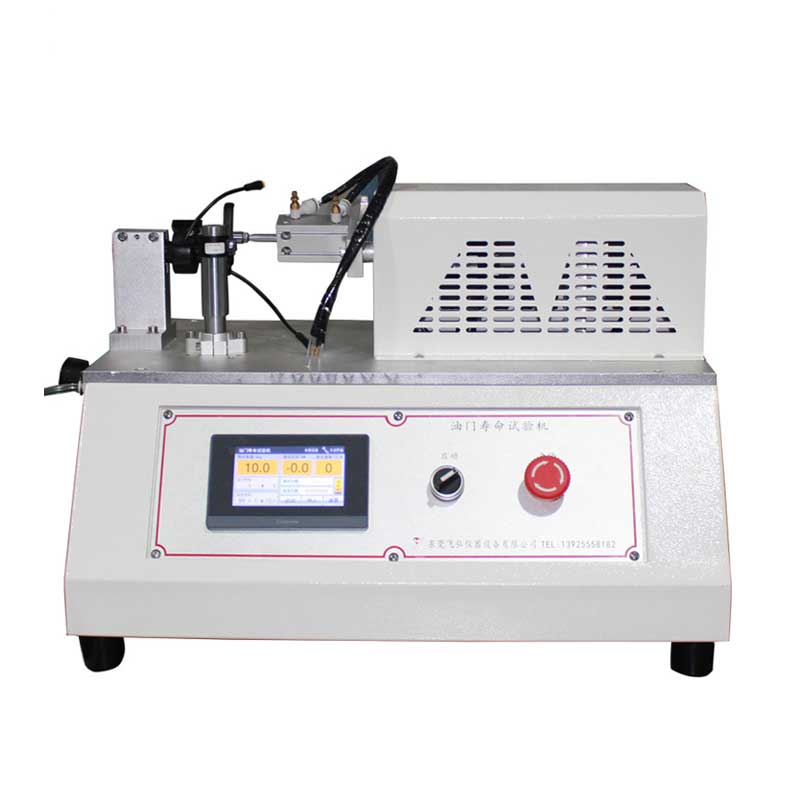
A scooter throttle life test machine must precisely replicate the actuation patterns that a throttle experiences in real-world use. The test setup consists of an actuation mechanism (typically pneumatic or servo-driven), a fixture to hold the throttle assembly, signal measurement instrumentation, and a data acquisition system. The actuator must be capable of applying force within ±2% of the specified actuation force and completing each cycle within the specified time interval.
The signal measurement system should capture the throttle output voltage at a minimum sampling rate of 1 kHz to detect transient anomalies such as contact bounce, signal spikes, or momentary dropouts. The data acquisition system records the voltage output at three critical positions per cycle: fully closed (0% throttle), mid-range (50% throttle), and fully open (100% throttle). These measurements are compared against the baseline calibration values recorded before the test begins.
Standard Test Protocol
The standard throttle life test protocol consists of the following sequence:
- Pre-test calibration: Record baseline signal values at 0%, 25%, 50%, 75%, and 100% throttle positions. Measure return time from 100% to 0%. Verify linearity and hysteresis within the manufacturer’s specified tolerance band.
- Endurance cycling: Execute the specified number of actuation cycles (typically 100,000 for EN 17128) at a rate of 1-2 cycles per second. Each full cycle consists of: actuate from 0% to 100%, hold at 100% for 0.2 seconds, release to 0%, hold at 0% for 0.3 seconds.
- Intermediate inspections: At 25%, 50%, and 75% of the total cycle count, pause the test and perform a full calibration check identical to the pre-test calibration. Record any deviations from baseline.
- Post-test evaluation: After completing all cycles, perform a final full calibration. Compare all parameters against the acceptance criteria defined in the applicable standard.
- Environmental stress testing (optional): Repeat the endurance test under conditions of elevated temperature (60°C), low temperature (-20°C), and high humidity (85% RH) to evaluate environmental robustness.
Accelerated Testing Considerations
Manufacturers often wish to accelerate throttle life testing to reduce time-to-market. However, acceleration must be approached with caution. Increasing the actuation rate beyond 2 cycles per second can introduce thermal effects that do not occur in real-world use—the Hall sensor may experience elevated temperatures at high cycling rates that would not occur at normal riding frequencies. Similarly, reducing the hold time at full throttle below 0.2 seconds may not allow sufficient time for the return spring to fully engage, potentially creating failure modes that are artifacts of the test rather than genuine product weaknesses.
The recommended approach is to maintain realistic cycling parameters (1-2 Hz) but run the test continuously 24/7 on dedicated test machines. At 1.5 cycles per second, a 100,000-cycle test completes in approximately 18.5 hours, which is achievable within a single day. For higher cycle counts required by some OEM specifications (200,000 or more), multiple test machines running in parallel can provide the necessary throughput.
Equipment Specifications
Selecting the right throttle life test machine requires careful consideration of several technical parameters. Below is a detailed specification table for a professional-grade scooter throttle life testing system.
When evaluating throttle life test equipment, pay particular attention to the actuation mechanism. Servo-driven actuators offer superior force control and repeatability compared to pneumatic systems, but they come at a higher cost. Pneumatic actuators are more affordable and can achieve sufficient accuracy for most standard compliance testing, but they may require more frequent calibration and are more susceptible to drift in environments with fluctuating air pressure. The DeRui scooter throttle life test machine uses a precision servo system with closed-loop force feedback, ensuring consistent actuation force throughout the entire test duration.
Data Analysis and Acceptance Criteria
Key Performance Metrics
Throttle life testing generates substantial data that must be systematically analyzed to determine whether the throttle assembly meets acceptance criteria. The primary metrics evaluated include signal accuracy, return time, linearity error, and hysteresis. Each of these metrics provides insight into a different aspect of throttle performance degradation.
Signal accuracy measures the deviation of the throttle output voltage from the baseline calibration value at each measurement point. EN 17128 requires that signal deviation remain within ±5% of the initial value after 100,000 cycles. More stringent OEM specifications may require ±3% or even ±2% deviation limits, particularly for scooters intended for shared-use fleets where throttle reliability is critical for rider safety across thousands of users.
Return time measures the elapsed time from the moment the actuation force is removed to the moment the throttle output signal falls below 5% of its maximum value. This metric directly correlates with rider safety—a throttle that returns slowly may continue to deliver power after the rider releases the grip. The EN 17128 limit of 0.5 seconds is a maximum; well-designed throttles typically achieve return times of 0.1-0.2 seconds even after extensive cycling.
Linearity error quantifies the deviation of the throttle’s voltage output from an ideal linear response across the full throttle range. A new throttle assembly typically exhibits linearity error below 2%. After 100,000 cycles, the acceptance threshold is typically set at 5% maximum linearity error, though this may vary by standard and application.
Hysteresis measures the difference in output signal between the increasing (accelerating) and decreasing (decelerating) directions at the same throttle position. Excessive hysteresis creates a “dead zone” where the rider moves the throttle but experiences no change in speed, which is both frustrating and potentially dangerous. Acceptable hysteresis values are typically below 3% of full-scale output for new throttles and below 5% after life testing.
Interpreting Test Results
A thorough analysis of throttle life test data goes beyond simple pass/fail determination against acceptance criteria. Trend analysis across the intermediate inspection points (25%, 50%, 75% of cycle count) reveals the degradation trajectory of each metric. A throttle that shows linear degradation with a gentle slope is likely to have a predictable service life, whereas one that shows sudden jumps or non-monotonic behavior may have underlying design issues that manifest unpredictably in the field.
Pro Tip: Always document the complete test data trail, including raw voltage readings at each inspection point. This data is invaluable for root cause analysis if a throttle fails in the field, and it provides the evidence base needed for design improvements in future product iterations.
Common Testing Challenges
Throttle life testing presents several practical challenges that testing laboratories and manufacturers must address to ensure reliable and reproducible results.
Fixture Design and Alignment
The test fixture must hold the throttle assembly in a configuration that accurately replicates its mounted position on the scooter. Misalignment between the actuator and the throttle lever can introduce off-axis forces that do not occur in real-world use, leading to premature failure or inaccurate results. A well-designed fixture should allow precise adjustment of the actuator angle and position in at least three axes (X, Y, and rotation), with a repeatability of ±0.5 mm for position and ±1° for angle.
Environmental Variability
Throttle performance can be significantly affected by ambient temperature and humidity. A test conducted at 30°C may yield different results than one conducted at 20°C, even for the same throttle model. To ensure reproducibility, the test environment should be maintained at 23±5°C and 50±20% relative humidity unless environmental stress testing is being performed. Climate-controlled test chambers are recommended for laboratories in regions with significant seasonal temperature variations.
Signal Noise and Measurement Resolution
Electric scooter throttle signals operate in the 0-5V range with resolutions typically requiring measurement accuracy of ±10 mV or better. Electromagnetic interference from the test machine’s motors, solenoids, or power supplies can introduce noise into the signal measurement path, potentially masking genuine signal drift or creating false positives. Proper shielding of signal cables, use of differential measurement techniques, and appropriate signal filtering (without over-filtering, which would mask real anomalies) are essential for reliable data acquisition.
Best Practices for Manufacturers
Based on extensive experience in scooter throttle testing, the following best practices can help manufacturers optimize their testing programs and improve product reliability.
- Test beyond the minimum: If the standard requires 100,000 cycles, test to 150,000 or 200,000. This provides a safety margin and reveals the actual durability ceiling of the design, which is valuable information for marketing claims and warranty calculations.
- Test multiple samples: Statistical confidence requires testing at least 3-5 samples from the same production batch. A single sample passing does not guarantee batch consistency, particularly for components that involve manual assembly steps.
- Include environmental stress: Standard ambient-condition testing alone is insufficient. Combine life cycling with temperature and humidity stress to simulate real-world conditions where scooters are used outdoors in varying climates.
- Monitor continuously: Rather than only checking at intermediate inspection points, implement continuous monitoring that records signal parameters at every cycle. Modern data acquisition systems can easily handle the data volume, and continuous monitoring catches transient failures that periodic inspections miss.
- Establish correlation with field data: Compare lab test results with warranty claim data and field failure reports. This correlation validates the test methodology and helps refine acceptance criteria to better predict real-world performance.
- Document everything: Maintain detailed test records including fixture configuration, environmental conditions, raw data files, and analysis results. This documentation is essential for audit compliance and for supporting product certification applications.
Frequently Asked Questions
Q1: How many cycles should a scooter throttle life test include?
EN 17128 specifies a minimum of 100,000 cycles, but this should be considered a baseline. For shared-use scooters that may be operated by dozens of different riders daily, testing to 200,000-300,000 cycles provides better confidence in long-term reliability. The exact cycle count should be determined based on the intended service life of the scooter and the expected frequency of throttle operation per ride.
Q2: Can throttle life testing be performed on a complete scooter, or only on the throttle component?
Both approaches are valid and serve different purposes. Component-level testing isolates the throttle assembly and provides precise, reproducible measurements of throttle-specific parameters. Full-scooter testing evaluates the throttle in the context of the complete electrical system, including the controller, motor, and wiring harness, which can reveal integration issues that component testing misses. Best practice is to perform both: component-level testing for compliance certification, and system-level testing for design validation.
Q3: What is the difference between throttle life testing and throttle endurance testing?
While the terms are often used interchangeably, throttle life testing typically refers to testing that simulates the full range of real-world throttle usage patterns, including partial actuations and varying actuation speeds. Throttle endurance testing is a subset that focuses on maximum-cycle testing at a fixed actuation pattern to determine the absolute durability limit. Life testing is more representative of real-world conditions, while endurance testing provides a worst-case durability baseline.
Q4: How do I calibrate the throttle signal measurement system?
Calibration should be performed using a traceable voltage reference standard with an accuracy at least four times better than the required measurement accuracy. For a ±10 mV measurement requirement, the calibration reference should be accurate to ±2.5 mV or better. Calibration should be verified before each test series and after any maintenance or modification of the measurement system. Record all calibration data in the test log.
Q5: What acceptance criteria should I use if my product targets multiple markets?
When targeting multiple markets with different standards, apply the most stringent requirements across all applicable standards. For example, if EN 17128 requires 100,000 cycles and ASTM F2264 requires 50,000 cycles, design and test to the 100,000-cycle requirement. Similarly, if one standard specifies ±5% signal deviation and another specifies ±3%, use ±3% as the acceptance threshold. This approach ensures a single product design can meet all market requirements without the need for market-specific variants.
Q6: How long does a typical throttle life test take to complete?
At the standard cycling rate of 1.5 Hz, a 100,000-cycle test takes approximately 18.5 hours of continuous machine operation. Including setup time, pre-test calibration, intermediate inspections, and post-test evaluation, the total test duration is typically 24-30 hours. For 200,000-cycle tests, plan for approximately 48-60 hours total duration. Multiple test stations operating in parallel can significantly reduce the calendar time required to test a full batch of samples.
Q7: Is throttle life testing required for regulatory compliance in all markets?
Throttle life testing is explicitly required under EN 17128 for the European market and is commonly expected by certification bodies in other regions. In the United States, UL 2272 certification includes requirements for electrical system durability that encompass throttle functionality. In China, GB/T 34667 includes specific provisions for control system reliability testing. While the exact requirements vary by jurisdiction, throttle life testing is effectively a universal requirement for any e-scooter seeking formal certification for sale in major markets.
Q8: What should I do if my throttle fails the life test?
If a throttle fails the life test, conduct a systematic root cause analysis. Begin by examining the failure mode—signal drift, stuck throttle, return spring fatigue, or another issue. Disassemble the failed unit and inspect for physical signs of wear, corrosion, or mechanical damage. Compare the failed unit with units that passed at intermediate inspection points to identify the point at which degradation accelerated. Based on the root cause, implement design modifications such as upgrading the return spring material, improving the Hall sensor encapsulation for moisture protection, or adjusting the contact geometry for potentiometer-type throttles. After implementing changes, re-run the full life test to validate the improvement.
Related Products
- ▸ Scooter Handlebar Fatigue Testing: Methods and Equipment
- ▸ Scooter Folding Mechanism Fatigue Test: EN 17128 Requirements
- ▸ Scooter Stem Fatigue Testing: EN 14619 & ASTM F2264 Compliance
- ▸ Scooter Motor Durability Testing: Best Practices for Manufacturers
- ▸ Scooter Drop Testing: Understanding Impact Durability Standards
Need Professional E-Scooter Testing Equipment?
Explore our range of testing machines designed for compliance with international standards.