Derui chamber
Tire quality directly determines the ride comfort, safety, and operational lifespan of every electric scooter that rolls off the production line. Among the dozens of quality parameters that manufacturers must monitor, tire roundness—also referred to as radial runout or trueness—stands as one of the most critical yet frequently underestimated metrics. A tire that deviates even slightly from a perfect circular profile generates vibrations, accelerates bearing wear, reduces battery range, and ultimately compromises rider safety at higher speeds. In this comprehensive guide, we explore the science behind tire roundness testing for electric scooters, the standards that govern acceptable tolerances, the equipment used to measure these deviations, and the best practices that leading e-scooter manufacturers follow to maintain consistent product quality.
Key Takeaways
- UL 2272 and EN 17128 are the primary safety standards governing e-scooter electrical and mechanical performance testing requirements.
- Frame fatigue testing for e-scooters requires higher impact energy levels compared to conventional bicycles due to additional battery and motor mass.
- Tire, wheel, and axle endurance tests simulate real-world urban riding conditions across varied road surfaces and loading scenarios.
- Brake system testing evaluates both mechanical and regenerative braking efficiency under dry and wet conditions per applicable standards.
- Environmental testing (IP rating, temperature cycling) ensures e-scooter safety across diverse operating climates and weather conditions.
📑 Table of Contents
What Is Tire Roundness?
Tire roundness, technically known as radial runout, measures the degree to which a tire’s profile deviates from a mathematically perfect circle when viewed from the side. In practical terms, it quantifies how much the tire’s outer surface moves closer to or farther from the axis of rotation as the tire completes one full revolution. This deviation is typically measured in millimeters or thousandths of an inch and is assessed at multiple points around the tire’s circumference.
In the context of electric scooters, tire roundness is especially important because e-scooter tires are generally small—ranging from 6 inches to 12 inches in diameter—compared to automobile or motorcycle tires. Smaller tires amplify the effects of roundness deviations. A 0.5 mm runout on a 26-inch bicycle tire may be barely perceptible, but that same 0.5 mm deviation on an 8.5-inch e-scooter tire translates into a significantly larger proportional variation, producing noticeable vibrations at typical riding speeds of 15–25 km/h. For premium e-scooters designed for commuting at speeds up to 45 km/h, even smaller deviations become problematic because the frequency of the vibration increases with rotational speed, causing resonance effects in the handlebars, deck, and rider’s hands.
Tire roundness must be distinguished from tire balance, which addresses mass distribution around the tire. A perfectly round tire can still be unbalanced if one section is denser than another. Conversely, a well-balanced tire may have poor roundness. Both parameters matter independently, but roundness testing is particularly critical during manufacturing because it reveals defects in the molding process, curing stage, and material uniformity that cannot be corrected by balancing weights alone.
Why Roundness Matters for E-Scooters
The impact of tire roundness on e-scooter performance spans multiple dimensions, from rider comfort to mechanical longevity. Understanding these impacts helps manufacturers justify the investment in dedicated roundness testing equipment and establish appropriate quality thresholds.
Ride Comfort and Vibration Transmission
When a tire with poor roundness rotates, it creates a periodic up-and-down motion at the contact patch. This motion transmits directly through the axle, fork, handlebars, and deck to the rider. Studies conducted by ride-sharing scooter operators have shown that vibration levels exceeding ISO 5349 exposure limits can cause rider fatigue within 20–30 minutes of continuous use. For shared-mobility fleets where average trip durations are 8–12 minutes, excessive vibration leads to poor user experience and increased customer churn. Premium consumer e-scooters targeting the commuter market face similar expectations for smooth ride quality, making roundness a key differentiator.
Component Wear and Durability
Non-circular tires impose cyclic loading patterns on bearings, axles, and frame attachment points. These dynamic loads can accelerate bearing degradation by 30–50% compared to properly round tires, based on accelerated life testing data from major e-scooter OEMs. For motorized scooters, the rear wheel’s roundness also affects the drive belt or chain tension in belt-drive or chain-drive models, leading to uneven wear patterns and premature replacement. Hub motor assemblies, which are the most common drivetrain configuration in e-scooters, are particularly sensitive because the stator and rotor clearances are very tight—excessive vibration can cause rubbing between components and degrade motor efficiency over time.
Battery Range and Energy Efficiency
The additional rolling resistance created by a non-circular tire directly impacts the energy consumed per kilometer. Testing has demonstrated that tires with radial runout exceeding 0.8 mm can reduce an e-scooter’s effective range by 3–7%, depending on tire size, riding speed, and road surface. For a scooter with a nominal range of 40 km, this represents a loss of 1.2–2.8 km—enough to strand a commuter who planned their trip around the advertised range. For fleet operators managing thousands of vehicles, this translates to significantly higher charging costs and more frequent battery swaps.
Safety Considerations
At speeds above 30 km/h, tire roundness deviations can cause the scooter to develop a wobble or oscillation in the handlebars, particularly during braking or cornering. This instability is not only uncomfortable but dangerous, as it reduces the rider’s ability to maintain a stable trajectory. In extreme cases, severe roundness defects can lead to localized tire wear patterns that weaken the tire structure and increase the risk of tread separation or blowout. Regulatory standards in several jurisdictions now include provisions related to tire quality as part of broader e-scooter safety requirements.
Measurement Principles and Parameters
Tire roundness testing for e-scooters measures several interrelated geometric parameters. Each parameter provides different insights into the tire’s manufacturing quality and its expected performance characteristics in the field.
Radial runout is the primary metric for e-scooter tire quality because it most directly correlates with the vibration experienced by the rider. Lateral runout, while less critical for ride feel, affects the tire’s tracking behavior and can cause the scooter to drift laterally during straight-line riding. Conicity is a more subtle defect that results from asymmetric tire construction—typically uneven belt or carcass ply placement—and causes the scooter to pull toward one side even when the handlebars are aligned straight ahead.
Advanced testing equipment can decompose the roundness deviation into its harmonic components. The first harmonic (one peak per revolution) indicates eccentricity—the tire’s center is offset from the axle center. The second harmonic (two peaks per revolution) suggests ovality—the tire is slightly elliptical. Higher-order harmonics reveal more complex surface irregularities such as those caused by mold imperfections, curing inconsistencies, or material joint overlaps. This harmonic analysis is invaluable for diagnosing the root cause of roundness defects and guiding process improvements at the manufacturing facility.
Testing Equipment Overview
Modern tire roundness testing equipment for e-scooter tires has evolved significantly from the manual dial-indicator gauges used in early bicycle and scooter manufacturing. Today’s machines offer automated measurement, digital data logging, statistical process control integration, and the ability to test tires at various rotational speeds that simulate real-world operating conditions.
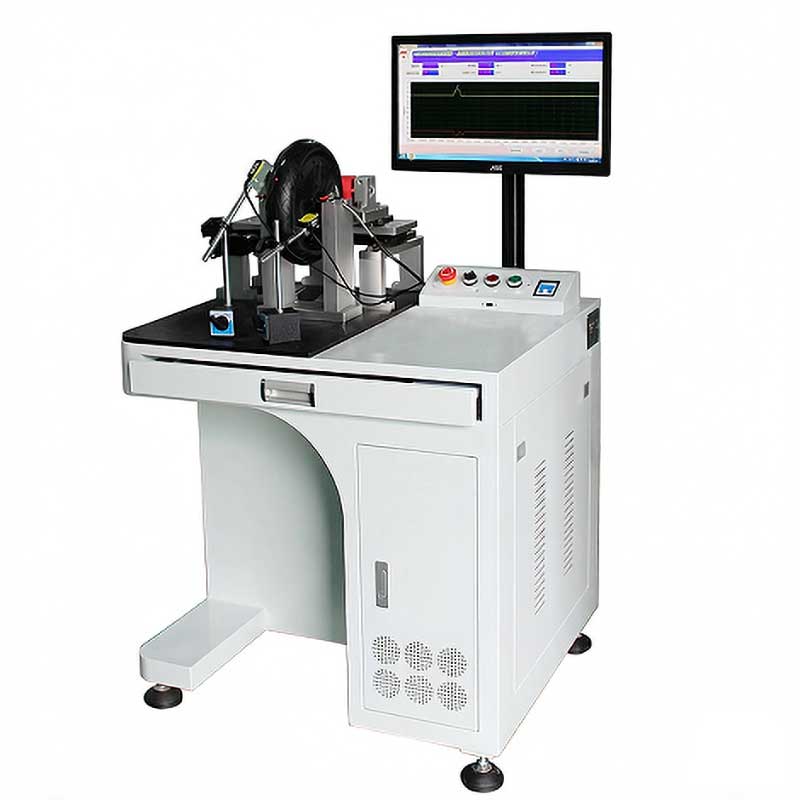
Dedicated Tire Roundness Testers
Dedicated tire roundness testing machines like the Tire True Roundness and Wobble Testing Machine are purpose-built for measuring radial and lateral deviations in small-diameter tires. These machines typically feature precision rotary spindles that hold the tire on its rim or mounted on a dedicated hub adapter. A high-resolution contact probe—usually a LVDT (Linear Variable Differential Transformer) or laser displacement sensor—traces the tire’s outer surface as it rotates, capturing thousands of data points per revolution.
Key specifications to look for when selecting a tire roundness tester for e-scooter applications include measurement resolution (should be ≤ 0.001 mm), maximum tire diameter (must accommodate the largest tire in the product range, typically up to 14 inches), spindle runout accuracy (must be better than the tire tolerance being measured, ideally ≤ 0.01 mm), and data output capabilities (USB, Ethernet, or direct integration with SPC software).
Comprehensive Tire Testing Systems
Some manufacturers prefer comprehensive tire testing systems that can measure multiple parameters in a single setup, including roundness, dynamic balance, tread depth uniformity, and sidewall stiffness. These integrated systems are more expensive but offer higher throughput and reduce the need for multiple test stations. For e-scooter OEMs producing more than 500 units per day, a comprehensive system can deliver significant cost savings through reduced handling time and consolidated quality data.
Inline Production Line Testers
For manufacturers implementing 100% inspection of outgoing tires, inline roundness testers can be integrated directly into the production conveyor. These automated systems load the tire, perform the measurement, and discharge it to either the pass or reject lane within seconds. Inline testers typically sacrifice some measurement resolution for speed—resolutions of 0.01–0.02 mm are common—but provide the assurance that every single tire meets the minimum quality threshold before it is shipped to the e-scooter assembly line.
Step-by-Step Testing Procedure
Performing tire roundness testing correctly requires attention to several critical details that can significantly affect measurement accuracy. The following procedure represents the industry best practice for e-scooter tire roundness testing on a dedicated bench-top tester.
Step 1: Equipment Calibration
Before beginning any measurement session, verify the machine’s calibration using a certified reference standard—typically a precision-machined master ring with known roundness values traceable to national standards. Run the master ring through the full measurement sequence and compare the instrument’s readings against the certificate of calibration. Any deviation exceeding 10% of the tire tolerance threshold (typically 0.05 mm for e-scooter applications) requires recalibration before proceeding. Most modern testers include automated calibration routines, but the master ring verification should still be performed at the start of each shift or at minimum once per day.
Step 2: Tire Mounting
Mount the tire on the test spindle using the appropriate hub adapter. For tires with inner tubes, test with the tube inflated to the manufacturer’s recommended operating pressure, as the tube affects the tire’s external profile. For tubeless tires, mount on the designated test rim and inflate to the specified pressure. Ensure the tire beads are properly seated in the rim well—improper seating is one of the most common causes of false roundness failures, where the tire itself is perfectly round but appears out-of-round due to uneven bead seating.
Step 3: Probe Positioning
Position the measurement probe so that it contacts the tire at the point of maximum radius—typically the center of the tread surface. The probe should be oriented radially inward toward the tire’s axis of rotation. For radial runout measurement, the probe measures the variation in distance from the spindle center to the tread surface. For lateral runout, a separate probe (or the same probe repositioned) measures side-to-side movement of the tire’s sidewall or tread edge.
Step 4: Measurement
Initiate the rotation at the specified test speed. For e-scooter tires, typical test speeds range from 2 to 10 RPM, which allows the probe to capture sufficient data points without introducing dynamic effects from centripetal forces. The machine records the radial position at each angular increment—modern testers typically sample at 1,000 to 3,600 points per revolution, providing extremely detailed roundness profiles. Allow the tire to complete at least three full revolutions and use the average of the last two revolutions to minimize startup transient effects.
Step 5: Data Analysis and Pass/Fail
The testing software calculates the total radial runout (maximum minus minimum radius), lateral runout, and optionally the harmonic components. Compare each measured value against the predefined tolerance for the specific tire model and size. The pass/fail determination should account for both the total indicator reading (TIR) and the individual harmonic amplitudes if specified by the OEM’s quality standard. Record all results in the quality database with the tire’s serial number, batch code, and test timestamp for traceability.
Industry Tolerance Standards
Unlike automotive tires, which benefit from decades of standardization through organizations like ISO, JATMA, and ETRTO, e-scooter tire roundness tolerances are not yet governed by a single international standard. Instead, each major e-scooter OEM typically establishes its own internal specifications, often adapted from bicycle tire standards such as ISO 5775 or from automotive practices scaled for smaller tires.
When establishing tolerance specifications, manufacturers should consider the interaction between tire roundness and other factors such as rim runout, bearing preload, fork alignment, and deck flexibility. In practice, the total perceived vibration is the sum of contributions from all rotating components, and excessively tight tire tolerances may not provide meaningful improvement if the rim or hub assembly has looser tolerances. A system-level approach to vibration management typically yields better results than optimizing individual components in isolation.
Best Practice Tip: When setting roundness tolerances for a new e-scooter model, start with the mid-range standard (≤ 0.5 mm radial) and then tighten or loosen based on prototype testing results. Measure the actual vibration at the handlebars using an accelerometer at representative speeds, and correlate the measured vibration levels with the tire roundness data to determine the real-world impact of the chosen tolerance. This data-driven approach ensures you invest quality-control resources where they provide the greatest benefit.
Common Defects and Root Causes
Understanding the most common causes of tire roundness defects enables manufacturers to implement targeted preventive measures rather than relying solely on end-of-line inspection to catch problems. The following are the most frequently encountered root causes identified through years of production quality analysis.
Mold Eccentricity
The most common cause of systematic roundness defects is mold eccentricity—when the mold’s cavity center does not perfectly align with the mold’s rotational axis during curing. This produces tires with a consistent first-harmonic deviation (eccentricity pattern) that shows up as a single high point and single low point per revolution. Mold eccentricity typically develops gradually over thousands of molding cycles due to thermal expansion, mechanical wear of the mold alignment pins, or debris accumulation in the mold’s locating features. Regular mold inspection and re-machining or re-alignment at defined intervals is the primary corrective action.
Uneven Curing
Non-uniform heat distribution during the vulcanization curing process causes differential shrinkage across the tire’s cross-section, resulting in ovality (second-harmonic deviation). This is particularly common in tires with thick tread sections or complex tread patterns where heat transfer through the rubber compound is uneven. Corrective measures include optimizing mold heating channel design, ensuring uniform platen temperature, and adjusting curing time and pressure profiles for tires with varying cross-sectional geometries.
Material Joint Overlap
During tire building, the rubber tread, carcass plies, and other components are joined at splice points. If the splice is too thick (overlap) or too thin (gap), it creates a localized deviation in the tire’s profile that appears as a higher-order harmonic in the roundness trace. Joint defects typically affect only one or two angular positions and are easy to identify through harmonic analysis. Improving the precision of the tire building machine’s splice mechanism and implementing automated splice monitoring can significantly reduce this type of defect.
Transportation and Storage Damage
Tires can develop roundness defects after manufacturing if they are subjected to improper handling, stacking, or storage conditions. Stacking tires flat without supports causes deformation over time, particularly for soft-compound tires used in premium e-scooters. Exposure to elevated temperatures during storage accelerates creep and permanent deformation. Proper storage practices—hanging tires on racks, avoiding point loads, and maintaining temperature control—are essential for preserving the roundness achieved during manufacturing.
Integrating Testing into QC Lines
For e-scooter manufacturers that produce or source tires in significant quantities, integrating roundness testing into the incoming quality control workflow provides early detection of supplier quality issues and prevents defective tires from reaching the assembly line. The integration strategy depends on the production volume and quality philosophy of the operation.
Sampling Inspection
For manufacturers sourcing tires from external suppliers, an acceptance sampling plan based on ISO 2859 (AQL standards) is the most common approach. A typical plan for e-scooter tires might specify AQL 1.0 for critical dimensions (roundness, runout) with a sample size of 13 units from each incoming batch of 500–1,200 tires. Any batch with two or more defective units is rejected or subjected to 100% inspection. Sampling inspection balances cost against quality assurance but carries the risk of accepting batches containing a percentage of defective tires up to the AQL limit.
100% Inline Inspection
Manufacturers with in-house tire production or those supplying premium e-scooter brands may implement 100% roundness inspection at the end of the tire production line. Inline testers integrated into the conveyor system can process 200–600 tires per hour depending on the complexity of the measurement sequence. The investment in inline equipment is justified by the elimination of warranty claims related to tire vibration, reduced assembly line downtime from incoming quality rejections, and the ability to provide real-time statistical process control data to the tire production team for continuous improvement.
SPC Data Management
Regardless of the inspection strategy, effective utilization of roundness testing data requires robust statistical process control (SPC) practices. Modern testing machines export data directly to SPC software that generates control charts (X-bar and R charts), calculates process capability indices (Cp, Cpk), and triggers alerts when the process drifts toward tolerance limits. A capable tire roundness process should achieve a Cpk of at least 1.33 (preferably 1.67 or higher for premium applications), meaning the process spread occupies no more than 75% of the tolerance band, providing adequate margin for normal process variation.
Frequently Asked Questions
Q1: What is the acceptable radial runout for an e-scooter tire?
For standard commuter e-scooters, the typical acceptable radial runout is ≤ 0.5 mm. Premium and high-performance models may specify ≤ 0.3 mm, while budget rental scooters may accept ≤ 1.0 mm. The exact tolerance should be defined by the OEM based on the scooter’s design speed, suspension characteristics, and intended use case.
Q2: How is tire roundness different from tire balance?
Roundness (radial runout) measures the geometric deviation of the tire’s profile from a perfect circle. Balance measures the distribution of mass around the tire. A tire can be perfectly round but unbalanced if one section is heavier than the opposite section, and vice versa. Both parameters affect ride quality independently, though they are often tested together in comprehensive tire quality systems.
Q3: Can I test tire roundness without dedicated equipment?
Basic roundness can be checked manually using a dial indicator mounted on a fixed stand, with the tire rotated on a smooth axle. However, this method is slow, operator-dependent, and insufficient for production quality control due to limited resolution and lack of data recording. Dedicated equipment is strongly recommended for any operation producing more than a few dozen e-scooters per month.
Q4: What causes a tire to fail roundness testing?
Common causes include mold eccentricity (misaligned mold halves), uneven curing temperature distribution, material splice overlap or gaps during tire building, improper bead seating during testing, and post-manufacturing deformation from poor storage or handling. Harmonic analysis of the roundness trace helps identify which of these root causes is responsible for a specific failure.
Q5: How often should roundness testing equipment be calibrated?
Master ring verification should be performed at the start of each shift or at minimum once per day. Full calibration (with adjustment if necessary) should be performed monthly or whenever the master ring check shows deviation exceeding 10% of the tolerance threshold. Annual calibration by an accredited laboratory ensures traceability to national measurement standards.
Q6: Does tire pressure affect roundness measurement results?
Yes, significantly. Tires must be tested at the manufacturer’s recommended operating pressure. Underinflated tires show increased runout because the sidewalls flex more, while overinflated tires may mask some profile deviations. Always use the same inflation pressure specified in the test procedure and verify pressure with a calibrated gauge before each measurement.
Q7: What test speed should I use for e-scooter tire roundness testing?
Standard practice uses low rotational speeds of 2–10 RPM for static roundness measurement, which avoids dynamic effects from centripetal forces and allows the probe to capture sufficient data points per revolution. Some advanced testers can also perform dynamic roundness tests at higher speeds (50–200 RPM) to evaluate tire behavior under simulated riding conditions, but this is generally reserved for R&D rather than production QC.
Q8: Is there an international standard specifically for e-scooter tire roundness?
Currently, there is no dedicated ISO or other international standard that specifies roundness tolerances exclusively for e-scooter tires. Most manufacturers adapt tolerances from ISO 5775 (bicycle tire standards) or JATMA/ETRTO automotive tire standards, scaled for the smaller diameter and different operating conditions of e-scooter tires. EN 17128 includes general tire quality provisions but does not specify explicit roundness values.
Q9: Can roundness defects be corrected after manufacturing?
Minor eccentricity caused by improper bead seating can sometimes be corrected by deflating, re-seating the beads on the rim, and re-inflating to the correct pressure. However, roundness defects originating from the molding or curing process are permanent and cannot be corrected—these tires must be rejected and returned to the supplier or scrapped. This is why incoming inspection is critical for catching systematic defects before tires reach the assembly line.
Q10: How does tire roundness affect e-scooter battery range?
Tires with radial runout exceeding 0.8 mm increase rolling resistance by 3–7%, which directly reduces the scooter’s effective range. For a scooter with a 40 km nominal range, this means losing 1.2–2.8 km per charge. The increased resistance arises from the tire’s variable contact patch size during each revolution, which creates micro-slips and additional deformation losses at every point around the circumference.
Related Products
style=”color:#fff;margin:0 0 12px;font-size:22px”>Ready to Upgrade Your Testing Capabilities?
Contact our engineering team to discuss your specific testing requirements and find the right solution.