Derui chamber
Electric motorcycle dyno testing has become an indispensable part of modern two-wheeled EV development and quality assurance. As manufacturers push for higher performance, longer range, and stricter compliance with international regulations, the dynamometer—commonly known as the dyno—serves as the definitive tool for measuring real-world power output, torque curves, and overall drivetrain efficiency. Whether you are an OEM developing a new electric motorcycle platform or a third-party testing laboratory validating production units, understanding how to properly configure, operate, and interpret results from an electric motorcycle dyno is critical. This technical guide covers every aspect of electric motorcycle dyno testing, from the fundamental principles of chassis dynamometry to advanced calibration techniques and data analysis methodologies.
Key Takeaways
- ECE R.62, ISO 4209, and UN Regulation No. 78 set the mandatory safety and performance benchmarks for motorcycle frame and component testing.
- Fatigue testing protocols require a minimum of 100,000 load cycles at specified force magnitudes to simulate multi-year real-world usage.
- Drop impact testing evaluates frame integrity at defined heights — typically 300-500 mm — to simulate crash scenarios and curb impacts.
- Steering head strength and torsion tests verify handling stability under extreme cornering loads encountered in sport and adventure riding.
- Exhaust system durability testing ensures compliance with noise emission regulations and vibration resistance across 5,000+ hours of operation.
📑 Table of Contents
- ▸ What Is a Chassis Dynamometer?
- ▸ Key Metrics in Dyno Testing
- ▸ How Dyno Testing Works for Electric Motorcycles
- ▸ Test Procedures and Protocols
- ▸ Efficiency Measurement Techniques
- ▸ Calibration and Accuracy
- ▸ Common Challenges and Solutions
- ▸ Data Analysis and Reporting
- ▸ Industry Standards and Regulations
- ▸ Choosing the Right Dyno Equipment
- ▸ FAQ
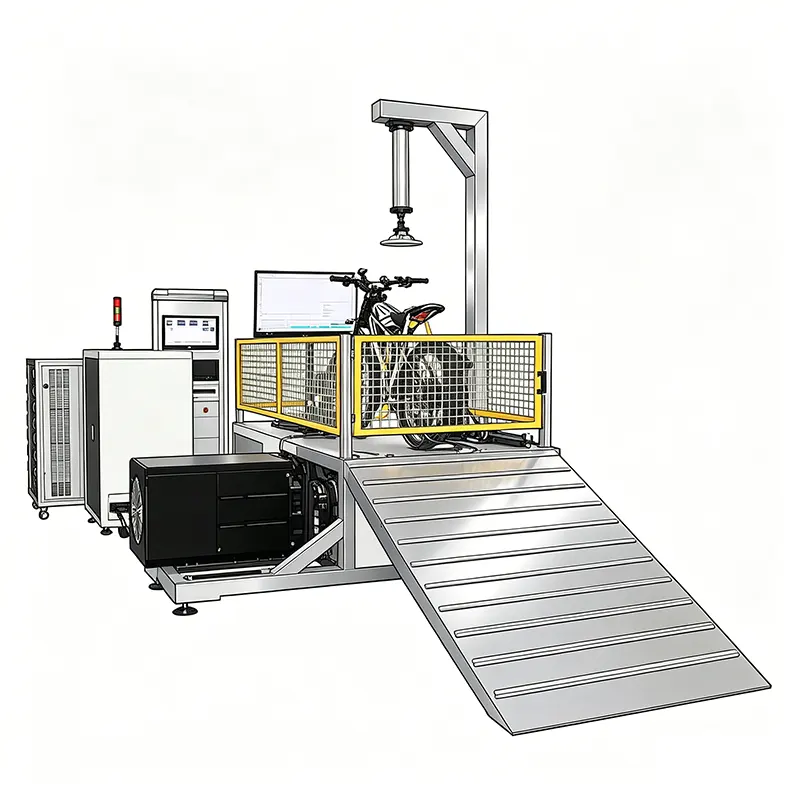
What Is a Chassis Dynamometer?
A chassis dynamometer is a precision testing instrument that measures the power and torque output of a vehicle at its drive wheels. Unlike an engine dynamometer, which connects directly to the engine crankshaft, a chassis dynamometer tests the complete powertrain as it operates in the vehicle. For electric motorcycles, this means the dyno measures the combined output of the electric motor, motor controller, transmission (if any), and drive system as a single integrated unit. The motorcycle is positioned on the dyno with its rear wheel resting on a set of rotating rollers. As the motor drives the wheel, the rollers spin, and load cells and speed sensors capture torque and rotational speed data in real time.
Chassis dynamometers come in several configurations, but the most common types for electric motorcycle testing are single-roller and double-roller designs. Single-roller systems use one large-diameter drum (typically 48 to 72 inches) that the tire contacts from above. This design closely replicates flat-road conditions and minimizes tire deformation. Double-roller systems use two smaller-diameter rollers positioned side by side, with the tire sitting between them. This configuration provides better tire grip and is easier for loading the motorcycle onto the machine. For electric motorcycle applications, double-roller chassis dynamometers are widely preferred because they offer superior traction control during high-torque, low-speed testing scenarios that are characteristic of electric drivetrains.
Modern electric motorcycle dynos integrate advanced features specifically designed for EV testing, including regenerative braking simulation, bidirectional power flow measurement, high-speed data acquisition (up to 1000 Hz or more), and software interfaces that display real-time power curves, efficiency maps, and thermal profiles. These capabilities go far beyond what traditional internal combustion engine dynos offer, making them essential for the unique requirements of electric powertrain validation.
Key Metrics in Dyno Testing
Electric motorcycle dyno testing revolves around three primary metrics: peak power, continuous power, and torque. Understanding the distinction between these measurements is fundamental to interpreting dyno data correctly and making informed engineering decisions.
Peak power represents the absolute maximum power the electric motorcycle can deliver, typically measured during a wide-open-throttle acceleration run from low speed to top speed. For a mid-range electric motorcycle, peak power typically falls between 5 kW and 15 kW for commuter models, 15 kW to 40 kW for sport-oriented machines, and can exceed 100 kW for high-performance racing motorcycles. Continuous power, by contrast, is the power the motor can sustain indefinitely without overheating. This metric is particularly important for electric motorcycles because thermal management directly affects real-world range and usability. A motor that delivers 40 kW peak but only 10 kW continuous will struggle during extended highway riding.
Torque is the rotational force the motor produces, and electric motors excel at delivering high torque from zero RPM—a characteristic that fundamentally differs from internal combustion engines. The instant torque delivery of electric motors means that the dyno must be capable of measuring very high torque values at very low rotational speeds, which presents unique challenges for instrumentation accuracy. Modern electric motorcycle dynos use strain-gauge load cells with high sensitivity at low forces to capture this data accurately.
How Dyno Testing Works for Electric Motorcycles
The dyno testing process for electric motorcycles follows a structured workflow that begins with equipment preparation and ends with comprehensive data analysis. The first step involves securing the motorcycle on the dynamometer platform. The rear wheel is positioned on the rollers, and restraint straps are attached to the frame at multiple points to prevent the motorcycle from moving forward or backward during testing. For electric motorcycles, additional precautions are necessary because the high, instantaneous torque can cause rapid acceleration on the rollers if the throttle is applied abruptly. Most modern dyno systems include an emergency stop mechanism and automatic throttle cut-off if roller speed exceeds a preset threshold.
Once the motorcycle is secured, the test operator configures the dyno software with the motorcycle’s specifications, including tire circumference, total vehicle weight, and the test protocol to be executed. Tire circumference is critical because it determines the relationship between roller rotational speed and actual ground speed. An incorrect tire circumference value will introduce systematic errors in all speed-dependent measurements. The tire pressure should be set to the manufacturer’s recommended value and measured with a calibrated gauge before each test session.
The core measurement principle of a chassis dynamometer is straightforward: the dyno measures the torque applied to the rollers and the rotational speed of the rollers, then calculates power using the formula P = T × ω, where P is power in watts, T is torque in Newton-meters, and ω is angular velocity in radians per second. In practice, the torque is measured by a load cell that detects the reaction force on the dynamometer’s absorption unit (typically an eddy-current brake or a permanent-magnet motor used as an absorber), and the speed is measured by an optical encoder or magnetic pickup attached to the roller shaft.
For electric motorcycle testing specifically, the dyno must also measure energy consumption simultaneously with power output. This is accomplished by integrating a high-precision power analyzer into the battery circuit to measure voltage and current draw from the battery pack while the dyno measures mechanical output at the wheel. By comparing electrical input power to mechanical output power, the overall drivetrain efficiency can be calculated at any operating point. This bidirectional measurement capability is what distinguishes an electric motorcycle dyno from a conventional one.
Test Procedures and Protocols
Standardized test procedures ensure that dyno results are repeatable, comparable, and meaningful. The following protocols represent the most commonly used test methods in electric motorcycle development and production testing.
Full-Load Acceleration Test
The full-load acceleration test is the primary method for determining peak power and torque. The motorcycle is started from a standstill (or from a low reference speed, typically 10 km/h) and accelerated at full throttle through the entire speed range up to the maximum speed. The dyno records power and torque at each speed increment, generating a complete power curve. For electric motorcycles, this test reveals the characteristic flat torque curve that extends from zero RPM to the motor’s base speed, after which torque decreases inversely with speed while power remains relatively constant. A typical test run takes 15 to 45 seconds depending on the power level and maximum speed of the motorcycle.
Continuous Power Test
The continuous power test evaluates the motorcycle’s ability to sustain power output over an extended period without thermal derating. The motorcycle is operated at a specified power level (typically 80% of peak power or the manufacturer’s claimed continuous rating) for a minimum of 30 minutes. During the test, the dyno monitors power output, motor temperature (via thermocouples attached to the motor casing), controller temperature, and coolant temperature (if liquid-cooled). A well-designed thermal management system should maintain power output within 5% of the initial value throughout the 30-minute test. Significant power drop indicates inadequate cooling or motor design limitations that could affect real-world performance during sustained riding.
Economy and Range Simulation
Range simulation testing uses the dyno to replicate standardized driving cycles—such as the WMTC (World Motorcycle Test Cycle) or custom urban/suburban/highway profiles—to estimate real-world energy consumption and range. The dyno applies a varying load profile that simulates acceleration, cruising, deceleration, and idle phases according to the cycle specification. Energy consumed during the cycle is measured precisely, and the result is extrapolated to estimate total range based on the usable battery capacity. This test is critical for marketing claims and regulatory compliance, as range figures must be substantiated by standardized test data.
Efficiency Measurement Techniques
Drivetrain efficiency is one of the most critical metrics for electric motorcycles because it directly determines range per charge. A seemingly small efficiency difference—say, 85% versus 90%—can translate to a meaningful range reduction in real-world riding. The dyno measures efficiency by simultaneously recording electrical power input from the battery (voltage × current) and mechanical power output at the wheel (torque × angular velocity). The ratio of output to input, expressed as a percentage, gives the total drivetrain efficiency.
Efficiency is not a single number; it varies significantly with operating conditions. Electric motors are most efficient at moderate speeds and loads, typically around 70-80% of their maximum rated speed and 50-70% of their maximum torque. At very low speeds, fixed losses (such as bearing friction, windage, and controller standby power) become a large proportion of total power, reducing efficiency. At very high speeds, copper losses (I²R heating in the motor windings) and iron losses (eddy currents and hysteresis in the stator core) increase substantially. A comprehensive efficiency map requires testing at multiple speed-load combinations, which is accomplished through a speed step test protocol where the motorcycle is stabilized at 5-10 km/h increments and efficiency is measured at each point.
Key Insight: Most electric motorcycles achieve peak drivetrain efficiency between 40-80 km/h, which conveniently aligns with typical urban commuting speeds. A well-optimized system should deliver 88-93% efficiency in this range. High-performance motorcycles with large motors may see efficiency drop to 80-85% at peak power due to increased thermal and electrical losses.
Regenerative braking efficiency is another important parameter that the dyno can measure. During regen testing, the motorcycle is decelerated from a reference speed (typically 60 km/h or 80 km/h) using the regenerative braking system while the dyno measures the power fed back to the battery. The regen efficiency is calculated as the ratio of energy returned to the battery to the kinetic energy lost by the vehicle. Typical regen efficiencies range from 40% to 70%, depending on the sophistication of the motor controller and the health of the battery pack. Higher regen efficiency directly improves overall vehicle range, especially in stop-and-go urban driving conditions.
Calibration and Accuracy
Accurate dyno results depend entirely on proper calibration and maintenance of the testing equipment. The calibration process involves verifying the accuracy of all measurement systems against traceable reference standards. Torque calibration is performed using certified calibration weights or a torque arm with known dimensions, applying known forces to the load cell and verifying that the dyno’s reading matches the calculated torque within the specified tolerance (typically ±0.5% of reading). Speed calibration uses a high-precision tachometer or strobe light to verify that the roller speed reading matches the actual rotational speed.
Power calibration combines torque and speed calibration and can be verified by driving the roller at a known speed with a known torque load and confirming that the calculated power matches. Additionally, the electrical measurement system (voltage probes, current shunts or Hall-effect sensors, and power analyzer) must be calibrated independently using reference voltage and current sources. For electric motorcycle testing, the electrical measurement accuracy is particularly important because even small errors in current or voltage measurement compound when calculating energy consumption over long test durations.
Environmental factors also affect dyno accuracy and must be controlled or corrected. Tire temperature changes during testing alter the tire’s rolling resistance and grip characteristics, which can cause power readings to drift by 2-5% over the course of a long test session. Ambient temperature affects motor and battery performance, with lithium-ion batteries delivering less energy at low temperatures and more energy (but with accelerated degradation) at high temperatures. Most professional testing laboratories maintain ambient temperature at 23±3°C and relative humidity at 50±20% per ISO 558 requirements, and perform tire warm-up runs before recording test data.
Common Challenges and Solutions
Electric motorcycle dyno testing presents several challenges that differ from conventional ICE dyno testing. Understanding these challenges and implementing appropriate solutions is essential for obtaining reliable and meaningful results.
Challenge 1: Tire Slip at High Torque. Electric motors deliver maximum torque from zero RPM, which can cause the tire to slip on the rollers during initial acceleration. Tire slip invalidates power and torque measurements because the roller speed no longer accurately represents the wheel speed. Solutions include using textured or knurled rollers to increase grip, applying higher strap tension, and performing a tire warm-up to increase tire temperature and grip coefficient before the actual test run. Some advanced dynos use a closed-loop speed control that automatically reduces throttle if wheel slip is detected.
Challenge 2: Thermal Management Interference. During extended testing, the motor and controller temperatures rise, which can trigger the motorcycle’s built-in thermal protection and reduce power output. While this is exactly the behavior the continuous power test is designed to capture, it can interfere with other tests that require consistent power output. Using a fan to direct airflow over the motor and controller can help stabilize temperatures for shorter-duration tests, but the fan must be positioned carefully to avoid cooling the tire (which would alter rolling resistance) or affecting the thermocouple readings.
Challenge 3: Measurement Noise at Low Speed. At very low wheel speeds (below 10 km/h), the signal-to-noise ratio of torque measurements degrades because the torque signal is small and the roller encoder resolution may be insufficient. This can cause erratic power readings in the low-speed range. Using high-resolution encoders (2048+ pulses per revolution) and applying digital filtering (low-pass or moving average) to the raw data can significantly improve low-speed measurement quality. Some dyno manufacturers offer special low-speed measurement modules specifically designed for electric vehicle testing.
Data Analysis and Reporting
The raw data generated by a dyno test session requires careful analysis and interpretation to extract meaningful engineering insights. Modern dyno software provides built-in tools for data visualization, including power and torque curves plotted against vehicle speed or motor RPM, efficiency contour maps, and thermal profiles. However, engineers should also perform manual analysis to validate the software’s automatic calculations and identify anomalies that automated systems might miss.
A comprehensive dyno test report should include the following elements: test identification (date, operator, motorcycle model and VIN), environmental conditions (ambient temperature, humidity, atmospheric pressure), equipment identification (dyno model, calibration date, calibration certificate number), motorcycle specifications (tire size and pressure, total weight, battery state of charge), test protocol description with all parameters, raw data plots (power, torque, speed vs. time), processed data plots (power and torque curves, efficiency map), statistical analysis (mean, standard deviation, coefficient of variation for repeated tests), and a conclusion comparing results to specifications or previous test data. Including uncertainty analysis—the estimated measurement uncertainty for each key metric—demonstrates the rigor of the testing process and is often required for regulatory submissions.
Industry Standards and Regulations
Several international standards and regulations govern electric motorcycle dyno testing, each addressing different aspects of performance measurement and safety compliance.
- UN ECE R68: Defines the measurement method for maximum speed of two- and three-wheeled vehicles, including electric motorcycles. Requires speed measurement under controlled conditions with the vehicle at maximum design mass.
- UN ECE R92: Covers the measurement of power and torque for motorcycle engines and powertrains. While originally written for ICE engines, the principles are applied to electric powertrains with appropriate modifications for electric motor characteristics.
- ISO 6469-1: Specifies safety requirements for electrically propelled road vehicles, including test methods for measuring power output and energy consumption of the traction battery system.
- WMTC (GTR No. 10): The Worldwide Harmonized Motorcycle Test Cycle used for type approval of emissions, fuel consumption, and energy consumption. Applies to electric motorcycles for range and energy consumption declarations.
- GB/T 24156 (China): Chinese national standard for electric motorcycle performance testing methods, including specific provisions for dyno-based power and range testing.
Manufacturers targeting multiple markets must ensure their dyno testing covers all applicable standards for each target region. A motorcycle destined for both European and Chinese markets, for example, must comply with both ECE regulations and GB/T standards, which may require slightly different test configurations or operating conditions.
Choosing the Right Dyno Equipment
Selecting a chassis dynamometer for electric motorcycle testing requires careful evaluation of several factors. The maximum power absorption capacity must exceed the peak power of the motorcycles to be tested by at least 20-30% to provide adequate margin. For most electric motorcycle applications, a dyno rated for 75-150 kW at the roller is sufficient. The maximum speed rating should accommodate the top speed of the fastest motorcycle to be tested, typically 160-200 km/h for production motorcycles and up to 300 km/h for racing applications.
The absorption system type is another critical selection criterion. Eddy-current absorbers offer simple, reliable operation and are well-suited for steady-state testing, but they cannot absorb power during deceleration (when the motorcycle is braking, the rollers drive the absorber). AC regenerative absorbers can both absorb and motor the rollers, making them ideal for electric motorcycle testing because they can simulate regenerative braking and perform bidirectional power flow tests. AC absorbers also offer finer control and faster transient response, which is important for reproducing dynamic driving cycles.
Software capabilities should be evaluated carefully. The dyno software should support electric-vehicle-specific test protocols, including bidirectional power measurement, regen braking simulation, and battery energy consumption tracking. Integration with battery simulation systems and motor controller diagnostic tools is a valuable feature for development laboratories. Additionally, consider the data export capabilities—the software should be able to export test data in standard formats (CSV, MDF, or similar) for analysis in third-party engineering software.
Frequently Asked Questions
1. What is the difference between a chassis dyno and an engine dyno for electric motorcycles?
A chassis dynamometer measures power at the drive wheel, capturing the performance of the entire drivetrain including the motor, controller, transmission, and drive components. An engine dyno (in the context of EVs, often called a motor test bench) connects directly to the motor shaft and measures only the motor’s output. Chassis dyno results include drivetrain losses (typically 3-8% for chain-driven electric motorcycles), while motor dyno results represent pure motor performance. For type approval and consumer-facing specifications, chassis dyno results are more relevant because they reflect real-world performance at the wheel.
2. How often should a chassis dynamometer be calibrated?
Calibration frequency depends on usage intensity and regulatory requirements. For production testing facilities, torque and speed calibration should be verified at least every 6 months, with a full recalibration annually. For development laboratories performing precision measurements, monthly calibration verification is recommended. Any event that could affect calibration—such as a physical impact to the load cell, a power surge, or a major temperature change in the testing environment—should trigger an immediate calibration check.
3. Can a standard motorcycle dyno be used for electric motorcycle testing?
A standard motorcycle dyno can be used for basic power and torque measurements on electric motorcycles, but it will lack several critical capabilities. Standard dynos typically cannot measure regenerative braking power, do not have integrated battery power measurement, and may have insufficient low-speed measurement accuracy for electric motor characteristics. For comprehensive electric motorcycle testing, a dyno with EV-specific features—bidirectional operation, electrical power measurement integration, and low-speed optimization—is strongly recommended.
4. What tire pressure should I use for dyno testing?
Always use the motorcycle manufacturer’s recommended tire pressure as specified in the owner’s manual or service manual. Tire pressure significantly affects rolling resistance, tire deformation on the rollers, and consequently the power readings. Even a 0.2 bar deviation from the recommended pressure can alter power readings by 1-2%. Check and adjust tire pressure before every test session using a calibrated digital gauge, and recheck after the tire has warmed up during initial stabilization runs.
5. How does battery state of charge affect dyno test results?
Battery state of charge (SoC) has a measurable impact on electric motorcycle performance. At low SoC (below 20%), the battery’s internal resistance increases, which reduces the maximum current the battery can deliver and consequently limits peak power output. Most manufacturers specify that performance tests should be conducted with the battery at 80-100% SoC to ensure consistent results. For range testing, the battery should be fully charged to 100% SoC at the start of the test, and the test continues until the battery management system reduces power output due to low SoC.
6. What is the typical drivetrain efficiency of an electric motorcycle?
Typical total drivetrain efficiency (from battery to wheel) for a well-designed electric motorcycle ranges from 82% to 92%, depending on the motor type, controller efficiency, drive configuration, and operating conditions. Belt-driven systems tend to be slightly more efficient (89-92%) than chain-driven systems (85-90%) due to lower friction losses. Hub motor configurations eliminate the chain or belt entirely and can achieve 88-91% efficiency, though they add unsprung weight to the wheel. The efficiency value varies with speed and load, so a single number should always be accompanied by the specific test conditions under which it was measured.
7. Is it necessary to test regenerative braking on the dyno?
Yes, if the electric motorcycle is equipped with a regenerative braking system, testing its performance on the dyno is highly valuable. The dyno can precisely measure the amount of energy recovered during deceleration events, the power level of regenerative braking at different speeds, and the transition smoothness between regenerative and mechanical braking. This data is essential for optimizing the regen control algorithm, validating that the system meets its design targets, and ensuring that regen braking integrates properly with the conventional brake system for safety compliance.
8. What safety precautions are required for electric motorcycle dyno testing?
Electric motorcycle dyno testing requires specific safety precautions beyond those for ICE motorcycles. The high voltage battery system (typically 48V to 400V+) presents electrocution risk—only trained personnel should handle the motorcycle, and insulated tools must be used. The lithium-ion battery presents a fire risk during thermal runaway, so a fire extinguisher rated for electrical fires (Class C or ABC) and lithium battery fires must be readily accessible. The motorcycle should be securely strapped with at least four anchor points, and the dyno area should be equipped with an emergency stop button accessible from both the operator station and the motorcycle position. Additionally, the test area should be well-ventilated to prevent hydrogen gas accumulation (produced during battery charging) and to dissipate heat generated during testing.
Related Products
Need Professional Motorcycle Testing Equipment?
Explore our range of testing machines designed for compliance with international standards.