Derui chamber
ECE R78 is the United Nations Economic Commission for Europe regulation that governs braking performance for motorcycles, mopeds, and tricycles sold in European and many international markets. For manufacturers seeking type approval, compliance with ECE R78 is not optional—it is a legal prerequisite. This guide provides a complete technical walkthrough of ECE R78 brake testing requirements, covering test procedures, equipment specifications, performance criteria, and common pitfalls that cause certification failures.
Key Takeaways
- ECE R.62, ISO 4209, and UN Regulation No. 78 set the mandatory safety and performance benchmarks for motorcycle frame and component testing.
- Fatigue testing protocols require a minimum of 100,000 load cycles at specified force magnitudes to simulate multi-year real-world usage.
- Drop impact testing evaluates frame integrity at defined heights — typically 300-500 mm — to simulate crash scenarios and curb impacts.
- Steering head strength and torsion tests verify handling stability under extreme cornering loads encountered in sport and adventure riding.
- Exhaust system durability testing ensures compliance with noise emission regulations and vibration resistance across 5,000+ hours of operation.
📑 Table of Contents
What Is ECE R78?
ECE Regulation No. 78 was established by the United Nations Economic Commission for Europe (UNECE) as a uniform provision for the approval of vehicles with regard to braking. Originally adopted in the 1990s and updated several times since, ECE R78 applies to category L vehicles—motorcycles (L3e), mopeds (L1e), tricycles (L5e), and quadricycles (L6e/L7e). The regulation specifies minimum braking performance levels, test procedures for dry and wet surfaces, requirements for anti-lock braking systems (ABS), and partial braking system failure conditions.
The significance of ECE R78 extends far beyond Europe. Over 60 countries recognize UNECE regulations as part of their type approval framework, including all EU member states, the UK, Japan, South Korea, Australia, and numerous others. For motorcycle manufacturers, this means that ECE R78 compliance opens doors to multiple markets simultaneously, making it one of the most commercially important regulations in the two-wheeler industry.
The regulation has evolved significantly since its inception. The 03 series of amendments, which is the current version most commonly referenced, introduced mandatory ABS requirements for motorcycles above 125cc, updated stopping distance requirements, and added provisions for combined braking systems (CBS). Understanding which amendment series applies to your product is critical, as the performance thresholds differ between versions.
Scope and Vehicle Classifications
ECE R78 categorizes vehicles into several groups based on engine displacement and design speed. Each category has distinct braking performance requirements that reflect the operational characteristics and risk profiles of the vehicle type.
The ABS mandate for motorcycles of 125cc and above was a landmark change introduced in the 03 series amendments. This requirement has driven significant investment in ABS technology across the industry, with suppliers like Bosch, Continental, and Nissin developing compact, motorcycle-specific ABS units. For electric motorcycles, which are classified under L3e based on their power output and maximum speed, ABS compliance is equally mandatory.
Brake Test Procedures Under ECE R78
Type 0 Test: Normal Stopping Distance
The Type 0 test is the fundamental braking performance test. The vehicle is accelerated to the specified test speed, and then the brakes are applied with a controlled lever or pedal force. The test measures the stopping distance from the moment the brake control is actuated until the vehicle comes to a complete stop. For category L3e motorcycles, the test is typically conducted from 60 km/h and 100 km/h, with separate requirements for each speed.
The test procedure specifies exact conditions: the vehicle must be loaded to its maximum technically permissible mass (or a defined test mass), tire pressure must be set to manufacturer specifications, and the test surface must have a peak braking coefficient (PBC) of at least 0.8 as measured by a reference tire. Ambient temperature must be between 4°C and 45°C, and wind speed must not exceed 5 m/s. These environmental constraints are essential for reproducibility and are strictly verified during type approval audits.
During the Type 0 test, the rider applies the front brake only, the rear brake only, and both brakes simultaneously in separate runs. Each configuration has its own stopping distance requirement. The application force must be within the specified limits—typically 200-350 N for hand levers and 350-700 N for foot pedals—ensuring that the test reflects realistic rider inputs rather than extreme forces that could lock the wheels.
Type I Test: Fade Resistance
The Type I test evaluates brake fade resistance by subjecting the braking system to repeated stops from a specified speed. For motorcycles, this typically involves 10 consecutive stops from 100 km/h at 3-minute intervals, with each stop achieving a deceleration of at least 3.0 m/s². After the fade sequence, a final Type 0 test is performed to verify that the stopping distance has not deteriorated beyond 120% of the original Type 0 result.
Brake fade occurs when the friction coefficient of the brake pads or shoes decreases due to elevated temperatures at the friction interface. As temperatures rise above 300-400°C, most organic brake pad compounds begin to lose effectiveness, with resin binders melting and forming a lubricating layer between the pad and disc. The Type I test ensures that even under thermal stress, the braking system retains sufficient performance to bring the vehicle to a safe stop.
Wet Brake Test
The wet brake test evaluates braking performance after the brake components have been exposed to water. This simulates riding through heavy rain or standing water. The procedure involves spraying water onto the brake disc or drum at a specified flow rate (typically 2-3 liters per hour per brake) while the vehicle is driven at a constant speed for a defined distance. Immediately after wetting, a Type 0 stop is performed, and the stopping distance must not exceed 150% of the dry Type 0 requirement.
Wet brake performance is particularly critical for motorcycles because the exposed nature of disc brakes means they are directly affected by road spray. Water on the disc surface creates a hydrodynamic film that significantly reduces the friction coefficient between pad and disc. The test verifies that the brake system can clear this water film quickly enough—typically within the first 1-2 seconds of brake application—to provide adequate stopping power.
Performance Criteria and Stopping Distance Requirements
ECE R78 defines specific stopping distance limits for each vehicle category and test condition. These limits have been derived from extensive research into real-world accident data and represent the minimum performance level needed to avoid collisions in typical emergency scenarios.
The stopping distance values above assume a dry, high-grip surface. On wet surfaces, the limits are relaxed by 50% to account for the reduced tire-road friction coefficient. It is worth noting that these are minimum requirements—most modern motorcycles significantly outperform these thresholds when equipped with quality braking systems. A typical 250cc motorcycle with dual disc front brakes can achieve stopping distances of 12-14 meters from 60 km/h, well below the 19-meter limit.
The deceleration requirements provide an alternative compliance path. Instead of measuring stopping distance, manufacturers may demonstrate a mean fully developed deceleration (MFDD) of at least 5.2 m/s² for the combined brake test at 60 km/h. MFDD is calculated between 80% and 10% of the initial test speed, excluding the transient response at the beginning and end of the braking event. This method is often preferred because it is less affected by reaction time and initial speed variations.
Test Equipment Requirements
Conducting ECE R78 brake tests requires specialized measurement and control equipment that meets stringent accuracy requirements. The quality of your test equipment directly affects the reliability and acceptance of your results by type approval authorities.
Speed Measurement Systems
Speed must be measured with an accuracy of ±1% or better. Most test laboratories use either optical speed sensors (such as the Correvon or Datron systems) that project a light pattern onto the road surface and measure the Doppler shift, or GPS-based systems with RTK correction that achieve sub-centimeter position accuracy. Fifth-wheel systems, while still used in some labs, are less reliable on rough surfaces and are increasingly being replaced by non-contact methods.
Brake Force Application
The force applied to the brake lever or pedal must be measured with an accuracy of ±5 N or better. Load cells integrated into custom brake levers and pedal pads are the standard approach. The force application rate is also critical—the regulation specifies that the force must be applied progressively, reaching the target value within 0.2 to 0.5 seconds. Too-rapid application can trigger ABS prematurely, while too-slow application may not generate sufficient deceleration.
Data Acquisition Systems
A high-speed data acquisition system is essential for capturing the transient behavior of the braking system. Key parameters include vehicle speed (sampled at ≥100 Hz), brake force (≥200 Hz), brake disc temperature (via infrared sensors or embedded thermocouples at ≥10 Hz), and brake hydraulic pressure (≥200 Hz). The system must also record ambient temperature, wind speed, and road surface condition for each test run.
ABS Testing Requirements
Since the 03 series amendments, ECE R78 mandates ABS for all L3e category motorcycles with engine displacements of 125cc or greater. The ABS testing protocol is one of the most technically demanding aspects of the regulation, requiring precise control of test conditions and careful data analysis.
Low-Friction Surface Test
The ABS must be tested on a low-friction surface with a peak braking coefficient (PBC) between 0.3 and 0.5. The vehicle is braked from 60 km/h with both front and rear brakes applied simultaneously at maximum force. The ABS must prevent wheel lock-up, and the vehicle must remain stable throughout the stop without lateral deviation exceeding 1.5 meters from the original course. This test verifies that the ABS can modulate brake pressure effectively when grip is severely limited, such as on wet leaves, ice, or loose gravel.
High-to-Low Friction Transition
One of the most critical ABS tests involves transitioning from a high-friction surface (PBC ≥ 0.8) to a low-friction surface (PBC ≤ 0.3) during hard braking. This simulates the real-world scenario of encountering a patch of ice or wet leaves while braking. The ABS must detect the sudden change in grip and rapidly reduce brake pressure to prevent wheel lock-up on the slippery surface. The transition must occur within one wheel revolution, requiring the ABS ECU to detect the wheel deceleration spike and respond in under 20-30 milliseconds.
Low-to-High Friction Transition
The reverse transition—from low to high friction—is equally important. When the vehicle moves from a slippery surface to a grippy one during braking, the ABS must rapidly increase brake pressure to take advantage of the available grip. If the ABS is too slow to adapt, the stopping distance increases unnecessarily. ECE R78 requires that the wheel must not exceed a slip ratio that would indicate insufficient braking effort for more than 1 second after the transition. The pressure build-up rate must achieve at least 75% of maximum available deceleration within 1 second of the surface transition.
Key Insight: The dual-surface ABS tests require a special test track with adjacent high-friction and low-friction lanes. Many manufacturers use portable low-friction tiles (epoxy resin with PBC ≈ 0.3) laid over a standard asphalt surface. The transition between surfaces must be clearly marked, and the vehicle’s trajectory must cross the boundary at a specified angle (typically 90° ± 5°).
Common Failure Modes and How to Avoid Them
Based on industry experience, approximately 25-30% of first-time ECE R78 submissions result in test failures requiring design modifications and re-testing. Understanding the most common failure modes can help manufacturers avoid costly delays.
- Excessive stopping distance with rear brake only: Many manufacturers focus on front brake performance but neglect the rear brake, which must independently meet stopping distance requirements. Drum brakes on rear wheels are particularly prone to fade and inconsistent performance. Solution: Use larger drum diameter or switch to rear disc brakes, and ensure proper brake proportioning valve calibration.
- ABS false activation on rough surfaces: Wheel speed sensors may misinterpret road bumps as wheel lock events, causing unwanted ABS intervention. This extends stopping distances on rough but grippy surfaces. Solution: Improve sensor signal filtering algorithms and use higher-resolution tone rings (48+ teeth instead of 24).
- Wet brake failure: Disc brakes with minimal pad-to-disc clearance may trap water, resulting in extended stopping distances after water exposure. Solution: Design disc geometry with water clearance channels, and select pad compounds with porous surface layers that expel water quickly.
- Brake hose expansion under high pressure: Rubber brake hoses can expand under the high pressures generated during ABS operation, reducing effective caliper clamping force. Solution: Use stainless steel braided hoses, which expand less than 0.5% under 200 bar pressure compared to 3-5% for rubber hoses.
- Inconsistent brake feel with combined braking systems (CBS): CBS distributes braking force between front and rear wheels based on a single control input. Improper calibration can result in unpredictable brake response. Solution: Validate CBS proportioning across the full range of input forces and vehicle loading conditions.
Setting Up a Motorcycle Brake Testing Lab
For manufacturers who want to conduct in-house pre-compliance testing before submitting for official type approval, setting up a properly equipped brake testing laboratory requires careful planning and significant investment. Here are the key considerations:
Test Track Requirements: You need a straight, level test track at least 500 meters long with a high-friction surface (PBC ≥ 0.8). The surface must be consistent across its width and length, with a longitudinal gradient not exceeding 1%. For ABS testing, you will need a low-friction section or portable low-friction tiles. The track should be equipped with weather monitoring stations to record ambient conditions during each test run.
Instrumentation Package: A complete instrumentation package for ECE R78 brake testing typically costs between $50,000 and $150,000, depending on the sensor quality and data acquisition system. This includes optical speed sensors ($8,000-15,000), brake force measurement levers and pedals ($5,000-10,000 per channel), infrared temperature sensors ($2,000-5,000 each), hydraulic pressure transducers ($500-1,500 each), and a data acquisition system ($15,000-40,000).
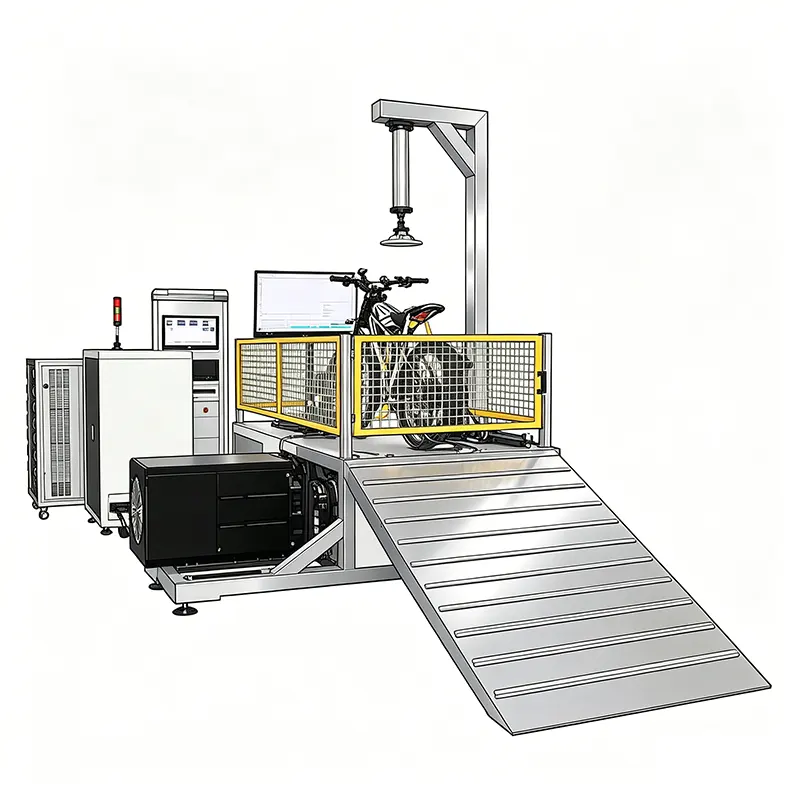
Chassis dynamometer Alternative: For preliminary brake testing, a motorcycle chassis dynamometer can be used to evaluate brake performance under controlled conditions. While dynamometer results cannot replace track testing for type approval, they are invaluable for development work, allowing engineers to measure brake torque, disc temperature rise, and pad wear characteristics without the variability of on-track conditions. The dynamometer must be capable of simulating vehicle inertia accurately across the test speed range.
Environmental Chamber Testing: Some national authorities require brake testing at extreme temperatures (down to -20°C). An environmental chamber large enough to accommodate a motorcycle on a dynamometer allows year-round testing regardless of ambient conditions. These chambers typically cost $100,000-300,000 but are essential for manufacturers selling into Scandinavian, Canadian, or Northern Asian markets.
Frequently Asked Questions
Q1: Does ECE R78 apply to electric motorcycles?
Yes. Electric motorcycles are classified under the same L3e category as ICE motorcycles if their maximum speed exceeds 45 km/h and their continuous rated power exceeds 4 kW. All braking performance requirements, including ABS, apply equally to electric motorcycles. In fact, electric motorcycles may face additional considerations because regenerative braking systems must be evaluated to ensure they do not interfere with ABS operation or cause unstable braking behavior.
Q2: Can I use a combined braking system (CBS) instead of ABS?
For motorcycles between 50cc and 125cc, CBS is an acceptable alternative to ABS under the 03 series amendments. However, for motorcycles above 125cc, ABS is mandatory and cannot be substituted by CBS. For L1e mopeds, neither ABS nor CBS is required, though many manufacturers include CBS as a safety feature on higher-spec models.
Q3: How many test vehicles are required for type approval?
Typically, one to two vehicles are required for the physical testing portion of type approval. The first vehicle undergoes the complete brake test program, while a second vehicle may be required for specific variant testing (e.g., different brake caliper specifications or tire sizes). The technical documentation package must cover all variants and versions within the type approval family.
Q4: What happens if my vehicle fails the test?
If a vehicle fails any ECE R78 test, the type approval authority will issue a non-compliance report detailing the specific failures. The manufacturer must then modify the braking system (different pad compound, larger disc diameter, revised ABS calibration, etc.) and resubmit for testing. There is no limit on the number of resubmission attempts, but each test session incurs significant costs in terms of testing fees, vehicle preparation, and engineering time. Typical costs for a re-test range from €5,000 to €15,000 per test day.
Q5: Is dyno testing accepted instead of track testing?
No. ECE R78 specifically requires track testing for type approval. Dynamometer testing may be used for development and pre-compliance verification, but the official results must come from track tests conducted under the specified environmental conditions. Some authorities accept dyno data as supplementary evidence, but it cannot replace the track test results in the type approval submission.
Q6: How does regenerative braking affect ECE R78 compliance?
Regenerative braking on electric motorcycles must be carefully integrated with the friction braking system. ECE R78 requires that the braking system remain functional even if the regenerative system fails. Additionally, the transition between regenerative and friction braking must be smooth and must not cause wheel lock-up or instability. Most manufacturers implement a “blended braking” strategy where regenerative braking provides initial deceleration and friction brakes take over as speed decreases or when ABS intervention is required.
Q7: What is the validity period of an ECE R78 type approval?
ECE type approvals do not have a fixed expiration date but remain valid as long as the vehicle continues to meet the regulation requirements. However, if the regulation is amended with new requirements (as happened with the introduction of mandatory ABS), existing approvals may need to be updated. Manufacturers are also required to maintain production conformity, meaning that production vehicles must continue to meet the same performance standards as the tested prototype.
Q8: Can I test on any road surface?
No. The test surface must have a peak braking coefficient (PBC) of at least 0.8 for dry tests and between 0.3-0.5 for low-friction ABS tests. The PBC must be measured using a reference tire and a skid trailer or similar device, and the measurement must be conducted within 24 hours of the brake test. Many test tracks used for automotive homologation (such as IDIADA in Spain, Nardò in Italy, or Papenburg in Germany) have pre-qualified brake test surfaces with documented PBC values.
Q9: What documentation must accompany the test results?
The type approval submission must include complete test reports with raw data, instrument calibration certificates (traceable to national standards), vehicle technical specifications, brake system descriptions and drawings, ABS algorithm descriptions (without revealing proprietary source code), and photographs of the test vehicle and instrumentation setup. The documentation typically runs to 200-400 pages and must be submitted in English, French, or German.
Q10: How does ECE R78 compare to FMVSS 122?
FMVSS 122 is the US federal standard for motorcycle brake systems, administered by NHTSA. While both standards address similar safety concerns, there are key differences: FMVSS 122 does not mandate ABS (as of 2026), uses different test speeds and stopping distance criteria, and does not include the high-to-low friction transition test for ABS. Vehicles compliant with ECE R78 generally also meet FMVSS 122 requirements, but the reverse is not always true. Manufacturers targeting both markets should design to ECE R78 standards as the more stringent requirement.
Related Products
Need Professional Motorcycle Testing Equipment?
Explore our range of testing machines designed for compliance with international standards.