Derui chamber
Bicycle seat posts are among the most heavily stressed components on any bicycle. Every bump, pothole, and sprint transfers load directly through the seat post into the frame, making fatigue failure a real safety concern. ISO 4210 defines specific fatigue test requirements that manufacturers must meet before a seat post can be considered road-worthy. This guide provides a comprehensive breakdown of ISO 4210 seat post fatigue testing — covering test setup, load parameters, acceptance criteria, and equipment selection — so your lab can achieve reliable, repeatable results.
Key Takeaways
- ISO 4210 and EN 14766 standards define mandatory test procedures, impact energy levels, and fatigue cycle requirements for bicycle frames and components.
- Accurate fixture alignment and load cell calibration are critical — misalignments of just 2-3 mm can introduce 15-20% measurement errors in fatigue testing results.
- Each component (frame, fork, saddle, brake) has distinct test parameters: frame fatigue requires 50,000-100,000 cycles while brake testing demands higher force thresholds.
- Data acquisition sampling rates of 10 kHz or higher are necessary to capture transient impact events without losing peak force data.
- Regular equipment calibration (every 6-12 months) and documented calibration certificates are essential for ISO-accredited lab compliance.
📑 Table of Contents
Why Seat Post Fatigue Testing Matters
A seat post failure at speed can cause catastrophic injury. Unlike frame failures that may develop slowly with visible cracking, seat post fatigue failures often occur suddenly — the post snaps without warning, dropping the rider onto a sharp stump inside the frame. Historical data from consumer safety databases shows that seat post failures account for approximately 8-12% of all bicycle component-related injury reports, with the majority occurring on road and mountain bikes subjected to repeated high-load cycling.
Fatigue testing simulates years of riding stress in a compressed timeframe. By applying cyclic loads that represent realistic riding conditions — standing sprints, rough road vibrations, and impact events — the test determines whether a seat post will survive its intended service life. ISO 4210 mandates these tests specifically because field failures have demonstrated that static strength alone is insufficient; components that hold up under a single maximum load may still crack after thousands of smaller repeated loads.
For manufacturers, passing ISO 4210 fatigue tests is not just about compliance — it is about liability protection and brand reputation. A single product recall due to seat post failures can cost millions and permanently damage consumer trust. Rigorous fatigue testing during the design and production qualification phases catches defects before they reach the market.
ISO 4210 Seat Post Test Requirements Overview
ISO 4210-9 (the part specific to saddle and seat post testing) defines two primary fatigue test configurations for seat posts: the longitudinal fatigue test (fore-aft loading) and the transverse fatigue test (side-to-side loading). Both tests must be passed for a seat post to comply with the standard. The standard differentiates between city/trekking bicycles (Category 1), mountain/bMX bicycles (Category 2), and racing bicycles (Category 3), with varying load levels appropriate to each use case.
The standard requires that the seat post be clamped at its minimum insertion depth — the shallowest position a rider might use — because this creates the longest lever arm and highest bending moment. This is a critical detail: testing at full insertion depth would underestimate the actual stresses experienced in the field, since many riders adjust their seat posts to various heights depending on leg length and riding style.
Test Setup and Fixturing
Proper fixturing is essential for valid test results. The seat post must be mounted in a fixture that simulates the frame seat tube, with the clamp engaging the post at the specified minimum insertion depth. The saddle clamp at the top of the post must also be secured, as the load is applied through the saddle rails or a representative fixture attached at the saddle clamp position.
Clamping Requirements
The lower clamp (frame seat tube simulation) must grip the post with sufficient force to prevent slippage during cycling but without deforming the post in a way that would create artificial stress concentrations. Most test fixtures use a split-collar clamp with a specified bolt torque (typically 8-12 Nm) to ensure consistency. The clamp inner diameter should match the nominal seat post diameter (e.g., 25.4mm, 27.2mm, 30.9mm, or 31.6mm) within a tolerance of +0.05/-0.00mm to replicate real frame conditions.
Load Application Point
For the longitudinal fatigue test, the force is applied at a point 70mm forward of the seat post centerline at the saddle clamp level. This offset represents the typical fore-aft position of a rider’s center of gravity relative to the seat post. For the transverse test, the force is applied at a point 70mm to the side. These offsets create the bending moments that replicate real-world loading patterns, and they must be maintained precisely throughout the test to avoid invalidating the results.
Load Parameters and Cycling Rates
The load levels specified in ISO 4210 vary by bicycle category, reflecting the different stress environments each type of bicycle experiences. Mountain bikes, which encounter large impact loads from jumps and rough terrain, require higher test loads than city bicycles. The standard specifies minimum test forces that apply to the most common seat post diameters and materials.
These forces are applied cyclically with a sinusoidal waveform. The cycling rate should be maintained between 1 Hz and 4 Hz — fast enough to complete 100,000 cycles within a reasonable timeframe (7-28 hours) but slow enough to avoid excessive heat generation in the specimen, which could alter the material properties and invalidate the test. For carbon fiber seat posts specifically, a maximum rate of 3 Hz is recommended because carbon composites are sensitive to self-heating effects that can accelerate fatigue damage beyond what would occur in service.
The force is applied as a fully reversed cyclic load (tension-compression for longitudinal, left-right for transverse). This means each cycle subjects the seat post to stress in both directions, which is more representative of real riding conditions than unidirectional loading. The peak force values listed above represent the amplitude of this cyclic load — the post is pushed 650N forward and then 650N backward in each cycle for the Category 1 longitudinal test.
Acceptance Criteria and Failure Modes
ISO 4210 defines clear pass/fail criteria for seat post fatigue tests. A seat post passes if it completes the required number of cycles (100,000) without visible cracking, fracture, or permanent deformation exceeding specified limits. The standard specifies that any visible crack detected by visual inspection (with or without magnification up to 5x) constitutes a failure, regardless of whether the crack has propagated through the full cross-section.
Types of Failure Observed
- Circumferential cracking at the clamp edge: The most common failure mode. Stress concentration at the transition between the clamped and unclamped region initiates a crack that propagates around the post. This is especially prevalent in thin-wall aluminum posts where the clamp creates a sharp bending moment gradient.
- Longitudinal splitting: More common in carbon fiber posts, where internal ply delamination leads to splitting along the fiber direction. This failure mode may not be immediately visible externally, making post-test inspection with tap testing or ultrasonic methods advisable for composite posts.
- Clamp bolt hole cracking: Posts with integrated clamp hardware may develop cracks emanating from bolt holes, which act as stress risers. This is a design-specific failure that indicates the bolt hole geometry needs reinforcement.
- Permanent bending deformation: If the post remains bent after unloading beyond the specified limit (typically 2° deviation from the original axis), it fails even without cracking. Permanent deformation indicates that the material has yielded and will continue to accumulate damage with further use.
Key Point: For carbon fiber seat posts, visual inspection alone may miss internal delamination. Manufacturers should supplement visual checks with non-destructive evaluation (NDE) methods such as ultrasonic testing or acoustic emission monitoring during the fatigue test to detect subsurface damage that could lead to sudden failure in service.
Equipment for Seat Post Fatigue Testing
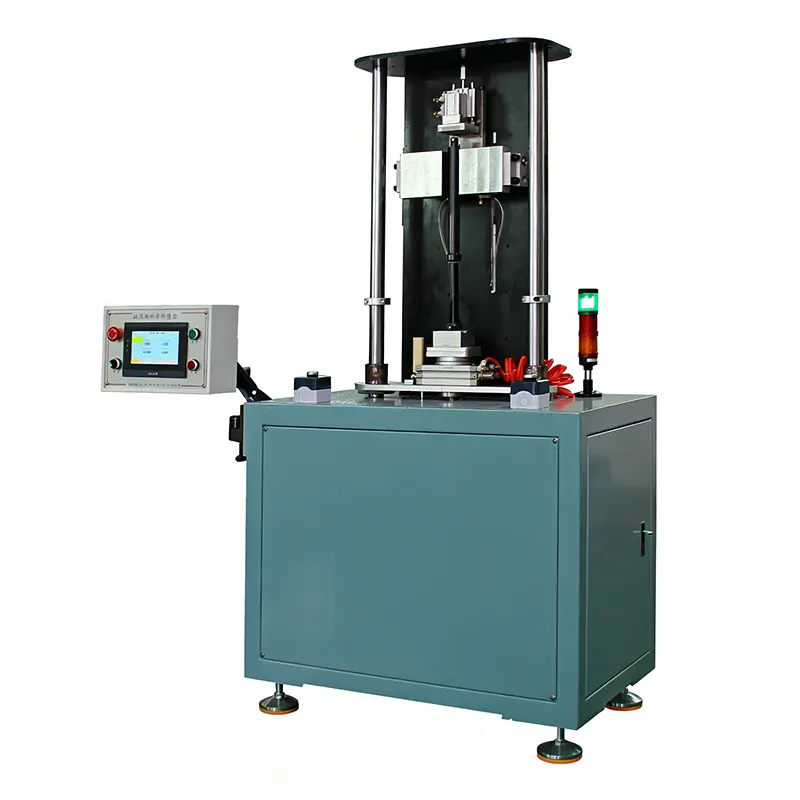
Selecting the right fatigue testing equipment is critical for achieving ISO 4210 compliance. The test machine must be capable of applying precise cyclic loads in both longitudinal and transverse directions, with force control accuracy better than ±2% of the set point. A dedicated bicycle seat post fatigue testing machine offers several advantages over general-purpose universal testing machines, including purpose-built fixtures, integrated safety enclosures, and software pre-configured for ISO 4210 test protocols.
Key Machine Specifications
A professional seat post fatigue tester should meet the following minimum specifications to handle the full range of ISO 4210 test requirements across all bicycle categories:
- Maximum test force: At least 1,000N to cover Category 2 mountain bike loads with margin. Machines rated at 2,000N provide additional headroom for research and development testing above standard minimums.
- Force control mode: Closed-loop servo control with load cell feedback. Force control is preferred over displacement control for fatigue testing because it maintains constant stress amplitude as the specimen deforms, which is essential for valid S-N curve generation.
- Cycling frequency: Adjustable from 0.5 Hz to 5 Hz. The ability to test at lower frequencies is important for carbon fiber specimens where self-heating must be minimized.
- Fixture compatibility: Quick-change fixtures for common seat post diameters (25.4mm, 27.2mm, 30.9mm, 31.6mm) and the ability to switch between longitudinal and transverse loading configurations without major retooling.
- Data acquisition: Real-time force, displacement, and cycle count monitoring with automatic test termination upon specimen failure detection (sudden displacement increase or force drop).
The Bicycle Seat Post Tester from Derui Tester is specifically designed for ISO 4210 compliance, featuring dual-axis loading capability, servo-controlled force application, and integrated test software that automates the standard test sequence from setup through final report generation.
Common Testing Pitfalls and How to Avoid Them
Even experienced testing laboratories can produce invalid results if certain procedural details are overlooked. Here are the most common pitfalls and their solutions:
- Incorrect insertion depth: Testing at greater than minimum insertion depth reduces the bending moment and makes the test less severe than intended. Always verify the minimum insertion mark on the post before clamping and document the insertion depth used.
- Overtightening the clamp: Excessive clamp force can crush thin-wall posts (especially carbon), creating artificial stress concentrations that cause premature failure not representative of field conditions. Use a calibrated torque wrench and follow the specified torque range.
- Ignoring specimen temperature: At cycling rates above 3 Hz, metal posts can heat up due to internal friction at crack initiation sites, while carbon posts heat up from matrix viscoelastic damping. Monitor specimen temperature with an infrared sensor and reduce cycling rate if temperature exceeds 40°C above ambient.
- Inadequate post-test inspection: Visual inspection alone may miss micro-cracks in dark-colored or anodized posts. Use dye-penetrant inspection for aluminum posts and ultrasonic C-scan for carbon posts to ensure no damage is overlooked.
- Not testing both orientations: Some asymmetric seat post designs (e.g., aero posts) have different fatigue resistance depending on the loading direction relative to the profile orientation. ISO 4210 requires testing in the worst-case orientation, which must be determined by analysis or preliminary testing.
- Sample size too small: Testing a single specimen does not provide statistically valid results. ISO 4210 requires testing at minimum 3 specimens per configuration. For production qualification, 5-10 specimens per batch are recommended to establish confidence intervals on fatigue life.
FAQ: ISO 4210 Seat Post Fatigue Testing
Q1: What is the minimum number of test specimens required by ISO 4210?
ISO 4210 requires a minimum of 3 specimens per seat post model and size for each test type (longitudinal and transverse). All three specimens must pass the test for the model to be considered compliant. If any specimen fails, the model does not pass, and design modifications are necessary before retesting.
Q2: Can the longitudinal and transverse tests be performed on the same specimen?
No. Each test type requires a separate, previously untested specimen. Performing both tests on the same post would accumulate fatigue damage from the first test, making the second test invalid because the specimen no longer represents a new product condition.
Q3: How does ISO 4210 handle seat posts with integrated saddles?
Seat posts with integrated or permanently attached saddles are tested as an assembly. The load is applied at the same offset (70mm) from the post centerline, but through a fixture that engages the saddle rather than the saddle clamp. The acceptance criteria remain the same — no cracking or excessive permanent deformation after 100,000 cycles.
Q4: What about suspension seat posts?
Suspension seat posts with internal elastomer or spring mechanisms must be tested in their extended position (rider weight not applied). The standard does not currently include specific provisions for suspension posts, so they are tested using the same parameters as rigid posts of the same category. However, many manufacturers also conduct additional tests with the suspension compressed to simulate loaded riding conditions.
Q5: What cycling frequency should I use?
ISO 4210 specifies a frequency range of 1-4 Hz. For aluminum posts, 3-4 Hz is typically acceptable. For carbon fiber posts, limit the frequency to 1-3 Hz and monitor specimen temperature. If the surface temperature exceeds 40°C above ambient, reduce the frequency. Most production testing labs use 2-3 Hz as a compromise between test duration and specimen integrity.
Q6: Does the test apply to seat post shims and adapters?
Yes. If a seat post is designed to be used with a shim (e.g., a 25.4mm post in a 27.2mm frame), the fatigue test must be conducted with the shim installed. The shim changes the stress distribution at the clamp, and its inclusion in the test ensures the complete system meets the safety requirements. Shims must also be inspected after testing for deformation or cracking.
Q7: What happens if a specimen fails at 99,900 cycles?
It fails. ISO 4210 does not provide a tolerance band on the cycle count — the specimen must complete the full 100,000 cycles without failure. However, for internal quality purposes, recording the exact failure cycle count is valuable data that helps engineers understand the fatigue margin and optimize the design. A post that fails at 99,900 cycles has a much thinner safety margin than one that survives 200,000 cycles.
Q8: Can I use a universal testing machine instead of a dedicated seat post tester?
Yes, provided the universal testing machine has sufficient force capacity, appropriate fixtures, and closed-loop force control. However, dedicated seat post testers offer significant advantages in terms of setup speed, fixture accuracy, and test reproducibility. Universal testing machines require custom fixture fabrication for each test orientation and may introduce alignment errors that dedicated machines are designed to eliminate.
Q9: How should I document test results for regulatory submission?
Test reports should include: specimen identification (model, size, material, batch number), insertion depth used, clamp torque, applied force amplitude, cycling frequency, total cycles completed, any failure observed (with photographs), and a clear pass/fail statement. Many test laboratories also include force-displacement hysteresis plots from representative cycles, which can reveal progressive stiffness degradation even in specimens that pass the visual inspection criterion.
Q10: Are there additional tests beyond fatigue that ISO 4210 requires for seat posts?
Yes. ISO 4210 also requires a static strength test (Clause 4.5.3) where a single large force is applied to verify that the seat post can withstand an extreme overload event without fracturing. The static test force is significantly higher than the fatigue test force (typically 1,500-2,000N depending on category) and is applied for 1 minute. Additionally, seat posts with quick-release mechanisms must pass a separate clamp effectiveness test to verify that the QR mechanism holds under load without slippage.
Related Products
Need Professional Bicycle Testing Equipment?
Explore our range of testing machines designed for compliance with international standards.