Derui chamber
Bicycle Testing Equipment Guide
Bicycle Test Bench Selection Guide: Load, Speed, Fixtures and Data Requirements
A useful bicycle test bench specification begins with the decision the test must support. Define the bicycle, test method, motion, fixtures, measurements and acceptance evidence before comparing machine capacity.
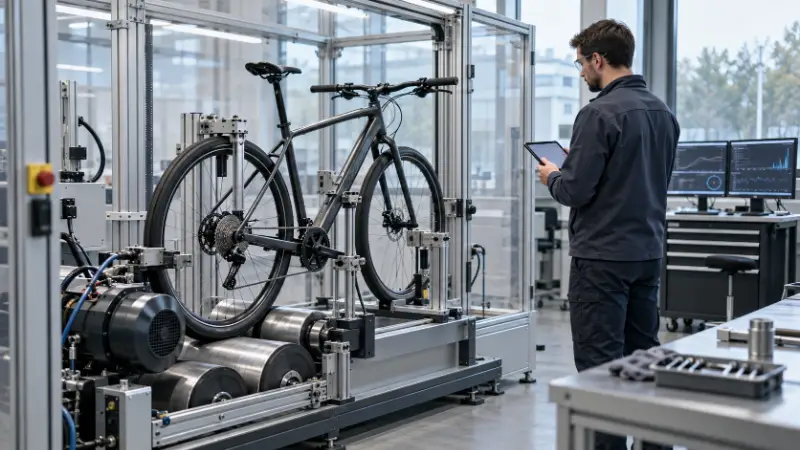
Buyers often begin with a short request such as “We need a 5 kN bicycle test bench” or “Please quote a bicycle durability tester.” That sounds specific, but it leaves the most important engineering questions unanswered. A high load rating does not prove that the machine can mount the specimen correctly, reproduce the required motion, control the right variable or record the evidence needed by the laboratory.
The term bicycle test bench may describe a roller system for complete-vehicle performance, a servo-actuated structure for frame fatigue, a brake endurance rig, an impact machine or a component-specific tester. These systems can share controls and measurement technology, but their mechanics and boundary conditions are different. Selection therefore starts with the test programme, not the supplier catalogue.
Start with the Test Decision
Write one sentence describing what the test result must decide. Examples include releasing a frame design, checking production consistency, comparing two brake assemblies, validating a component after durability cycling or confirming that a complete e-bike operates within an approved performance envelope. This sentence separates necessary functions from attractive but irrelevant options.
Next, identify the governing method. It may be a published standard, an internal procedure, a customer specification or a development test. Record the exact edition or controlled document number, but do not stop at the title. Extract the specimen condition, mounting points, applied forces or motions, sequence, cycle definition, stop conditions and required measurements. A supplier needs those details to translate the method into equipment.
If one bench must support several methods, list them separately. Mark which methods are required at commissioning and which are future options. This prevents a possible future test from expanding the first machine beyond the budget, footprint or complexity the current programme needs.
Define the Specimen and Application
Provide drawings or dimensioned photographs for every representative bicycle or component. Include mounting interfaces, wheelbase or component envelope, mass, material where relevant, expected deflection and areas that fixtures must not contact. For a family of specimens, provide the minimum, typical and maximum geometry rather than one nominal sample.
The application also changes the machine architecture. A development laboratory may value flexible fixtures and configurable sequences. A production line may prioritize quick changeover, recipe control and traceable pass/fail results. A certification laboratory may require documented calibration paths, controlled permissions and repeatable reports. A university laboratory may need safe access and broad teaching use without production automation.
| Application | Primary decision | Specification emphasis |
|---|---|---|
| R&D validation | Compare designs and investigate failure | Flexible control, extra measurements, accessible data |
| Compliance laboratory | Demonstrate a controlled method | Boundary conditions, calibration, repeatability, reports |
| Production quality control | Accept or reject products consistently | Cycle time, changeover, recipe control, traceability |
| Supplier qualification | Verify component consistency | Defined fixtures, comparable results, clear acceptance logic |
Specify the Useful Load Range, Not Only the Maximum
State the normal working load, expected peaks, preload, direction and sign convention. Include whether the load is static, cyclic, impact-related or derived from road-load simulation. If the procedure uses several stages, provide each level and its duration or cycle count.
The maximum machine rating is only a boundary. Measurement quality and control stability must be appropriate in the range actually used. A system selected only for a large headline capacity may spend the entire test near the bottom of its useful sensor range. Ask the supplier to identify the proposed load cell range, working range and overload strategy for each method.
For multi-direction or multi-axis work, describe the load vectors and timing relationship. “Two-axis test” is not enough. The actuators may run independently, simultaneously or with a defined phase relationship, and the fixture must preserve the intended load path throughout specimen deflection.
Define Speed, Travel and Motion Requirements
Different bicycle benches use different motion variables. A roller bench may be specified by speed, acceleration, resistance and duty cycle. A fatigue bench may use force, displacement, frequency and waveform. An impact system may use drop height, mass, impact geometry and energy. Put the correct variable beside each test method.
For actuator-based tests, distinguish commanded stroke from the total travel needed for setup, specimen deflection and safe clearance. Define the expected waveform and frequency range, including any hold periods, ramps or staged loading. For roller systems, provide wheel size, wheelbase, tyre range, target speed and the road-load or resistance function the bench must reproduce.
Also define what happens when the specimen changes. A bench that meets one nominal geometry may lose usable travel or fixture clearance at the largest size. The review should cover the full specimen envelope, not only the easiest sample.
Treat Fixtures as Part of the Measurement System
Fixtures establish the boundary conditions of the test. Their stiffness, alignment, contact geometry and adjustment method can influence the result as much as actuator capacity. Generic clamping that distorts a tube, allows slip or introduces an unintended moment can invalidate an otherwise stable machine.
Ask how each fixture represents the real interface or the method-defined support. Define permissible adjustment, datum locations, alignment checks and tightening control. If different sizes share a bench, specify change parts and the target changeover process. Quick adjustment is valuable only when it remains repeatable.
Derui’s bicycle and frame testing equipment category illustrates why a single “bicycle tester” description is too broad: complete bicycles, frames, saddles and other components require different load paths and fixtures. Component pages such as the bicycle frame vertical fatigue testing machine and bicycle saddle fatigue testing machine should be evaluated against the specific method and specimen, not treated as interchangeable platforms.
Choose the Control Mode, Measurements and Data Output
State whether the primary variable is force, displacement, speed, torque or another measured quantity. Define any transition between modes and how the system should respond as the specimen changes stiffness or begins to fail. The appropriate control architecture depends on the test physics; it should not be selected from a feature list.
List required measurement channels with expected ranges, accuracy needs and sampling purpose. Separate channels used for closed-loop control from channels recorded for analysis. Typical projects may involve force, displacement, speed, torque, voltage, current, temperature or event signals, but only include channels the test decision actually needs.
Describe the required output: live display, raw data, summary values, curves, alarms, specimen ID, operator record and report format. For production use, define recipe permissions and traceability. For laboratory use, define data export and how calibration information is associated with each channel.
| Requirement | Information to provide | Why it matters |
|---|---|---|
| Control variable | Force, displacement, speed, torque or defined sequence | Determines actuator and controller behavior |
| Useful range | Normal, minimum and peak values | Supports appropriate sensors and stable control |
| Stop logic | Limit, fracture, displacement change, cycle count or operator stop | Protects the specimen and preserves failure evidence |
| Data output | Channels, sampling purpose, file and report needs | Makes results usable and auditable |
Build a Decision-Ready Bicycle Test Bench RFQ
A strong RFQ lets suppliers explain how the proposed system meets each requirement, where configuration is needed and what remains outside scope. Ask for a compliance matrix rather than a general statement that the machine “supports” a standard. The matrix should connect each test clause or internal method to the fixture, sensor, control mode, sequence and evidence produced.
For combined vehicle work, identify where a shared platform creates real value. Derui’s two-in-one electric bicycle and scooter test bench is an example of a shared platform for compatible performance-testing applications. A combined system is appropriate only when its roller geometry, adjustment range, measurements and operating sequence cover both product families without weakening the required method.
Information to Send with Your RFQ
- Test purpose and acceptance decision
- Applicable methods and document editions
- Specimen drawings and full size range
- Mounting points and boundary conditions
- Normal, peak and preload requirements
- Speed, frequency, waveform and travel
- Control mode and transition logic
- Measurement channels and useful ranges
- Failure detection and stop conditions
- Cycle time and changeover target
- Data, report and traceability requirements
- Site utilities, footprint and safety constraints
- Calibration and acceptance requirements
- Future tests that must be accommodated
Attach representative samples or drawings early enough for a fixture review. For a custom or multi-method system, agree on drawing approval, software review and factory acceptance testing before production. A witnessed FAT should use representative specimens and measurable criteria tied to the RFQ.
The best bicycle test bench is not the machine with the longest option list. It is the simplest configuration that reproduces the required condition, fits the complete specimen range and produces evidence the engineering or quality team can use.
Need a bicycle test bench configuration?
Send Derui your test methods, specimen drawings, size range, target loads or speeds, fixture interfaces and data requirements. Our team can review the application and prepare a technical configuration for discussion.
Application note
This guide explains equipment-selection principles. Final configuration, test parameters and acceptance criteria must be confirmed against the applicable controlled method, approved specimen information and project requirements.